Backed by market attractiveness analysis, total addressable market sizing, company benchmarking matrices, interactive Excel dashboards, wider supply chain intelligence, emerging startup coverage, and detailed product-level insights, The Business Research Company’s 2026 market reports are designed to offer research that is more actionable and strategically valuable than ever.
Smart Smoke Detector Market Size Outlook: How Quickly Will Revenue Expand Through 2030?
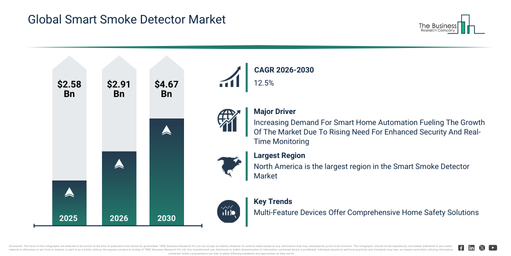
The smart smoke detector market has witnessed rapid expansion in recent years. It is projected to increase from $2.58 billion in 2025 to $2.91 billion in 2026, achieving a compound annual growth rate (CAGR) of 12.8%. The growth observed historically can be attributed to factors such as fire safety regulations, an increase in residential construction, heightened awareness of fire hazards, the adoption of wireless devices, and insurance compliance requirements.
The smart smoke detector market is projected to experience substantial expansion in the coming years. This market is forecast to reach $4.67 billion by 2030, demonstrating a compound annual growth rate (CAGR) of 12.5%. Factors contributing to this growth during the forecast period include smart city initiatives, the increasing number of connected homes, the optimization of insurance premiums, a rising need for predictive fire safety solutions, and the broadening of commercial safety standards. Key trends anticipated within the same period encompass the growing uptake of smart home safety devices, their integration with mobile and voice assistants, an increased call for real-time remote monitoring, the proliferation of wireless connected detectors, and an emphasis on multi-sensor fire detection technologies.
Get A Free Sample Report With In-Depth Market Insights:
Smart Smoke Detector Market Growth Drivers: What’s Behind The Acceleration?
The rising interest in smart home automation is anticipated to drive the expansion of the smart smoke detector market in the future. Smart home automation involves employing technology to remotely supervise, manage, and automate various household systems and devices, including lighting, heating, security, and appliances, to enhance convenience, efficiency, and safety. The heightened demand for smart home automation is primarily due to the need for improved security, as residents seek continuous monitoring and immediate alerts from connected devices such as cameras, sensors, and alarms. Smart smoke detectors augment smart home automation by incorporating real-time alerts and remote monitoring capabilities, thereby improving fire safety and emergency responses. They provide features like voice alerts and smartphone notifications, which contribute to increased household protection and ease of use. For instance, in July 2023, data from the Central Statistics Office, an Ireland-based government agency, indicated that 30% of internet users had adopted smart solutions in their households in 2024, marking an increase from 17% in 2022. Thus, the escalating demand for smart home automation is a significant factor propelling the growth of the smart smoke detector market.
Smart Smoke Detector Market Segmentation And Category Overview
The smart smoke detector market covered in this report is segmented –
1) By Product Type: Photoelectric Smoke Detectors, Ionic Smoke Detectors, Dual-Sensor Smoke Detectors, Smart Wired Smoke Detectors, Smart Battery-Operated Smoke Detectors
2) By Connectivity: Wireless Fidelity, Zigbee, Z-Wave, Bluetooth, Other Connectivity
3) By Power Source: Battery Operated, Hardwired, Hybrid
4) By Application: Residential, Commercial, Industrial, Other Applications
5) By End User: Homeowners, Property Managers, Contractors, Insurance Companies, Facility Managers
Subsegments:
1) By Photoelectric Smoke Detectors: Residential Photoelectric Smart Smoke Detectors, Commercial Or Industrial Photoelectric Smart Smoke Detectors, Standalone Photoelectric Smart Detectors, Networked Or Integrated Photoelectric Smoke Detectors
2) By Ionic Smoke Detectors: Smart Ionization Smoke Detectors For Homes, Industrial-Grade Ionization Smart Detectors, Combination Ionization + CO Detectors, Wireless Ionization Smart Detectors
3) By Dual-Sensor Smoke Detectors: Residential Dual-Sensor Smart Detectors, Commercial Dual-Sensor Smart Systems, Hardwired Dual-Sensor Smoke Detectors, Battery-Operated Dual-Sensor Smoke Detectors
4) By Smart Wired Smoke Detectors: Hardwired With Battery Backup, Smart Wired Detectors With Voice Alerts, Smart Wired Detectors With App Connectivity, Wired Detectors With Integrated Emergency Lighting
5) By Smart Battery-Operated Smoke Detectors: Replaceable Battery Smart Detectors, Rechargeable Battery Smart Detectors, 10-Year Sealed Battery Smart Detectors, Battery Smart Detectors With Wireless Fidelity Or Bluetooth
Smart Smoke Detector Market Trends Redefining Industry Growth
Leading companies in the smart smoke detector market are prioritizing the creation of advanced products, such as multi-feature smart home safety systems, to improve immediate fire notifications, enable remote oversight, and enhance overall home protection. These multi-feature smart home safety systems are integrated devices that combine smoke detection, carbon monoxide monitoring, motion sensing, and smartphone connectivity to deliver thorough and automated home safety. For instance, in June 2025, Gentex Corporation introduced PLACE, an innovative smart home safety system aimed at enhancing household safety, comfort, and security. This system incorporates numerous features including smart smoke and carbon monoxide detection, Wi-Fi connectivity, ambient temperature and humidity monitoring, motion detection, a smart nightlight, and localized voice alerts, all accessible through a dedicated mobile application. It also unveils an industry-first low-frequency sounder specifically designed to boost alarm effectiveness, particularly for deep sleepers and individuals with hearing impairments.
Smart Smoke Detector Market Competitive Analysis Of Leading Industry Participants
Major companies operating in the smart smoke detector market are First Alert, Kidde, Inc., X-Sense Co., Ltd., Roost, Inc., Samsung Electronics Co., Ltd., Schneider Electric SE, Honeywell International Inc., Johnson Controls International plc, Robert Bosch GmbH, Siemens AG, Hochiki Corporation, BRK Brands, Inc., Netatmo SA, Aqara Technology Co., Ltd., BOSCH Smart Home GmbH, ANKA Security, Universal Security Instruments, Inc., Emerson Electric Co., United Technologies Corporation / Carrier brands, Aico Ltd.
View The Full Smart Smoke Detector Market Report:
Smart Smoke Detector Market Regional Analysis And Top Geography
North America was the largest region in the smart smoke detector market in 2025. Asia-Pacific is expected to be the fastest-growing region in the forecast period. The regions covered in the smart smoke detector market report are Asia-Pacific, South East Asia, Western Europe, Eastern Europe, North America, South America, Middle East, Africa
Reach Out To Our Team:
The Business Research Company: https://www.thebusinessresearchcompany.com/
Americas: +1 310-496-7795
Asia: +44 7882 955267 & +91 8897263534
Europe: +44 7882 955267
Email us at: marketing@tbrc.info
Follow us on:
LinkedIn: https://in.linkedin.com/company/the-business-research-company
YouTube: https://www.youtube.com/channel/UC24_fI0rV8cR5DxlCpgmyFQ
Global Market Model: https://www.thebusinessresearchcompany.com/global-market-model

Wasay has over a decade of experience in market research, data modelling, and analytics, with prior experience at GlobalData and Decision Tree Consulting Services. At The Business Research Company , he leads research operations across syndicated studies, customized consulting engagements, and the Global Market Model platform. His professional experience includes supporting organizations such as Boston Consulting Group, KPMG, and Ernst & Young. Wasay holds a degree in Electronics and Communications Engineering, postgraduate management qualifications from International Management Institute Belgium and Indian School of Business and Entrepreneurship, and completed the Integrated Program in Business Analytics from Indian Institute of Management Indore.