
Delivering more actionable and strategically valuable research, The Business Research Company’s 2026 market reports feature market attractiveness analysis, total addressable market evaluation, company benchmarking matrices, interactive Excel dashboards, expanded supply chain intelligence, emerging startup coverage, and detailed product insights.
Software-Defined Automation Market CAGR Analysis And Future Market Development
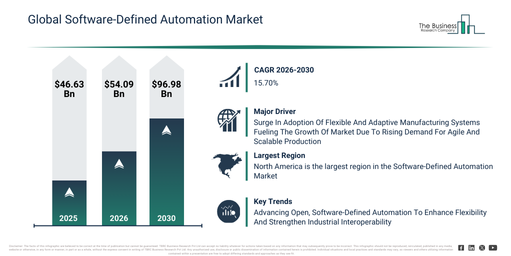
The software-defined automation market has experienced rapid expansion in recent years. This market is projected to increase from $46.63 billion in 2025 to $54.09 billion in 2026, achieving a compound annual growth rate (CAGR) of 16.0%. The historical growth of the market can be ascribed to factors such as the rising adoption of industrial automation software, the increasing deployment of robotic process automation, the enhanced integration of intelligent control systems, the broadening of manufacturing automation, and the escalating demand for cloud-based automation platforms.
The software-defined automation market is anticipated to experience substantial growth over the next few years. It is projected to expand to $96.98 billion by 2030, achieving a compound annual growth rate (CAGR) of 15.7%. This growth during the forecast period is driven by an escalating focus on artificial intelligence driven process automation, increasing enterprise digital transformation initiatives, wider implementation of hybrid automation solutions, expanding integration of internet of things with automation, and a rising emphasis on energy efficiency and operational optimization. Significant trends expected during this period include technological advancements in cloud computing, innovations in machine learning for automation, ongoing developments in digital twin applications, research and developments in predictive maintenance solutions, and progress in vendor neutral and open architecture automation platforms.
Download A Free Sample Report For Comprehensive Market Insights:
Software-Defined Automation Market Opportunity Drivers: What Is Creating New Revenue Potential?
The increasing integration of automation within manufacturing processes is projected to boost the expansion of the software-defined automation market in the future. Manufacturing automation involves a methodology where production lines and machinery operations can be flexibly adjusted, reassigned, or expanded as needed through software management, moving away from inflexible hardware-focused configurations. The surge in automation implementation stems from the requirement for adaptable production capabilities that can rapidly adjust to fluctuating demand and diverse product specifications. Software-defined automation facilitates manufacturing automation by separating the control logic from dedicated physical hardware, thereby allowing businesses to swiftly modify, reconfigure, or expand production using central software systems. As an illustration, by September 2025, data from the International Federation of Robotics, a Germany-based organization representing the robotics industry, indicated that in 2024, China had 2,027,000 industrial robots operating in its factories, an increase from slightly more than 1,890,000 units in 2023. Annual installations in China reached 295,000 units, a 7% rise from the prior year, accounting for 54% of worldwide demand and setting a new record. Consequently, the increasing implementation of adaptable and responsive manufacturing systems is fueling the expansion of the software-defined automation market.
Software-Defined Automation Market Segment Landscape: Which Areas Lead Market Development?
The software-defined automation market covered in this report is segmented –
1) By Component Outlook: Solutions, Services
2) By Deployment Type: On Premises, Cloud Based, Hybrid
3) By Organization Size: Large Enterprises, Small And Medium Enterprises
4) By Application Outlook: Process Automation, Network Automation, Security Automation, Other Applications
5) By End-user: Information Technology & Telecom, Banking, Financial Services, & Insurance (BFSI), Retail & E-commerce, Healthcare & Life Sciences, Manufacturing, Automotive, Transportation & Logistics, Other End Users
Subsegments:
1) By Solutions: Software Defined Control Systems, Industrial Automation Software, Robotic Process Automation Platforms, Cloud Based Automation Solutions, Artificial Intelligence Driven Automation Tools
2) By Services: Consulting Services, Integration Services, Deployment Services, Support And Maintenance Services, Managed Services
Software-Defined Automation Market Innovation Trends Driving Future Development
Leading companies within the hydrophobic concrete sealer market are concentrating on developing advanced products, such as silane-based penetrating sealers, to enhance concrete’s water repellency, durability, and overall lifespan. Silane-based penetrating sealers are defined as concrete or masonry sealers that permeate the surface and chemically react within the pores to establish a water-repellent (hydrophobic) barrier, without forming a surface film. For instance, in July 2024, Nuvoco Vistas Corp. Ltd., an India-based construction materials company, launched Concrete Uno Hydrophobic Concrete. This ready-mix concrete incorporates a patented Damp-lock Formula, which prevents the formation of capillaries within the concrete matrix, substantially reducing water permeability compared to standard concrete. It features integral hydrophobic properties and specialized admixtures, providing long-term protection against water ingress and dampness without requiring additional surface membranes. This silane-based penetrating sealer also lowers long-term maintenance expenses and preserves both structural integrity and aesthetics, thereby extending the lifespan of buildings and offering significant value for structural consultants, architects, and contractors.
Software-Defined Automation Market Industry Leaders And Market Competition
Major companies operating in the software-defined automation market are Amazon Web Services (AWS), Microsoft Corp., Dell Technologies Inc., Cisco Systems Inc., Intel Corporation, HP Inc., General Electric (GE Vernova/Aerospace), Schneider Electric SE, Mitsubishi Electric Corporation, Honeywell International Inc., SAP SE, Asea Brown Boveri Ltd.(ABB Ltd.), Emerson Electric Co., Rockwell Automation Inc., Bosch Rexroth AG, FANUC CORPORATION, KUKA AG, Yaskawa Electric Corporation, Yokogawa Electric Corporation, Red Hat (IBM Subsidiary), PTC Inc., AVEVA Group plc, Beckhoff Automation GmbH & Co. KG, Software Defined Automation GmbH
Access The Complete Software-Defined Automation Market Report:
Software-Defined Automation Market Regional Outlook: Where Are The Largest Opportunities Located?
North America was the largest region in the software-defined automation market in 2025. Asia-Pacific is expected to be the fastest-growing region in the forecast period. The regions covered in the software-defined automation market report are Asia-Pacific, South East Asia, Western Europe, Eastern Europe, North America, South America, Middle East, Africa.
Get in touch with us:
The Business Research Company: https://www.thebusinessresearchcompany.com/
Americas: +1 310-496-7795
Asia: +44 7882 955267 & +91 8897263534
Europe: +44 7882 955267
Email us at: marketing@tbrc.info
Follow us on:
LinkedIn: https://in.linkedin.com/company/the-business-research-company
YouTube: https://www.youtube.com/channel/UC24_fI0rV8cR5DxlCpgmyFQ
Global Market Model: https://www.thebusinessresearchcompany.com/global-market-model

Wasay has over a decade of experience in market research, data modelling, and analytics, with prior experience at GlobalData and Decision Tree Consulting Services. At The Business Research Company , he leads research operations across syndicated studies, customized consulting engagements, and the Global Market Model platform. His professional experience includes supporting organizations such as Boston Consulting Group, KPMG, and Ernst & Young. Wasay holds a degree in Electronics and Communications Engineering, postgraduate management qualifications from International Management Institute Belgium and Indian School of Business and Entrepreneurship, and completed the Integrated Program in Business Analytics from Indian Institute of Management Indore.