Featuring market attractiveness scoring, total addressable market sizing, company benchmarking matrices, interactive Excel dashboards, deeper supply chain intelligence, emerging startup tracking, and granular product-level insights, The Business Research Company’s 2026 market reports are built to deliver research that is both more actionable and more strategically valuable.
Superalloy Melting Equipment Market Size Forecast: How Big Could The Market Get By 2030?
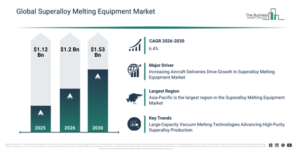
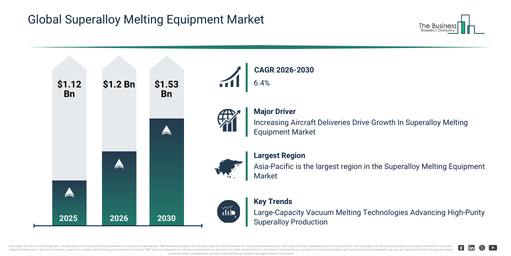
The superalloy melting equipment market has witnessed substantial growth in recent years. Forecasts indicate this market will expand from $1.12 billion in 2025 to $1.2 billion in 2026, achieving a compound annual growth rate (CAGR) of 6.7%. This historical expansion can be attributed to several factors, including the increasing demand for aerospace materials, advancements in high-temperature alloys, growth in the defense sector, developments in industrial metallurgy, and the widespread adoption of vacuum melting techniques.
The superalloy melting equipment market size is poised for robust expansion over the next few years. It is projected to climb to $1.53 billion by 2030, demonstrating a compound annual growth rate (CAGR) of 6.4%. This anticipated growth during the forecast period can be attributed to the production of next-generation aircraft, the increasing demand for high-performance materials, investments in advanced metallurgy, the integration of automation in metal processing, and the expansion within the energy and turbine sectors. Prominent trends observed in the forecast period encompass a surging demand from aerospace manufacturing, the heightened adoption of vacuum-based melting technologies, a growing embrace of precision-controlled furnaces, the expansion of superalloy production capacity, and the deeper integration of automation into melting processes.
Get A Free Sample Report With In-Depth Market Insights:
Superalloy Melting Equipment Market Growth Factors: What’s Supporting Expansion?
The increasing number of aircraft deliveries is expected to boost the growth of the superalloy melting equipment market in the future. The rise in aircraft deliveries is attributed to several factors, including heightened demand for air travel, the expansion of airline fleets, and the ongoing replacement of older aircraft with newer, more fuel-efficient models. Superalloy melting equipment is essential in aircraft manufacturing to create high-performance components designed to endure extreme conditions in aerospace applications. For example, in January 2024, Airbus SE, a Netherlands-based aerospace and defense company, reported delivering 735 commercial aircraft in 2023, which signifies an 11% increase compared to the 663 aircraft delivered in 2022. Thus, the growing volume of aircraft deliveries is a significant catalyst for the superalloy melting equipment market. The expansion of the renewable energy sector is projected to drive the growth of the superalloy melting equipment market moving forward. The renewable energy industry involves the generation, distribution, and consumption of energy derived from natural sources that replenish over a human timescale, such as solar, wind, hydro, and geothermal power. This expansion is fueled by technological advancements that reduce costs, alongside increased global awareness and policy initiatives to combat climate change. Superalloy melting equipment is critical in the renewable energy industry for manufacturing high-performance components used in wind turbines and solar power systems, thereby enhancing their efficiency and durability. As an illustration, in January 2024, according to The Energy Information Administration, a US-based government agency, the solar capacity operated by the electric power sector grew by 38% from 95 gigawatts (GW) at the end of 2023 to 131 GW by the end of 2024. Consequently, the expanding renewable energy industry is a key driver for the superalloy melting equipment market.
Superalloy Melting Equipment Market Segment Outlook: Which Categories Are Growing Fastest?
The superalloy melting equipment market covered in this report is segmented –
1) By Type: Induction Melting Equipment, Vacuum Arc Remelting (VAR) Equipment, Vacuum Induction Melting (VIM) Equipment, Electron Beam Melting (EBM) Equipment, Plasma Arc Melting (PAM) Equipment
2) By Sales Channel: Original Equipment Manufacturer (OEM), Aftermarket
3) By Application: Commercial, Industrial
Subsegments:
1) By Induction Melting Equipment: Coreless Induction Furnaces, Channel Induction Furnaces, Atmospheric Induction Melting Systems, Inert Gas Induction Melting Systems
2) By Vacuum Induction Melting (VIM) Equipment: Laboratory-Scale VIM Furnaces, Industrial-Scale VIM Furnaces, Continuous VIM Systems, Multi-Chamber VIM Systems
3) By Vacuum Arc Remelting (VAR) Equipment: Single-Electrode VAR Furnaces, Multi-Electrode VAR Furnaces, Automated VAR Systems, High-Capacity VAR Furnaces
4) By Electron Beam Melting (EBM) Equipment: Single-Gun Electron Beam Furnaces, Multi-Gun Electron Beam Furnaces, Cold Hearth Electron Beam Melting Systems, Drip Melting Electron Beam Furnaces
5) By Plasma Arc Melting (PAM) Equipment: Transferred Arc Plasma Furnaces, Non-Transferred Arc Plasma Furnaces, Multi-Torch Plasma Melting Systems, Inert Atmosphere Plasma Furnaces
Superalloy Melting Equipment Market Trends Shaping Long-Term Demand
Key players in the global superalloy melting equipment market are concentrating on creating large-capacity vacuum-induction melting (VIM) systems, such as 20-ton VIM furnaces, to facilitate high-purity alloy production with a consistent chemical makeup, reduced contamination, and scalable melt volumes for aerospace and industrial gas turbine applications. A 20-ton VIM furnace represents a high-capacity vacuum melting setup crafted to process substantial alloy batches under precisely controlled atmospheric and thermal conditions, ensuring uniform melting, degassing, and solidification of nickel- and cobalt-based superalloys. For instance, in April 2024, Ellwood Group, a US-based specialty metals company, announced plans for the installation of a 20-ton vacuum induction melting furnace at its New Castle, Pennsylvania facility. This system is distinguished by a significant melt capacity suitable for industrial-scale superalloy manufacturing, a vacuum-controlled melting chamber to minimize oxidation and impurity absorption, and the versatility to process various alloy families, including carbon steel, stainless steel, and advanced superalloys, thereby supporting the escalating demand for high-performance materials in aerospace and energy applications.
Superalloy Melting Equipment Market Leading Companies And Competitive Benchmarking
Major companies operating in the superalloy melting equipment market are ALD Vacuum Technologies GmbH, SMS group GmbH, Inductotherm Group LLC, ABP Induction Systems GmbH, SECO/WARWICK S.A., TAV Vacuum Furnaces S.p.A., ECM Technologies, IPSEN International GmbH, Tenova S.p.A., Fives Group, Danieli Group, Hitachi Industrial Equipment Systems Co., Ltd., OTTO JUNKER GmbH, PVA TePla AG, Electrotherm (India) Limited, Can-Eng Furnaces International Limited, Consarc Engineering, Retech Systems LLC, Harper International, BMI Fours Industriels, EBNER Industrieofenbau GmbH, VACUUMSCHMELZE GmbH
View The Full Superalloy Melting Equipment Market Report:
Superalloy Melting Equipment Market Geographic Landscape: Which Region Leads Industry Growth?
Asia-Pacific was the largest region in the superalloy melting equipment market in 2025. The regions covered in the superalloy melting equipment market report are Asia-Pacific, South East Asia, Western Europe, Eastern Europe, North America, South America, Middle East, Africa
Reach Out To Our Team:
The Business Research Company: https://www.thebusinessresearchcompany.com/
Americas: +1 310-496-7795
Asia: +44 7882 955267 & +91 8897263534
Europe: +44 7882 955267
Email us at: marketing@tbrc.info
Follow us on:
LinkedIn: https://in.linkedin.com/company/the-business-research-company
YouTube: https://www.youtube.com/channel/UC24_fI0rV8cR5DxlCpgmyFQ
Global Market Model: https://www.thebusinessresearchcompany.com/global-market-model

Wasay has over a decade of experience in market research, data modelling, and analytics, with prior experience at GlobalData and Decision Tree Consulting Services. At The Business Research Company , he leads research operations across syndicated studies, customized consulting engagements, and the Global Market Model platform. His professional experience includes supporting organizations such as Boston Consulting Group, KPMG, and Ernst & Young. Wasay holds a degree in Electronics and Communications Engineering, postgraduate management qualifications from International Management Institute Belgium and Indian School of Business and Entrepreneurship, and completed the Integrated Program in Business Analytics from Indian Institute of Management Indore.