Built to provide research that’s more actionable and strategically valuable, The Business Research Company’s 2026 market reports include market attractiveness analysis, total addressable market sizing, company benchmarking matrices, interactive Excel dashboards, broader supply chain intelligence, emerging startup tracking, and in-depth product insights.
Recycling Equipment Market Size Outlook: How Quickly Will Revenue Expand Through 2030?
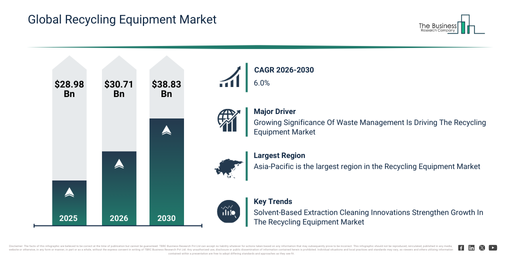
The recycling equipment market has shown significant growth in recent years. It is anticipated to increase from $28.98 billion in 2025 to $30.71 billion in 2026, achieving a compound annual growth rate (CAGR) of 6.0%. This historical expansion can be attributed to the rising generation of municipal solid waste, growing industrial waste volumes, the expansion of metal recycling activities, increased awareness of resource recovery, and the availability of conventional recycling machinery.
The recycling equipment market is projected to experience substantial expansion in the coming years. This market is forecast to reach $38.83 billion by 2030, exhibiting a compound annual growth rate (CAGR) of 6.0%. This anticipated growth during the forecast period stems from factors such as more stringent environmental regulations concerning waste disposal, the expansion of circular economy programs, increased funding for recycling infrastructure, a surge in e-waste production, and the manufacturing sector’s need for recycled raw materials. Key trends anticipated over this period encompass the increasing integration of automated recycling systems, a heightened need for highly efficient material separation machinery, the wider deployment of sophisticated shredding and granulation techniques, the enlargement of recycling infrastructure specifically for plastics and e-waste, and a greater emphasis on recycling equipment that is energy-efficient and produces low emissions.
Get A Free Sample Report With In-Depth Market Insights:
Recycling Equipment Market Development Factors: What’s Supporting Demand?
The increasing importance of waste management is anticipated to boost the expansion of the recycling equipment market in the future. Waste management encompasses the various operations and methods for gathering, managing, treating, keeping, and moving discarded materials from where they originate to their ultimate disposal sites. Several factors contribute to the rising importance of waste management, including heightened environmental consciousness, strict regulations, urban development, limited resources, and progress in recycling innovations. Modern waste management relies heavily on recycling equipment, which facilitates the sorting, processing, and conversion of materials that can be recycled. This notably decreases landfill waste, minimizes environmental harm, and aids in establishing a sustainable circular economy. An example is provided by the Global Waste Management Outlook 2024, issued in February 2024 by the United Nations Environment Programme, a Kenya-based global environmental authority. This report forecasts that global municipal solid waste generation will reach 2.68 billion tons by 2030, rise to 3.229 billion tons by 2040, and further increase to 3.782 billion tons by 2050. Consequently, the heightened importance of waste management is a key factor propelling the recycling equipment market.
Recycling Equipment Market Segments: Where Is Growth Concentrated?
The recycling equipment market covered in this report is segmented –
1) By Equipment: Baler Press, Shredders, Granulators, Agglomerators, Shears, Separators, Extruders, Other Equipments
2) By Processed Material: Metal, Plastic, Construction Waste, Paper, Rubber, Other Processed Materials
3) By Application: Municipal Solid Waste Recycling, Commercial And Industrial Waste, Metals Separation And Recycling, E-Waste Recycling, Transfer Station Recycling
Subsegments:
1) By Baler Press: Horizontal Baler, Vertical Baler, Manual Baler, Automated Baler
2) By Shredders: Single-Shaft Shredders, Dual-Shaft Shredders, Four-Shaft Shredders, High-Speed Shredders
3) By Granulators: High-Speed Granulators, Slow-Speed Granulators, Wet Granulators, Dry Granulators
4) By Agglomerators: Batch Agglomerators, Continuous Agglomerators, Agglomerating Mills
5) By Shears: Metal Shears, Plastic Shears, Cable Shears
6) By Separators: Magnetic Separators, Eddy Current Separators, Air Separators, Density Separators
7) By Extruders: Single-Screw Extruders, Twin-Screw Extruders, Ram Extruders, Ventless Extruders, Degassing Extruders
8) By Other Equipments: Crushers, Compactors, Conveyors, Washing & Drying Systems, Pelletizers, Briquetting Machines, Sorting Systems, Pulverizers
Recycling Equipment Market Trends Powering Strategic Industry Growth
Leading companies in the recycling equipment market are prioritizing the development of advanced solutions, such as solvent-based extraction cleaning, to enhance the purity of recycled materials. This innovation enables recyclers to satisfy stringent quality demands for various end-use applications. Solvent-based extraction cleaning is a technique that utilizes chemical solvents to eliminate impurities—like non-intentionally added substances, odors, adhesives, and printing inks—from polymer chains without causing structural damage, thereby producing high-quality recycled plastic suitable for sensitive uses. For example, in November 2025, Lindner-Recyclingtech GmbH, an Austria-based company specializing in shredding and recycling systems, collaborated with Procter & Gamble, a US-based consumer goods firm, to launch Flexloop, a system featuring a solvent-based extraction mechanism, at the trade fair K 2025. The Flexloop process incorporates an initial mechanical cleaning step followed by an additional solvent extraction phase, which reliably removes NIAS (non-intentionally added substances) such as pesticides, phthalates, dioxins, and organic residues, along with odors, adhesives, and printing inks, from polymer chains. The remarkable purity achieved through this method creates new opportunities for applications, allowing post-consumer recyclate to be used even in sensitive packaging for products like cosmetics and personal care. The modular Flexloop system is designed for integration into existing Lindner washing and recycling lines, empowering recyclers to upgrade product quality without necessitating a complete infrastructure replacement. Compared to chemical recycling, its lower capital expenditure and operating costs establish it as an economical and scalable solution.
Recycling Equipment Market Key Participants And Competitive Landscape
Major companies operating in the recycling equipment market are Metso, Danieli Centro Recycling, TOMRA Sorting ASA, Wastequip, Vecoplan AG, Shred-Tech, BHS-Sonthofen GmbH, Machinex Industries Inc., Stadler Anlagenbau GmbH, CP Manufacturing Inc., Marathon Equipment, General Kinematics Corporation, WEIMA Maschinenbau GmbH, Komar Industries Inc., Bollegraaf Recycling Solutions, Lindner Recyclingtech, Kiverco Limited, Eldan Recycling A/S, Granutech-Saturn Systems, Green Machine LLC, Suny Group, American Baler Company, Presona AB, ZERMA Machinery & Recycling Technology, Recycling Equipment Manufacturing Inc
View The Full Recycling Equipment Market Report:
Recycling Equipment Market Global Footprint: Which Region Leads The Market?
Asia-Pacific was the largest region in the recycling equipment market in 2025. The regions covered in the recycling equipment market report are Asia-Pacific, South East Asia, Western Europe, Eastern Europe, North America, South America, Middle East, Africa
Reach Out To Our Team:
The Business Research Company: https://www.thebusinessresearchcompany.com/
Americas: +1 310-496-7795
Asia: +44 7882 955267 & +91 8897263534
Europe: +44 7882 955267
Email us at: marketing@tbrc.info
Follow us on:
LinkedIn: https://in.linkedin.com/company/the-business-research-company
YouTube: https://www.youtube.com/channel/UC24_fI0rV8cR5DxlCpgmyFQ
Global Market Model: https://www.thebusinessresearchcompany.com/global-market-model

Wasay has over a decade of experience in market research, data modelling, and analytics, with prior experience at GlobalData and Decision Tree Consulting Services. At The Business Research Company , he leads research operations across syndicated studies, customized consulting engagements, and the Global Market Model platform. His professional experience includes supporting organizations such as Boston Consulting Group, KPMG, and Ernst & Young. Wasay holds a degree in Electronics and Communications Engineering, postgraduate management qualifications from International Management Institute Belgium and Indian School of Business and Entrepreneurship, and completed the Integrated Program in Business Analytics from Indian Institute of Management Indore.