The Business Research Company’s 2026 market reports are designed to deliver research that is more actionable and strategically valuable. Key offerings include market attractiveness scoring, total addressable market sizing, company benchmarking matrices, interactive Excel dashboards, deeper supply chain intelligence, emerging startup tracking, and granular product-level insights.
Gantry Industrial Robots Market Size 2026: Valuation, Growth Rate And Forecast To 2030
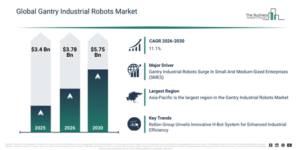
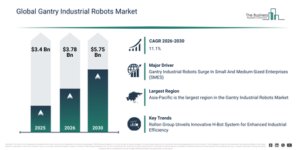
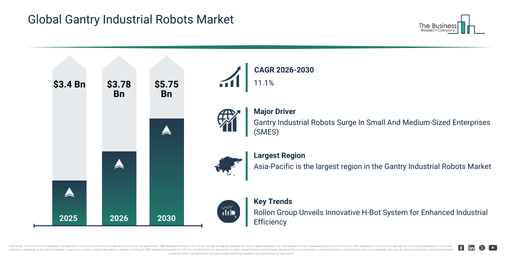
The gantry industrial robots market has experienced significant expansion in recent years. Its size is anticipated to rise from $3.4 billion in 2025 to $3.78 billion in 2026, exhibiting a compound annual growth rate (CAGR) of 11.2%. This past growth can be attributed to factors such as the expansion of industrial automation, an increase in automotive manufacturing capacity, the growing adoption of robotics in material handling, the need for high-precision manufacturing systems, and the availability of robust linear motion technologies.
The gantry industrial robots market is projected for significant expansion over the coming years. Its value is anticipated to reach $5.75 billion in 2030, exhibiting a compound annual growth rate (CAGR) of 11.1%. This expansion during the projection period stems from factors such as the increasing implementation of smart factories, a greater need for high-load automation solutions, the development of electronics and semiconductor production, an increased emphasis on operational efficiency, and the incorporation of AI-based robotic control systems. Key developments expected within this timeframe involve the enlargement of high-payload gantry robot systems, broader application in heavy-duty pick-and-place tasks, increased use in automated welding, stronger integration with smart factory control systems, and an elevated commitment to precision and repeatability.
Get A Free Sample Of The Gantry Industrial Robots Market Report 2026:
What Is Driving The Growth Of The Gantry Industrial Robots Market?
The expansion of the gantry industrial robots market is anticipated to be driven by the rising incorporation of automation among small and medium-sized enterprises (SMEs). SMEs are defined as businesses operating within specific thresholds regarding employee numbers, revenue, or operational scope, and they constitute a significant segment of global economic activity. The inherent flexibility, precision, and adaptability of gantry robots enable SMEs to streamline their production processes, effectively accommodate diverse manufacturing requirements, and ultimately enhance their overall operational efficiency. The escalating adoption of automation within SMEs is a key factor propelling the growth of the gantry industrial robots market.
How Is The Gantry Industrial Robots Market Segmented?
The gantry industrial robots market covered in this report is segmented –
1) By Type: 1-Axis, 2-Axis, 3-Axis, 4-Axis, Other Types
2) By Application: Handling, Palletizing, Welding, Other Applications
3) By Industry: Packaging, Automotive, Pharmaceuticals, Food And Beverage, Semiconductors And Electronics, Heavy Engineering Machinery, Aerospace And Railway, Other Industries
Subsegments:
1) By 1-Axis: Linear Gantry Robots, Simple Pick-And-Place Robots
2) By 2-Axis: XY Gantry Robots, Gantry Robots For Horizontal Movement
3) By 3-Axis: XYZ Gantry Robots, Gantry Robots With Vertical Lift
4) By 4-Axis: Gantry Robots With Rotational Axis, Robots For Complex Manipulation Tasks
5) By Other Types: Multi-Axis Gantry Robots, Custom Configured Gantry Systems
What Are The Latest Trends In The Gantry Industrial Robots Market?
Leading firms within the gantry industrial robots market are concentrating on creating sophisticated motion control solutions, like the H-Bot system, to boost productivity and optimize operational space across diverse industrial sectors. The H-Bot system represents an inventive gantry robot setup, providing efficient and adaptable movement, making it perfectly suited for tasks demanding high precision and swift positioning in industrial settings.
Who Are The Key Players In The Gantry Industrial Robots Market?
Major companies operating in the gantry industrial robots market are Liebherr-International AG, ABB Ltd., KUKA AG, FANUC Corporation, Parker Hannifin Corporation, Yamaha Motor Co. Ltd., Güdel Group AG, Yaskawa Electric Corporation, Bahr Modultechnik GmbH, Shibaura Machine Co. Ltd., OMRON Corporation, Robert Bosch GmbH, Macron Dynamics Inc., Intelligent Actuator Inc., Cimcorp Oyj, Mitsubishi Electric Corporation, Ston Robot Changzhou Co. Ltd., ALIO Industries Inc., Aerotech Inc., Comau S.p.A., Epson Taiwan Technology and Trading Ltd., Nachi-Fujikoshi Corp., Panasonic Corporation, Siasun Robot & Automation Co. Ltd., Stäubli Robotics
Read The Complete Gantry Industrial Robots Market Report 2026:
Which Region Is The Largest In The Gantry Industrial Robots Market?
Asia-Pacific was the largest region in the gantry industrial robots market share in 2025. The regions covered in the gantry industrial robots market report are Asia-Pacific, South East Asia, Western Europe, Eastern Europe, North America, South America, Middle East, Africa
Reach Out To Our Team:
The Business Research Company: https://www.thebusinessresearchcompany.com/
Americas: +1 310-496-7795
Asia: +44 7882 955267 & +91 8897263534
Europe: +44 7882 955267
Email us at: marketing@tbrc.info
Follow us on:
LinkedIn: https://in.linkedin.com/company/the-business-research-company
YouTube: https://www.youtube.com/channel/UC24_fI0rV8cR5DxlCpgmyFQ
Global Market Model: https://www.thebusinessresearchcompany.com/global-market-model

Wasay has over a decade of experience in market research, data modelling, and analytics, with prior experience at GlobalData and Decision Tree Consulting Services. At The Business Research Company , he leads research operations across syndicated studies, customized consulting engagements, and the Global Market Model platform. His professional experience includes supporting organizations such as Boston Consulting Group, KPMG, and Ernst & Young. Wasay holds a degree in Electronics and Communications Engineering, postgraduate management qualifications from International Management Institute Belgium and Indian School of Business and Entrepreneurship, and completed the Integrated Program in Business Analytics from Indian Institute of Management Indore.