Through market attractiveness analysis, total addressable market evaluation, company benchmarking matrices, interactive Excel dashboards, expanded supply chain intelligence, emerging startup coverage, and detailed product insights, The Business Research Company’s 2026 market reports provide more actionable and strategically valuable research.
Warehouse Robotics Market Growth Potential: How Will Market Size Change Through 2030?
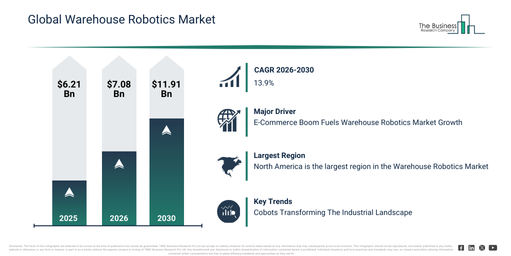
The warehouse robotics market has experienced substantial growth in recent years. Its value is projected to climb from $6.21 billion in 2025 to $7.08 billion in 2026, achieving a compound annual growth rate (CAGR) of 14.1%. This historic expansion can be attributed to the rise in e-commerce fulfillment, increasing labor shortages, the demand for quicker order processing, the necessity for warehouse cost optimization, and the proliferation of distribution centers.
The warehouse robotics market size is anticipated to expand significantly in the near future, projected to achieve $11.91 billion in 2030, with a compound annual growth rate (CAGR) of 13.9%. This forecasted growth is largely due to expectations for same-day delivery, the rise of omnichannel retail, innovations in AI vision systems, a greater emphasis on warehouse safety, and the expansion of automated logistics hubs. Notable trends for the forecast period include the swift adoption of autonomous mobile robots, an increase in goods-to-person automation, the implementation of AI-driven picking systems, the development of flexible and scalable robotics solutions, and an escalating demand for optimizing warehouse processes.
Download A Free Sample Report For Comprehensive Market Insights:
Warehouse Robotics Market Expansion Drivers: What Is Shaping Future Growth?
The expansion of the e-commerce sector is anticipated to propel the warehouse robotics market in the future. E-commerce, also known as online shopping, represents a business model facilitating the exchange of goods and services between individuals and businesses over the Internet. This highly dynamic e-commerce industry requires automated warehouse robots to streamline manual material handling within facilities and enhance overall warehouse efficiency. As an illustration, the United States Census Bureau, a US-based government agency, indicated in August 2025 that E-commerce sales for the second quarter of 2025 saw a 5.3 percent (±1.2%) increase relative to the corresponding quarter in 2024, surpassing the 3.9 percent (±0.4%) rise observed in total retail sales. During this same period, online sales constituted 16.3 percent of all retail transactions. Consequently, the expanding e-commerce industry is serving as a primary catalyst for the growth of the warehouse robotics market.
Warehouse Robotics Market Segment Outlook: Which Categories Are Expanding The Fastest?
The warehouse robotics market covered in this report is segmented –
1) By Type: Parallel Robots, Mobile Robots, Gantry Robots
2) By Function: Pick And Place, Transportation, Packaging
3) By End-User: E-Commerce, Automotive, Food And Beverages, Electronics And Electrical, Metal And Machinery, Pharmaceuticals, Other End-Users
Subsegments:
1) By Parallel Robots: Delta Robots, Other Parallel Kinematics Robots
2) By Mobile Robots: Automated Guided Vehicles (AGVs), Autonomous Mobile Robots (AMRs)
3) By Gantry Robots: Cartesian Gantry Robots, Overhead Gantry Systems
Warehouse Robotics Market Industry Trends Shaping Future Revenue Growth
Leading firms within the warehouse robotics sector are creating collaborative robots (cobots) to gain a competitive advantage. Cobots, an abbreviation for collaborative robots, are industrial robots engineered to operate in conjunction with human personnel in shared work environments. An example is the launch of the Lexium cobot by Schneider Electric SE, a France-based energy management company, in August 2023; this collaborative robot is engineered to manage substantial loads, decrease idle time, and enhance operational effectiveness in manufacturing settings. The Lexium cobot incorporates features like collision detection, a compact form factor, and straightforward integration, rendering it highly suitable for operations that are heavy, recurring, or intricate. Its objective is to mitigate the effects of labor scarcity on productivity and space demands, concurrently improving the safety and flexibility of workers in industrial facilities.
Warehouse Robotics Market Key Companies And Competitive Benchmarking
Major companies operating in the warehouse robotics market are ABB Ltd., Honeywell International Inc., FANUC Corporation, Amazon Robotics LLC, KUKA Aktiengesellschaft, Yaskawa Electric Corporation, Attabotics Inc., Omron Corporation, Daifuku Co. Ltd., Locus Robotics Corporation, GreyOrange Pte. Ltd., KION Group AG, Fetch Robotics Inc., SSI Schaefer Systems International Holding AG, Swisslog Holding AG, Knapp AG, Dematic Corp., Geek Plus Robotics Co. Ltd., Magazino GmbH, Vecna Robotics Inc., Mobile Industrial Robots ApS, Seegrid Corporation, Yamaha Robotics, Toshiba Corporation, Universal Robots A/S, Boston Dynamics Inc., RightHand Robotics Inc., IAM Robotics LLC, Clearpath Robotics Inc.
Access The Complete Warehouse Robotics Market Report:
Warehouse Robotics Market Global Footprint: Which Region Holds Market Leadership?
North America was the largest region in the warehouse robotics market share in 2025. Asia-Pacific is expected to be the fastest growing region in the forecast period. The regions covered in the warehouse robotics market report are Asia-Pacific, South East Asia, Western Europe, Eastern Europe, North America, South America, Middle East, Africa
Get in touch with us:
The Business Research Company: https://www.thebusinessresearchcompany.com/
Americas: +1 310-496-7795
Asia: +44 7882 955267 & +91 8897263534
Europe: +44 7882 955267
Email us at: marketing@tbrc.info
Follow us on:
LinkedIn: https://in.linkedin.com/company/the-business-research-company
YouTube: https://www.youtube.com/channel/UC24_fI0rV8cR5DxlCpgmyFQ
Global Market Model: https://www.thebusinessresearchcompany.com/global-market-model

Wasay has over a decade of experience in market research, data modelling, and analytics, with prior experience at GlobalData and Decision Tree Consulting Services. At The Business Research Company , he leads research operations across syndicated studies, customized consulting engagements, and the Global Market Model platform. His professional experience includes supporting organizations such as Boston Consulting Group, KPMG, and Ernst & Young. Wasay holds a degree in Electronics and Communications Engineering, postgraduate management qualifications from International Management Institute Belgium and Indian School of Business and Entrepreneurship, and completed the Integrated Program in Business Analytics from Indian Institute of Management Indore.