Backed by market attractiveness analysis, total addressable market sizing, company benchmarking matrices, interactive Excel dashboards, wider supply chain intelligence, emerging startup coverage, and detailed product-level insights, The Business Research Company’s 2026 market reports are designed to offer research that is more actionable and strategically valuable than ever.
Washing Equipment Market Revenue Outlook: What CAGR Lies Ahead Through 2030?
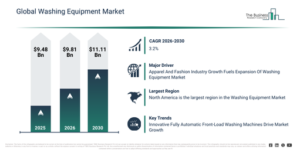
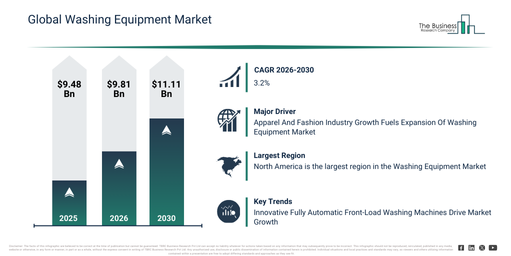
The washing equipment market size has demonstrated consistent expansion over recent years. It is anticipated to increase from $9.48 billion in 2025 to $9.81 billion in 2026, progressing at a compound annual growth rate (CAGR) of 3.4%. The expansion observed in the historic period can be ascribed to several factors, including the growth of the hospitality industry, the proliferation of healthcare facilities, increasing urban populations, heightened hygiene awareness, and the rising availability of laundromat services.
The washing equipment market size is anticipated to show consistent growth over the next few years. It is forecast to reach $11.11 billion by 2030, exhibiting a compound annual growth rate (CAGR) of 3.2%. This growth during the projection period stems from factors such as sustainable appliance regulations, an increase in shared laundry services, the integration of smart appliances, increasing demand for commercial laundry solutions, and the development of tourism infrastructure. Key trends anticipated during this period encompass a heightened demand for energy-efficient washing machines, the broadening of commercial laundry equipment offerings, increased uptake of automated washing systems, an emphasis on water-saving technologies, and a rise in the use of heat pump dryers.
Get A Free Sample Report With In-Depth Market Insights:
Washing Equipment Market Growth Backed By Core Demand Fundamentals
The expanding apparel and fashion sectors are anticipated to drive the washing equipment market’s expansion in the future. These industries cover the entire process from designing and producing to marketing and selling attire, shoes, and related items. Their growth stems from heightened consumer desire for a variety of fashionable and eco-friendly garments and accessories, influenced by global integration, technological progress, and greater disposable income. Washing machinery plays a crucial role within the apparel and fashion sectors for tasks such as fabric pre-treatment, garment completion, and guaranteeing the purity and standard of textiles prior to consumer distribution. As an illustration, data from March 2024, provided by the US central bank, the Federal Reserve Bank of St. Louis, indicated that personal spending on clothing, footwear, and associated services rose from $518,323 billion in 2022 to $535,762 billion in 2023. This marked an approximate increase of 3.36%. Consequently, the expansion witnessed in the apparel and fashion industries is fueling the growth of the washing equipment market.
Washing Equipment Market Segment Analysis And Revenue Potential
The washing equipment market covered in this report is segmented –
1) By Product Type: Washer, Dry Cleaning Equipment
2) By Sales Channel: E-Commerce, Retail Chains, Direct Sales
3) By End-Use: Hotel, Hospital, Laundromat, Other End-Uses
Subsegments:
1) By Washer: Front-Load Washers, Top-Load Washers, Commercial Washers, Washer-Dryer Combos
2) By Dry Cleaning Equipment: Dry Cleaning Machines, Steam Presses, Spotting Machines, Stain Removal Equipment
#Washing Equipment Market Growth Trends: What’s Shaping The Future Outlook?
Key companies operating in the washing equipment market are innovating products, such as fully automatic front-load washing machines, to satisfy the rising consumer demand for efficient, convenient, and high-performance laundry solutions. A fully automatic front-load washing machine is a washing appliance that automates the entire laundering process, from water filling to drying clothes. For example, in March 2024, Samsung Electronics Co. Ltd., an electronics company from South Korea, unveiled a new line of 11 kg AI Ecobubble fully automatic front-load washing machines, providing significant energy efficiency, faster wash times, and improved fabric care. These machines aim to enhance laundry convenience and efficiency while delivering better results. They are equipped with AI Ecobubble technology, which can save up to 70% of energy compared to traditional washing machines and boost fabric care by up to 45.5%.
Washing Equipment Market Key Players Shaping Industry Direction
Major companies operating in the washing equipment market are Samsung Electronics Co. Ltd, Robert Bosch GmbH, Siemens AG, LG Corporation, Panasonic Holdings Corporation, Haier Inc., Whirlpool Corporation, Sharp Corporation, Electrolux AB, Miele Inc., Indesit Company, The Maytag Corporation, Ariston Holding NV, Alliance Laundry Systems, The Hoover Company, Fisher & Paykel Technologies, IFB Appliances, Voltas Beko, Dexter Laundry, Candy Inc., Daewoo Electronics, Asko, Kenmore
View The Full Washing Equipment Market Report:
Washing Equipment Market Regional Breakdown: Where Is Demand Concentrated?
North America was the largest region in the washing equipment market in 2025. The regions covered in the washing equipment market report are Asia-Pacific, South East Asia, Western Europe, Eastern Europe, North America, South America, Middle East, Africa
Reach Out To Our Team:
The Business Research Company: https://www.thebusinessresearchcompany.com/
Americas: +1 310-496-7795
Asia: +44 7882 955267 & +91 8897263534
Europe: +44 7882 955267
Email us at: marketing@tbrc.info
Follow us on:
LinkedIn: https://in.linkedin.com/company/the-business-research-company
YouTube: https://www.youtube.com/channel/UC24_fI0rV8cR5DxlCpgmyFQ
Global Market Model: https://www.thebusinessresearchcompany.com/global-market-model

Wasay has over a decade of experience in market research, data modelling, and analytics, with prior experience at GlobalData and Decision Tree Consulting Services. At The Business Research Company , he leads research operations across syndicated studies, customized consulting engagements, and the Global Market Model platform. His professional experience includes supporting organizations such as Boston Consulting Group, KPMG, and Ernst & Young. Wasay holds a degree in Electronics and Communications Engineering, postgraduate management qualifications from International Management Institute Belgium and Indian School of Business and Entrepreneurship, and completed the Integrated Program in Business Analytics from Indian Institute of Management Indore.