
Backed by market attractiveness analysis, total addressable market sizing, company benchmarking matrices, interactive Excel dashboards, wider supply chain intelligence, emerging startup coverage, and detailed product-level insights, The Business Research Company’s 2026 market reports are designed to offer research that is more actionable and strategically valuable than ever.
Wearable Robotic Exoskeleton Market CAGR Outlook And Future Development
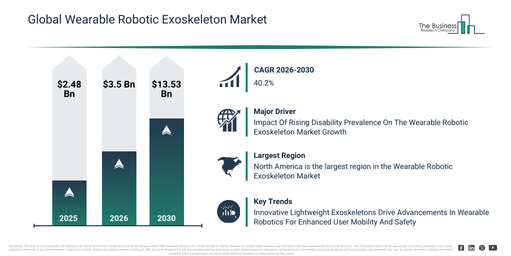
In recent years, the wearable robotic exoskeleton market has experienced rapid growth. This market is projected to expand from $2.48 billion in 2025 to $3.5 billion in 2026, exhibiting a compound annual growth rate (CAGR) of 41.1%. Several factors have contributed to its historical growth, including a higher incidence of mobility impairments, an increase in workplace injury rates, the proliferation of rehabilitation centers, the demand for assistive medical devices, and breakthroughs in robotics research.
The wearable robotic exoskeleton market size is anticipated to undergo substantial expansion in the coming years. It is projected to reach $13.53 billion by 2030, demonstrating a compound annual growth rate (CAGR) of 40.2%. This expansion during the forecast period is propelled by several factors, including the integration of AI-driven motion control, an aging global population, stricter industrial safety regulations, the broadening of military modernization initiatives, and the decreasing expenses associated with robotic components. Key trends during this period encompass the increasing adoption of rehabilitation exoskeletons, the growing deployment of these devices in industrial environments, a surging demand for powered lower limb systems, an expansion of defense and military applications, and an intensified emphasis on designs that are both lightweight and ergonomic.
Get A Free Sample Report With In-Depth Market Insights:
Wearable Robotic Exoskeleton Market Growth Backed By Core Demand Fundamentals
The increasing incidence of disabilities is anticipated to fuel the expansion of the wearable robotic exoskeletons market in the coming years. Disabilities are defined as physical, mental, or sensory conditions that substantially restrict an individual’s capacity to undertake daily activities or engage in society. The rise in disabilities can be attributed to multiple factors, such as an aging demographic, a surge in chronic health conditions, enhanced awareness and diagnosis of disabilities, and lifestyle issues including obesity and sedentary habits. Wearable robotic exoskeletons are essential for individuals with disabilities to boost mobility, offer physical assistance, support rehabilitation, and elevate their overall quality of life by allowing users to perform daily tasks more autonomously and securely. For instance, in October 2024, information from the House of Commons Library, a UK-based library and information resource of the lower house of the British Parliament, revealed that an estimated 16.1 million people in the UK had a disability in 2022/23, representing 24% of the total population. By February 2024, 6.9 million people in Great Britain were claiming extra-costs disability benefits, which accounted for 10.4% of the population. Consequently, the growing prevalence of disabilities is propelling the development of the wearable robotic exoskeletons market.
Wearable Robotic Exoskeleton Market Segmentation And Category Overview
The wearable robotic exoskeleton market covered in this report is segmented –
1) By Type: Passive, Powered
2) By Actuation Technology: Electric, Hydraulic, Fully Mechanical, Other Actuation Technology
3) By Application: Rehabilitation, Assistive, Body Parts Support
4) By End User: Healthcare, Industrial, Defense
Subsegments:
1) By Passive Exoskeletons: Soft Exoskeletons, Rigid Exoskeletons
2) By Powered Exoskeletons: Active Lower Limb Exoskeletons, Active Upper Limb Exoskeletons, Full-Body Exoskeletons
#Wearable Robotic Exoskeleton Market Growth Trends: What’s Shaping The Future Outlook?
Leading companies in the wearable robotic exoskeletons market are creating advanced products, such as lightweight models, aimed at reducing user tiredness, increasing comfort, and boosting movement capabilities. These lightweight exoskeletons are robotic wearable devices designed to aid in motion and provide support while keeping extra weight to a minimum. This design makes them easier to wear for longer periods and improves both user mobility and comfort. For example, in June 2023, Comau, an Italy-based industrial automation firm, and IUVO, a US-based developer of wearable robotics, in partnership with Esselunga, an Italy-based retail chain, introduced the MATE-XB wearable lumbar exoskeleton. This MATE-XB exoskeleton offers complete support to the lumbosacral joint during activities involving bending and lifting, allowing personnel to safely manage loads up to 25kg. As a completely passive apparatus, it boosts operator safety and overall well-being, demonstrating Comau’s commitment to wearable robotics through its provision of solutions for both upper and lower body support. Furthermore, MATE-XB fosters enduring and quantifiable ergonomic enhancements, leading to sustained health advantages while simultaneously elevating the standard and effectiveness of task execution.
Wearable Robotic Exoskeleton Market Competitive Analysis Of Leading Industry Participants
Major companies operating in the wearable robotic exoskeleton market are Lockheed Martin Corporation, Mitsubishi Heavy Industries, Ltd., Comau LLC, Shanghai Fourier Intelligence Co., Ltd., Hocoma AG (a DIH International Ltd. company), Myomo, Inc., Cyberdyne Inc., Sarcos Technology and Robotics Corporation, ATOUN Inc., Ekso Bionics Holdings, Inc., BioServo Technologies AB, Daiya Industry Co., Ltd., ReWalk Robotics Ltd., Skelex AG, Focal Meditech B.V., B-Temia Inc., Technaid S.L., Rex Bionics Ltd., Innervo Labs Inc., Harmonic Bionics, Inc., Gogoa Mobility Robots S.L., Bionik Laboratories Corp., P&S Mechanics Co., Ltd., Skeletonics Co., Ltd.
View The Full Wearable Robotic Exoskeleton Market Report:
Wearable Robotic Exoskeleton Market Top Region: Where Does Most Revenue Come From?
North America was the largest region in the wearable robotic exoskeleton market in 2025. Asia-Pacific is expected to be the fastest-growing region in the forecast period. The regions covered in the wearable robotic exoskeleton market report are Asia-Pacific, South East Asia, Western Europe, Eastern Europe, North America, South America, Middle East, Africa
Reach Out To Our Team:
The Business Research Company: https://www.thebusinessresearchcompany.com/
Americas: +1 310-496-7795
Asia: +44 7882 955267 & +91 8897263534
Europe: +44 7882 955267
Email us at: marketing@tbrc.info
Follow us on:
LinkedIn: https://in.linkedin.com/company/the-business-research-company
YouTube: https://www.youtube.com/channel/UC24_fI0rV8cR5DxlCpgmyFQ
Global Market Model: https://www.thebusinessresearchcompany.com/global-market-model

Wasay has over a decade of experience in market research, data modelling, and analytics, with prior experience at GlobalData and Decision Tree Consulting Services. At The Business Research Company , he leads research operations across syndicated studies, customized consulting engagements, and the Global Market Model platform. His professional experience includes supporting organizations such as Boston Consulting Group, KPMG, and Ernst & Young. Wasay holds a degree in Electronics and Communications Engineering, postgraduate management qualifications from International Management Institute Belgium and Indian School of Business and Entrepreneurship, and completed the Integrated Program in Business Analytics from Indian Institute of Management Indore.

