Market attractiveness scoring, total addressable market sizing, company benchmarking matrices, interactive Excel dashboards, deeper supply chain intelligence, emerging startup tracking, and granular product-level insights are among the key offerings featured in The Business Research Company’s 2026 market reports, designed to deliver more actionable and strategically valuable research.
Social Commerce Market Valued At $992.38 Billion In 2026, Projected To Reach $1616.99 Billion By 2030
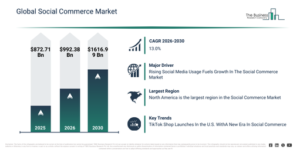
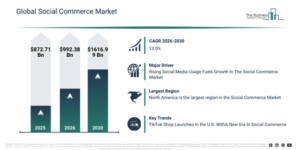
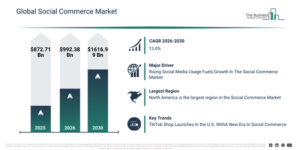
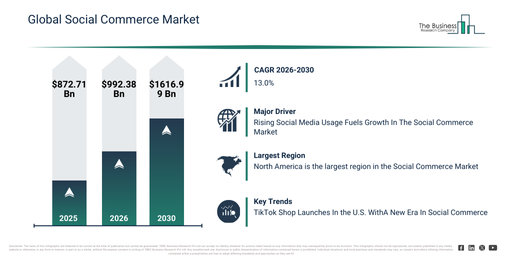
The social commerce market has experienced substantial growth in recent years. It is anticipated to expand from $872.71 billion in 2025 to $992.38 billion in 2026, demonstrating a compound annual growth rate (CAGR) of 13.7%. This historical expansion can be attributed to the early adoption of social media platforms, the rise of mobile commerce, the growth of influencer marketing, increasing smartphone penetration, and the expansion of digital payment systems.
The social commerce market size is anticipated to undergo significant expansion over the next few years. Projections indicate it will grow to $1616.99 billion in 2030, achieving a compound annual growth rate (CAGR) of 13.0%. This expected growth during the forecast period is attributed to several factors, including the increasing adoption of AI-powered recommendation engines, the rise of shoppable livestreams, the broader expansion of cross-border social commerce, the development of augmented reality shopping experiences, and the greater implementation of blockchain for secure transactions. Prominent trends for this period encompass influencer-led marketing approaches, the deeper integration of social media with e-commerce platforms, the widespread use of user-generated content and reviews, engaging livestream shopping experiences, and the gamification of shopping.
Request A Complimentary Social Commerce Market Research Sample:
Key Factor Propelling The Social Commerce Market Forward
Growing engagement with social media platforms is projected to fuel the expansion of the social commerce market in the future. This engagement involves individuals interacting with sites like Facebook, Instagram, and YouTube for activities including communication, entertainment, retail, and promotional efforts. The rise in social media activity is largely attributed to the widespread adoption of smartphones, which offer continuous internet access and convenient connectivity, allowing users to access social platforms at any moment and from any location. Social commerce utilizes these platforms, facilitating direct product transactions between businesses and consumers via social interactions and digital communities. Consequently, heightened social media engagement is propelling the expansion of the social commerce market.
Social Commerce Market Segments And Subsegments Explained
The social commerce market covered in this report is segmented –
1) By Product Type: Personal And Beauty Care, Apparel, Accessories, Home Products, Health Supplements, Food And Beverage, Other Products
2) By Device Type: Laptops And PCs, Mobiles, Other Devices
3) By Business Model: B2C, B2B, C2C
4) By End User: Individual, Commercial
Subsegments:
1) By Personal And Beauty Care: Skincare Products, Makeup And Cosmetics, Hair Care Products
2) By Apparel: Clothing, Footwear, Activewear
3) By Accessories: Jewelry, Bags and Purses, Watches
4) By Home Products: Furniture, Home Decor, Kitchenware
5) By Health Supplements: Vitamins and Minerals, Protein Supplements, Herbal Products
6) By Food and Beverage: Snacks, Beverages, Gourmet Foods
7) By Other Products: Electronics, Pet Supplies, Baby Products
Emerging Trends Transforming The Social Commerce Market
Leading firms within the social commerce sector are prioritizing the creation of advanced platform functionalities, such as creator-driven product tagging, to elevate user interaction, simplify shopping journeys, and drive greater online revenue. This creator-driven product tagging involves a feature that empowers social media content producers to embed product tags directly within their posts or videos, thereby facilitating effortless product discovery and acquisition for users.
Social Commerce Market Key Players: Major Companies In The 2026 Report
Major companies operating in the social commerce market are Amazon.com Inc., Microsoft Corporation, Alibaba Group Holding Limited, Facebook Inc., Tencent Holdings Limited, ByteDance Ltd., Instagram LLC, YouTube LLC, PayPal Payments Private Limited, Salesforce.com Inc., Xiaohongshu Inc., Pinduoduo Inc., Adobe Inc., LinkedIn Corporation, eBay Inc., TikTok Inc., Shopify Inc., Twitter Inc., Snapchat Inc., Pinterest Inc., Etsy Inc., Sina Corporation, Weibo Corporation, Wix.com Ltd., Squarespace Inc., BigCommerce Holdings Inc., Poshmark Inc., Automattic Inc., Renren Inc., Fabulous Inc., Big Cartel LLC, Volusion LLC, Ecwid Inc., PrestaShop SA, OpenCart Limited, Miva Inc., Zen Cart
Explore The Full Social Commerce Market Report With Forecasts To 2030:
Social Commerce Market By Region: Where Is Demand Strongest?
North America was the largest region in the social commerce market share in 2025. Europe was the second-largest region in the social commerce market. The regions covered in the social commerce market report are Asia-Pacific, South East Asia, Western Europe, Eastern Europe, North America, South America, Middle East, Africa.
Reach Out To Our Team:
The Business Research Company: https://www.thebusinessresearchcompany.com/
Americas: +1 310-496-7795
Asia: +44 7882 955267 & +91 8897263534
Europe: +44 7882 955267
Email us at: marketing@tbrc.info
Follow us on:
LinkedIn: https://in.linkedin.com/company/the-business-research-company
YouTube: https://www.youtube.com/channel/UC24_fI0rV8cR5DxlCpgmyFQ
Global Market Model: https://www.thebusinessresearchcompany.com/global-market-model

Wasay has over a decade of experience in market research, data modelling, and analytics, with prior experience at GlobalData and Decision Tree Consulting Services. At The Business Research Company , he leads research operations across syndicated studies, customized consulting engagements, and the Global Market Model platform. His professional experience includes supporting organizations such as Boston Consulting Group, KPMG, and Ernst & Young. Wasay holds a degree in Electronics and Communications Engineering, postgraduate management qualifications from International Management Institute Belgium and Indian School of Business and Entrepreneurship, and completed the Integrated Program in Business Analytics from Indian Institute of Management Indore.