Market attractiveness scoring, total addressable market sizing, company benchmarking matrices, interactive Excel dashboards, deeper supply chain intelligence, emerging startup tracking, and granular product-level insights are among the key offerings featured in The Business Research Company’s 2026 market reports, designed to deliver more actionable and strategically valuable research.
Television Broadcasting Market Size Estimate For 2026 And Revenue Forecast Through 2030
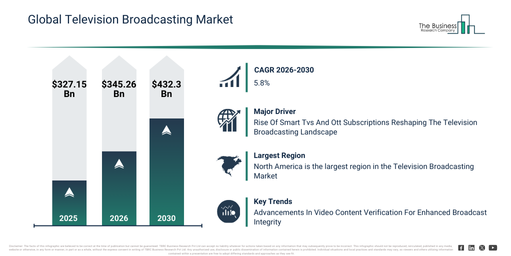
The television broadcasting market has experienced robust expansion over recent years. Its valuation is anticipated to climb from $327.15 billion in 2025 to $345.26 billion in 2026, reflecting a compound annual growth rate (CAGR) of 5.5%. This historical surge can be ascribed to factors such as the extensive uptake of cable networks, the proliferation of satellite TV, the establishment of national television networks, an uptick in advertisement earnings, and increased public television funding.
The television broadcasting market is projected to experience robust expansion over the coming years. Its valuation is anticipated to reach $432.3 billion by 2030, demonstrating a compound annual growth rate (CAGR) of 5.8%. This growth during the forecast period is attributable to several factors, including the increasing demand for personalized content, the expansion of streaming platforms, developments in smart TV technology, the proliferation of regional language channels, and the integration with IoT and connected ecosystems. Key trends shaping this period encompass a move towards high-definition and ultra-HD broadcasting, the wider adoption of over-the-top (OTT) platforms, the prevalence of personalized and interactive TV content, the rising significance of localized and regional programming, and the integration of smart TV functionalities and connected devices.
Free Television Broadcasting Market Report Sample Available For Download:
Why Is Demand In The Television Broadcasting Market Expected To Keep Rising?
The television broadcasting market is anticipated to expand in the coming years, driven by the growing adoption of smart TVs and Over-the-Top (OTT) subscriptions. A smart TV, also known as a connected or hybrid TV, integrates internet access and interactive Web 2.0 functionalities directly into the television set. An Over-the-top (OTT) subscription offers media services, including video and audio content, over the Internet, bypassing traditional cable or satellite TV delivery. These services, smart TVs and OTT, provide consumers with enhanced control over their viewing choices and enable access to video-on-demand content across various devices. Consequently, the rising prevalence of smart TVs and OTT subscriptions is a significant factor propelling the television broadcasting market.
How Is The Television Broadcasting Market Divided Across Segments And Subsegments?
The television broadcasting market covered in this report is segmented –
1) By Type: Television Station, Television Network
2) By Broadcaster Type: Public, Commercial
3) By Revenue Source: Subscription-Based, Advertisement-Based
Subsegments:
1) By Television Station: Local Television Stations (Broadcasting Content to Specific Geographic Areas), Public Television Stations (Non-commercial, Often Funded by Government or Donations), Cable Television Stations (Local Channels Accessible Through Cable Providers)
2) By Television Network: National Television Networks, Regional Television Networks (Serving Specific Regions or States), International Television Networks (Broadcasting Content Globally)
Television Broadcasting Market Trends Reshaping Customer Demand And Business Strategies
Leading companies within the television broadcasting market are concentrating on developing innovative solutions, such as video-compatible camera authenticity tools, to improve content validation, bolster confidence in news reporting, and counter the growing challenges of deepfakes and manipulated media, thereby boosting overall broadcast trustworthiness and viewer assurance. This type of solution is a technology designed to confirm that video material was genuinely recorded by a specific camera and has not been altered, manipulated, or artificially generated. For instance, in October 2025, Sony Group Corporation, a US-based supplier of electronics and professional video solutions, introduced its camera authenticity solution, which is the first in the industry to offer video verification for news and broadcast applications. This system currently supports five Sony cameras, specifically the Alpha 1 II, Alpha 9 III, FX3, FX30, and PXW-Z300iv, with intentions to incorporate four more by 2026, and enables quick verification of extensive video files while preserving their authenticity signatures. This technology not only elevates content credibility but also equips broadcasters with mechanisms to combat false information and sustain audience trust, thereby bridging an essential divide between conventional camera-recorded content and contemporary digital verification protocols.
Television Broadcasting Market Major Players: Companies At The Forefront Of The Industry
Major companies operating in the television broadcasting market are Comcast Corporation, Walt Disney, Time Warner Inc., ViacomCBS, NBC Universal Media LLC, Dish Network, Fox Corporation, British Broadcasting Corporation, American Broadcasting Company (ABC), A&E Television Networks, Ryukyu Broadcasting Corporation, ITV Network Limited, Marquee Broadcasting, NovyiVek, Fukushima Central Television Co., Metromedia, Jiangsu Radio And Television Station, China Beijing TV Station, Moskva Media, Guangdong Broadcasting And Television Network Co., MTV Networks Africa Pty Limited, Television Kanagawa, STS Media, Hunan Broadcasting System, UKTV Inc., Baishan Broadcast Television Station, Beijing Media Network, Kumamoto Telecasting Corp., Nankai Broadcasting Co., Telekanal 360 Ltd., Jiangsu Broadcasting & Television Group Co., Channel Four Television Corporation, The North United Cable Network Inc., 3sat, ARD, Bavarian Radio And Television Network, Deutsche Welle, Star India Private Limited, 1-2-3.TV GmbH, RTL Television GmbH, Gazprom Media, Seven National Pty Limited, WeltN24 GmbH, Sport1 GmbH, Don Media, Hearst Television, ABC Owned Television Stations, American Spirit Media, New Age Media, Natsionalnaya Media Gruppa, Bahakel Communications, Block Communications, Bonten Media Group, Capital Cities ABC Inc., Sky Channel Pty Ltd., Sony Pictures Networks India Private Limited, TV18 Broadcast Limited, Cowles Company, Cox Media Group, CBS Corporation, Shandong Radio And TV Station, Gray Television Inc.
Read More About The Television Broadcasting Market In The Full Report:
Television Broadcasting Market Regional Share Analysis For 2025
North America was the largest region in the television broadcasting market in 2025. Middle East is expected to be the fastest growing region in the forecast period. The regions covered in the television broadcasting market report are Asia-Pacific, South East Asia, Western Europe, Eastern Europe, North America, South America, Middle East, Africa.
Reach Out To Our Team:
The Business Research Company: https://www.thebusinessresearchcompany.com/
Americas: +1 310-496-7795
Asia: +44 7882 955267 & +91 8897263534
Europe: +44 7882 955267
Email us at: marketing@tbrc.info
Follow us on:
LinkedIn: https://in.linkedin.com/company/the-business-research-company
YouTube: https://www.youtube.com/channel/UC24_fI0rV8cR5DxlCpgmyFQ
Global Market Model: https://www.thebusinessresearchcompany.com/global-market-model

Wasay has over a decade of experience in market research, data modelling, and analytics, with prior experience at GlobalData and Decision Tree Consulting Services. At The Business Research Company , he leads research operations across syndicated studies, customized consulting engagements, and the Global Market Model platform. His professional experience includes supporting organizations such as Boston Consulting Group, KPMG, and Ernst & Young. Wasay holds a degree in Electronics and Communications Engineering, postgraduate management qualifications from International Management Institute Belgium and Indian School of Business and Entrepreneurship, and completed the Integrated Program in Business Analytics from Indian Institute of Management Indore.