Featuring market attractiveness scoring, total addressable market sizing, company benchmarking matrices, interactive Excel dashboards, deeper supply chain intelligence, emerging startup tracking, and granular product-level insights, The Business Research Company’s 2026 market reports are built to deliver research that is both more actionable and more strategically valuable.
#Artificial Eye Market Size Forecast: How Big Could The Market Get By 2030?#_x000D_
The artificial eye market size has demonstrated robust expansion in recent years. It is forecast to increase from $2.16 billion in 2025 to $2.34 billion in 2026, achieving a compound annual growth rate (CAGR) of 8.0%. Historically, this growth has been propelled by factors such as the occurrence of eye trauma, instances of cancer-related enucleation, the demand for cosmetic rehabilitation, the growth of hospital ophthalmic services, and progress in prosthetic technology._x000D_
_x000D_
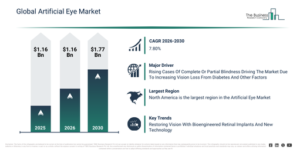
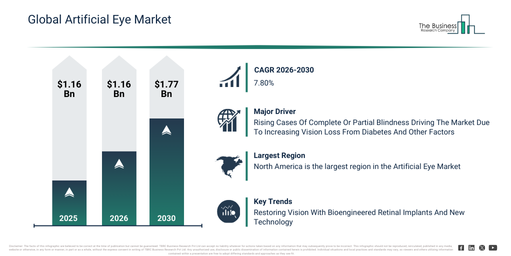
The artificial eye market size is projected to experience substantial expansion over the coming years. It is anticipated to reach a valuation of $3.16 billion by 2030, exhibiting a compound annual growth rate (CAGR) of 7.8%. This growth throughout the forecast period stems from factors such as the adoption of 3D printing, an increasing need for personalized prosthetics, enhanced access to healthcare, a heightened focus on psychological rehabilitation, and breakthroughs in material science. Key developments anticipated during this period include the development of custom-made ocular prosthetics, an expanding application of digital eye printing, a rising demand for superior aesthetic results, the utilization of lightweight and biocompatible materials, and increasing recognition of ocular rehabilitation._x000D_
_x000D_
#Get A Free Sample Report With In-Depth Market Insights:#_x000D_
_x000D_
#Artificial Eye Market Development Factors: What’s Supporting Demand?#_x000D_
The increasing prevalence of individuals experiencing complete or partial blindness is anticipated to boost the expansion of the artificial eye market. This condition signifies a substantial or total inability to see, preventing people from discerning light, shapes, or their environment, thereby severely hindering daily activities and overall quality of life. The surge in complete or partial blindness cases is attributed to the rise in retinal degenerative diseases, which progressively damage photoreceptor cells, leading to irreversible vision loss. Artificial eye technology offers novel solutions, such as bioengineered retinal implants, that can restore or improve vision, significantly enhancing the quality of life for affected individuals. For instance, in May 2024, a report from the East Sussex Joint Strategic Needs Assessment, a UK-based public health assessment body, stated that roughly 2 million people in the UK currently live with some degree of sight loss, with this figure projected to reach 2.7 million by 2030. Therefore, the growing number of people suffering from complete or partial blindness is a key factor driving the growth of the artificial eye market._x000D_
_x000D_
#Artificial Eye Market Segment Breakdown: Which Categories Lead On Revenue?#_x000D_
The artificial eye market covered in this report is segmented – _x000D_
_x000D_
1) By Product: Integrated, Semi-Integrated, Non-Integrated_x000D_
2) By Technology: Passive Prosthetic Technology, Mechanical_x000D_
3) By Distribution Channel: Direct Sales, Online Sales, Third Party Distributors, Specialized Ocular Prosthetic Clinics_x000D_
4) By Application: Orbital Support And Aesthetic Restoration, Cosmetic Enhancement, Medical Treatment, Reconstructive Surgery_x000D_
5) By End User: Hospitals, Ambulatory Surgical Centers, Other End Users_x000D_
_x000D_
Subsegments:_x000D_
1) Integrated: Hydroxyapatite (HA), Porous Polyethylene (Medpor), Bioceramic_x000D_
2) Semi-Integrated: Acrylic-Based, Silicone-Based, Polymer Composite_x000D_
3) Non-Integrated: Glass Prosthetic Eye, Acrylic Prosthetic Eye, Digital-Printed Prosthetic Eye_x000D_
_x000D_
#Artificial Eye Market Transformation Trends: What Innovations Are Driving Change?#_x000D_
Leading companies in the artificial eye field are concentrating on advancing innovations like bioengineered retinal implants to help patients with retinal degenerative diseases regain their vision. A bioengineered retinal implant is a synthetic, lab-developed device engineered to substitute or enhance compromised retinal tissue, thereby restoring or improving sight. It serves to restore vision for individuals afflicted with retinal degenerative conditions by replacing or bolstering impaired retinal function. For example, in May 2024, LambdaVision Inc., a US-based biotechnology firm, announced the successful first closure of its seed funding round, which will facilitate preclinical studies for its protein-based artificial retina. This groundbreaking bioengineered retinal implant leverages bacteriorhodopsin, a light-sensitive protein, to mimic the eye’s natural photoreceptor function, potentially offering a more fluid vision restoration method than conventional electronic implants. Additionally, the company is spearheading microgravity-based manufacturing on the International Space Station, which is expected to boost production quality and efficiency, setting a new precedent for precision in retinal prosthetics._x000D_
_x000D_
#Artificial Eye Market Top Companies Driving Competitive Growth#_x000D_
Major companies operating in the artificial eye market are Midwest Eye Laboratories Inc., Advanced Artificial Eyes, Boston Ocular Prosthetics Inc., Erickson Laboratories Inc., F.Ad. Muller Sohne GmbH & Co KG, Irises Unlimited Inc., Ocular Prosthetics Incorporated, International Prosthetic Eye Center Private Limited, New Zealand Prosthetic Eye Service, Southeastern Ocularists Inc., The Artificial Eye Co., John O. Hughes Prosthetic Eye Laboratory, Chadwick Optical Inc., Prosthetic Eye Center of New York, American Artificial Eye Center, Hanger Ocular Prosthetics, Romford Artificial Eye Service, Artificial Eye Services Australia, Queensland Artificial Eye Service, Moorfields Ocular Prosthetics Department, Artificial Eye Clinic of India, National Artificial Eye Service _x000D_
_x000D_
#View The Full Artificial Eye Market Report:#_x000D_
_x000D_
#Artificial Eye Market Global Footprint: Which Region Leads The Industry?#_x000D_
North America was the largest region in the artificial eye market in 2025. Asia-Pacific is expected to be the fastest-growing region in the forecast period. The regions covered in the artificial eye market report are Asia-Pacific, South East Asia, Western Europe, Eastern Europe, North America, South America, Middle East, Africa._x000D_
_x000D_
#Reach Out To Our Team:#_x000D_
_x000D_
The Business Research Company: https://www.thebusinessresearchcompany.com/_x000D_
Americas: +1 310-496-7795_x000D_
Asia: +44 7882 955267 & +91 8897263534_x000D_
Europe: +44 7882 955267_x000D_
Email us at: marketing@tbrc.info_x000D_
_x000D_
#Follow us on:#_x000D_
_x000D_
LinkedIn: https://in.linkedin.com/company/the-business-research-company_x000D_
YouTube: https://www.youtube.com/channel/UC24_fI0rV8cR5DxlCpgmyFQ_x000D_
Global Market Model: https://www.thebusinessresearchcompany.com/global-market-model

Wasay has over a decade of experience in market research, data modelling, and analytics, with prior experience at GlobalData and Decision Tree Consulting Services. At The Business Research Company , he leads research operations across syndicated studies, customized consulting engagements, and the Global Market Model platform. His professional experience includes supporting organizations such as Boston Consulting Group, KPMG, and Ernst & Young. Wasay holds a degree in Electronics and Communications Engineering, postgraduate management qualifications from International Management Institute Belgium and Indian School of Business and Entrepreneurship, and completed the Integrated Program in Business Analytics from Indian Institute of Management Indore.