
Built to provide research that’s more actionable and strategically valuable, The Business Research Company’s 2026 market reports include market attractiveness analysis, total addressable market sizing, company benchmarking matrices, interactive Excel dashboards, broader supply chain intelligence, emerging startup tracking, and in-depth product insights.
Intraoral X-ray Sensors Market Size Outlook: How Quickly Will Revenue Expand Through 2030?
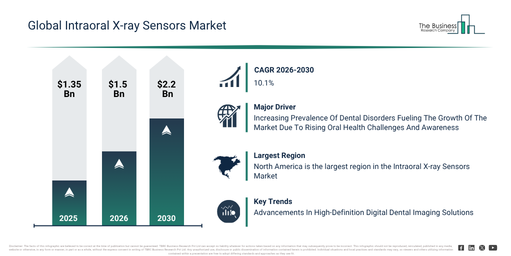
The intraoral x-ray sensors market has experienced substantial growth recently. It is forecast to expand from $1.35 billion in 2025 to $1.5 billion in 2026, achieving a compound annual growth rate (CAGR) of 10.6%. This historical growth can be attributed to the increasing incidence of dental disorders, a rising need for advanced dental diagnostics, the expanding adoption of digital dentistry practices, the development of dental healthcare infrastructure, and an increasing patient inclination towards minimally invasive procedures.
The intraoral x-ray sensors market is projected to witness significant expansion in the coming years, with its size expected to grow to $2.2 billion in 2030, demonstrating a compound annual growth rate (CAGR) of 10.1%. This growth during the forecast period can be attributed to several factors, including an escalating demand for precise dental imaging solutions, the increasing adoption of chairside digital diagnostic systems, ongoing advancements in wireless intraoral sensors, expanding initiatives for modernizing dental clinics, and a rising need for efficient dental workflow solutions. Major trends anticipated in this period encompass the wider embrace of high-resolution dental imaging sensors, a growing requirement for quicker digital image processing solutions, the increasing integration of advanced sensor technologies in dentistry, continued development of compact and portable intraoral imaging devices, and a heightened focus on improving diagnostic accuracy in dental procedures.
Get A Free Sample Report With In-Depth Market Insights:
Intraoral X-ray Sensors Market Demand Drivers: What’s Powering Industry Growth?
The rising occurrence of dental issues is projected to drive the expansion of the intraoral x-ray sensors market in the future. These disorders encompass conditions impacting the teeth, gums, and mouth, such as cavities, gum disease, and tooth extraction, all of which negatively affect oral health and general wellness. Poor eating habits, inadequate oral care, and an aging demographic contribute to the increase in dental disorders, resulting in a greater demand for restorative dental interventions. Intraoral X-ray sensors enhance the detection and management of dental ailments by generating detailed, live images that identify cavities, root canal problems, bone degeneration, and restorative needs sooner and with higher precision, thereby facilitating quicker, less intrusive, and more effective treatment. As an illustration, in March 2025, data from the Office for Health Improvement and Disparities, a government body in the UK, indicated that during the 2023 to 2024 timeframe, 5-year-old schoolchildren living in the most underprivileged fifth of the nation showed more than double the likelihood of having dentinal decay (32.2%) when contrasted with those in the least underprivileged fifth (13.6%). Consequently, the expanding occurrence of dental issues is fueling the growth of the intraoral x-ray sensors market.
Intraoral X-ray Sensors Market Segment Landscape: Which Areas Lead Development?
The intraoral x-ray sensors market covered in this report is segmented –
1) By Product Type: Wired Sensors, Wireless Sensors
2) By Technology: Charge Coupled Device Sensors, Flat Panel Sensors, Other Technologies
3) By Distribution Channel: Direct Sales, Distributors And Dealers, Online Sales Channels
4) By Application: Diagnostic Imaging, Therapeutic Procedures, Cosmetic Dentistry, Forensic Dentistry
5) By End User: Hospitals, Dental Clinics, Academic And Research Institutes, Other End Users
Subsegments:
1) By Wired Sensors: Complementary Metal Oxide Semiconductor Sensors, Photostimulable Phosphor Plate Sensors
2) By Wireless Sensors: Bluetooth Enabled Sensors, Wireless Fidelity Enabled Sensors, Portable Wireless Sensors, Battery Powered Wireless Sensors
Intraoral X-ray Sensors Market Innovation Trends: What Developments Are Reshaping The Industry?
Major companies operating in the intraoral x-ray sensors market are concentrating on developing advanced digital imaging solutions, such as high-definition intraoral sensors, to improve diagnostic accuracy, enhance workflow efficiency, and support safer dental imaging procedures. High-definition intraoral sensors are digital dental imaging devices designed to capture detailed X-ray images of teeth, gums, and surrounding oral structures by employing electronic sensors instead of conventional photographic film. This enables clinicians to achieve faster image acquisition, boosted diagnostic precision, reduced radiation exposure, and seamless integration with digital dental systems compared to traditional analog X-ray methods. For example, in October 2025, PreXion Inc., a US-based dental imaging technology company, launched the Evolve Sensor, an advanced intraoral dental digital imaging sensor introduced alongside the PreXion3D Evolve CBCT, PAN, and CEPH imaging system. This sensor provides high-definition image quality to facilitate accurate and safer clinical diagnoses while maintaining compatibility with a broad range of existing X-ray equipment. It also includes user-friendly imaging software specifically designed to simplify the transition from analog to digital workflows in dental practices. This solution helps in reducing operational costs and the environmental impact associated with film-based imaging, simultaneously enhancing the patient experience through quicker imaging procedures and improved diagnostic visualization.
Intraoral X-ray Sensors Market Industry Leaders And Competitive Landscape
Major companies operating in the intraoral x-ray sensors market are Air Techniques Inc., Carestream Dental, Denterprise International Inc., DentiMax LLC, Dürr Dental SE, Fussen Technology Co. Ltd., Genoray Co. Ltd., iRay Technology Co. Ltd., J. Morita Corporation, Midmark Corporation, Owandy Radiology Inc., Planmeca Oy, Ray Co. Ltd., Trident S.r.l., Vatech Co. Ltd., XpectVision Technology Co. Ltd., Envista Holdings Corporation, Dentsply Sirona Inc., Acteon Group, TPC Advanced Technology Inc., Suni Medical Imaging Inc.
View The Full Intraoral X-ray Sensors Market Report:
Intraoral X-ray Sensors Market Geographic Spread And Regional Opportunities
North America was the largest region in the intraoral x-ray sensors market in 2025. Asia-Pacific is expected to be the fastest-growing region in the forecast period. The regions covered in the intraoral x-ray sensors market report are Asia-Pacific, South East Asia, Western Europe, Eastern Europe, North America, South America, Middle East, Africa.
Reach Out To Our Team:
The Business Research Company: https://www.thebusinessresearchcompany.com/
Americas: +1 310-496-7795
Asia: +44 7882 955267 & +91 8897263534
Europe: +44 7882 955267
Email us at: marketing@tbrc.info
Follow us on:
LinkedIn: https://in.linkedin.com/company/the-business-research-company
YouTube: https://www.youtube.com/channel/UC24_fI0rV8cR5DxlCpgmyFQ
Global Market Model: https://www.thebusinessresearchcompany.com/global-market-model

Wasay has over a decade of experience in market research, data modelling, and analytics, with prior experience at GlobalData and Decision Tree Consulting Services. At The Business Research Company , he leads research operations across syndicated studies, customized consulting engagements, and the Global Market Model platform. His professional experience includes supporting organizations such as Boston Consulting Group, KPMG, and Ernst & Young. Wasay holds a degree in Electronics and Communications Engineering, postgraduate management qualifications from International Management Institute Belgium and Indian School of Business and Entrepreneurship, and completed the Integrated Program in Business Analytics from Indian Institute of Management Indore.