
Delivering more actionable and strategically valuable research, The Business Research Company’s 2026 market reports feature market attractiveness analysis, total addressable market evaluation, company benchmarking matrices, interactive Excel dashboards, expanded supply chain intelligence, emerging startup coverage, and detailed product insights.
Non-Wearable Sleep Tracker Market CAGR Analysis And Future Market Development
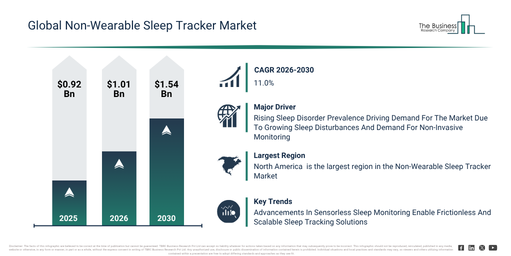
The non-wearable sleep tracker market has experienced significant expansion in recent years. It is anticipated to expand from $0.92 billion in 2025 to $1.01 billion by 2026, demonstrating a compound annual growth rate (CAGR) of 10.8%. This historical growth can be attributed to several factors, including the increasing occurrence of sleep disorders and insomnia, heightened awareness regarding sleep health and wellness monitoring, the early adoption of fundamental under-mattress sleep sensing devices, a surge in consumer demand for both wearable and non-wearable health monitoring, and the evolution of basic biometric sensing technologies for sleep analysis.
The non-wearable sleep tracker market size is projected to experience swift expansion over the coming years, with an anticipated growth to $1.54 billion by 2030, demonstrating a compound annual growth rate (CAGR) of 11.0%. This projected increase is attributed to the expansion of digital health and remote patient monitoring ecosystems, growing demand for contactless health monitoring solutions in homecare settings, the increasing integration of AI-powered sleep diagnostics and recommendations, a rise in preventive healthcare and wellness-focused consumer behavior, and technological advancements in radar and acoustic sleep sensing systems. Major trends for the forecast period include AI-driven sleep analytics for personalized sleep quality improvement, the integration of IoT-enabled smart home ecosystems with sleep monitoring systems, a rising adoption of contactless radar-based sleep tracking technologies, increased use of cloud-based sleep health data platforms for remote monitoring, and the development of non-invasive multi-sensor devices for optimizing the sleep environment.
Download A Free Sample Report For Comprehensive Market Insights:
https://www.thebusinessresearchcompany.com/sample_request?id=78047596&type=smp
Non-Wearable Sleep Tracker Market Opportunity Drivers: What Is Creating New Revenue Potential?
The increasing occurrence of sleep disorders is anticipated to stimulate the expansion of the non-wearable sleep tracker market. These conditions interfere with normal sleep patterns or cycles, resulting in poor sleep quality and decreased alertness during the day. The primary reason for the increase in sleep disorders is excessive screen time before bed, which disrupts melatonin production and delays the natural sleep cycle. Non-wearable sleep trackers assist in managing sleep disorders by continuously monitoring sleep patterns, breathing, and movement without requiring a device to be worn, thereby enabling early detection of irregularities and providing data-driven insights to enhance sleep quality. For instance, in November 2023, the National Health Service, a UK-based government health statistics body, indicated that the proportion of young people aged 17 to 23 years experiencing sleep problems three or more times in the past week rose slightly to 64.9%, compared to 64.0% in 2022. Thus, the escalating prevalence of sleep disorders is propelling the growth of the non-wearable sleep tracker market.
Non-Wearable Sleep Tracker Market Categorization By Product Type And Application
The non-wearable sleep tracker market covered in this report is segmented –
1) By Product Type: Under Mattress Sleep Trackers, Smart Mattresses Sleep Trackers, Bedside Sleep Trackers, Other Product Types
2) By Technology: Acoustic Analysis, Ballistocardiography, Infrared Sensors
3) By Distribution Channel: Online Sales, Pharmacy And Retail Stores, Sleep Centres And Fitness Centres, Hypermarkets And Supermarkets, Other Distribution Channels
4) By Application: Insomnia, Obstructive Sleep Apnoea, Other Applications
5) By End Use: Homecare, Institutional
Subsegments:
1) By Under Mattress Sleep Trackers: Pressure Sensor Based Trackers, Piezoelectric Sensor Based Trackers, Ballistocardiography Based Trackers, Wireless Connectivity Based Trackers
2) By Smart Mattresses Sleep Trackers: Integrated Sensor Mattresses, Temperature Regulating Smart Mattresses, Adjustable Smart Mattresses, Health Monitoring Smart Mattresses
3) By Bedside Sleep Trackers: Radar Based Sleep Trackers, Infrared Sensor Based Trackers, Acoustic Sound Based Trackers, Camera Based Sleep Trackers
4) By Other Product Types: Sleep Monitoring Pillows, Sleep Environment Monitoring Devices, Multi Functional Sleep Tracking Systems, Portable Non Wearable Sleep Devices
Non-Wearable Sleep Tracker Market Innovation Trends Driving Future Development
Leading companies operating within the non-wearable sleep tracker market are focusing on developing innovative solutions, such as frictionless sleep monitoring technology, to facilitate the non-invasive observation of sleep behavior and deliver personalized insights for enhancing sleep health and overall well-being. Frictionless sleep monitoring technology involves non-intrusive systems that track sleep patterns without wearable devices, utilizing embedded or nearby sensors to seamlessly monitor movement, breathing, and heart rate during sleep. For instance, in December 2025, Sleep.ai, a US-based digital health technology company, launched Sleep Sense, a frictionless sleep monitoring system that transforms any smartphone into a passive sleep sensor, enabling nearly 100 percent population-level coverage without requiring wearables, extra hardware, or daily user input. The solution features AI boundary detection for precise sleep and wake identification, multimodal contextual modeling using motion and environmental data, and a privacy-preserving architecture with no audio recording, thereby allowing for accurate and scalable sleep tracking across large populations.
Non-Wearable Sleep Tracker Market Company Landscape And Strategic Competition
Major companies operating in the non-wearable sleep tracker market are ResMed Inc., Sleep Number Corporation, iFIT Health & Fitness Inc., Wakefit Innovations Private Limited, Withings S.A.S., Happiest Baby Inc., Sleepiz AG, Fullpower Technologies Inc., Sleepace RestOn, Sleepace Technology Co. Ltd., Emfit Ltd., Sleep.me, Somnox B.V., Tochtech Technologies Ltd., Infocusp, Beddit Oy, OXI Sleep Systems, EarlySense Ltd., Rest Devices Inc., Sleep.ai
Access The Complete Non-Wearable Sleep Tracker Market Report:
https://www.thebusinessresearchcompany.com/report/non-wearable-sleep-tracker-market-report
Non-Wearable Sleep Tracker Market Regional Analysis And Leading Geography
North America was the largest region in the non-wearable sleep tracker market in 2025. Asia-Pacific is expected to be the fastest-growing region in the forecast period. The regions covered in the non-wearable sleep tracker market report are Asia-Pacific, South East Asia, Western Europe, Eastern Europe, North America, South America, Middle East, Africa.
Get in touch with us:
The Business Research Company: https://www.thebusinessresearchcompany.com/
Americas: +1 310-496-7795
Asia: +44 7882 955267 & +91 8897263534
Europe: +44 7882 955267
Email us at: marketing@tbrc.info
Follow us on:
LinkedIn: https://in.linkedin.com/company/the-business-research-company
YouTube: https://www.youtube.com/channel/UC24_fI0rV8cR5DxlCpgmyFQ
Global Market Model: https://www.thebusinessresearchcompany.com/global-market-model

Wasay has over a decade of experience in market research, data modelling, and analytics, with prior experience at GlobalData and Decision Tree Consulting Services. At The Business Research Company , he leads research operations across syndicated studies, customized consulting engagements, and the Global Market Model platform. His professional experience includes supporting organizations such as Boston Consulting Group, KPMG, and Ernst & Young. Wasay holds a degree in Electronics and Communications Engineering, postgraduate management qualifications from International Management Institute Belgium and Indian School of Business and Entrepreneurship, and completed the Integrated Program in Business Analytics from Indian Institute of Management Indore.