
Featuring market attractiveness scoring, total addressable market sizing, company benchmarking matrices, interactive Excel dashboards, deeper supply chain intelligence, emerging startup tracking, and granular product-level insights, The Business Research Company’s 2026 market reports are built to deliver research that is both more actionable and more strategically valuable.
Receiver-In-The-Ear (RITE) Hearing Aid Market Value Analysis: What Growth Lies Ahead Over The Forecast Period?
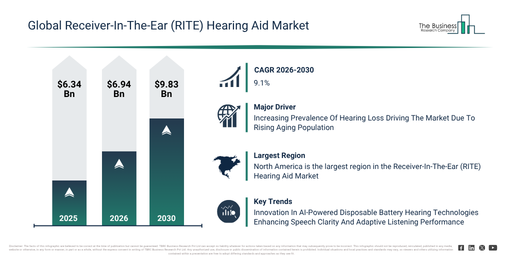
The market for receiver-in-the-ear (RITE) hearing aids has experienced substantial growth in recent times. This market is projected to expand from $6.34 billion in 2025 to reach $6.94 billion by 2026, exhibiting a compound annual growth rate (CAGR) of 9.5%. Historically, this expansion has been driven by factors such as the rising incidence of hearing impairment among older demographics, enhanced awareness of hearing health remedies, the increasing uptake of digital hearing aid technologies, a wider reach of audiology services, and a heightened desire for better speech clarity and sound amplification.
The receiver-in-the-ear (RITE) hearing aid market is poised for significant expansion in the coming years, projected to reach $9.83 billion by 2030, exhibiting a compound annual growth rate (CAGR) of 9.1%. This anticipated growth during the forecast period is driven by several factors, including an increasing demand for smart hearing aid devices, a rising preference for rechargeable hearing solutions, wider adoption of personalized hearing technologies, the expanding utilization of wireless connectivity features, and increased investments in sophisticated hearing care solutions. Key trends for the forecast period encompass a greater uptake of receiver-in-the-ear hearing aids featuring enhanced sound personalization, an elevated demand for hearing aid designs that are both compact and comfortable, the growing integration of advanced noise reduction and speech enhancement capabilities, the ongoing expansion in the development of rechargeable receiver-in-the-ear hearing aid solutions, and a heightened preference for discreet hearing devices offering superior user convenience.
Get A Free Sample Report With In-Depth Market Insights:
Receiver-In-The-Ear (RITE) Hearing Aid Market Growth Factors: What’s Supporting Expansion?
The expanding occurrence of hearing loss is anticipated to drive the future expansion of the receiver-in-the-ear (RITE) hearing aid market. Hearing loss denotes a medical condition characterized by an individual’s diminished capacity to perceive sounds, spanning from slight trouble with conversations to profound deafness. Its prevalence is increasing primarily due to the aging population, as the natural deterioration of inner ear structures over time renders older individuals more prone to hearing impairment. Receiver-in-the-ear (RITE) hearing aids assist those with hearing loss by providing clearer, more natural sound directly into the ear canal, thereby enhancing speech comprehension, lessening background noise disruption, and improving general communication and everyday listening experiences. For example, the World Health Organization (WHO), a Switzerland-based intergovernmental organization, stated in March 2026 that by 2050, approximately 2.5 billion people globally are expected to suffer from hearing loss, with over 700 million needing hearing rehabilitation, potentially resulting in an annual global economic cost of nearly $1 trillion if neglected. Consequently, the growing occurrence of hearing loss is fueling the expansion of the receiver-in-the-ear (RITE) hearing aid market. The increasing healthcare expenditure is anticipated to drive the future expansion of the receiver-in-the-ear (RITE) hearing aid market. Healthcare expenditure signifies the total financial outlay by individuals, organizations, and governments on medical services, health products, and initiatives focused on preserving or enhancing health. This spending is escalating because of the growing incidence of chronic diseases, which demand continuous medical treatments, regular healthcare appointments, and prolonged management, thus boosting overall healthcare costs. Elevated healthcare expenditure facilitates the growth of receiver-in-the-ear (RITE) hearing aids by allowing for increased investment in hearing care services and advanced audiology technologies, thereby enhancing device accessibility and improving patient results. For instance, the Office for National Statistics, a UK-based government agency, reported in April 2026 that healthcare expenditure constituted 11.4% of gross domestic product (GDP) in 2025, an increase from 11.1% in 2024. Thus, the increasing healthcare expenditure is propelling the expansion of the receiver-in-the-ear (RITE) hearing aid market.
Receiver-In-The-Ear (RITE) Hearing Aid Market Segment Trends And Revenue Contributors
The receiver-in-the-ear (rite) hearing aid market covered in this report is segmented –
1) By Product Type: Behind The Ear Hearing Aids, In The Ear Hearing Aids, In The Canal Hearing Aids, Completely In Canal Hearing Aids, Receiver In Canal Hearing Aids
2) By Technology: Analog Hearing Aids, Digital Hearing Aids, Smart Hearing Aids, Bluetooth Enabled Hearing Aids, Rechargeable Hearing Aids
3) By Price Range: Low End (Below 1,000 United States Dollars), Mid Range (1,000 United States Dollars To 3,000 United States Dollars), Premium (3,000 United States Dollars To 5,000 United States Dollars), Luxury (Above 5,000 United States Dollars)
4) By Distribution Channel: Retail Outlets, Online Sales Channels, Specialized Audiology Clinics, Hospitals And Medical Institutions, Direct To Consumer Brands
5) By End User: Adults, Children, Senior Citizens, Individuals With Hearing Impairment, Professionals In High Noise Environments
Subsegments:
1) By Behind The Ear Hearing Aids: Standard Behind The Ear Hearing Aids, Mini Behind The Ear Hearing Aids, Rechargeable Behind The Ear Hearing Aids, Bluetooth Enabled Behind The Ear Hearing Aids
2) By In The Ear Hearing Aids: Full Shell In The Ear Hearing Aids, Half Shell In The Ear Hearing Aids, Custom Molded In The Ear Hearing Aids, Digital In The Ear Hearing Aids
3) By In The Canal Hearing Aids: Custom Fit In The Canal Hearing Aids, Wireless In The Canal Hearing Aids, Rechargeable In The Canal Hearing Aids, Noise Reduction In The Canal Hearing Aids
4) By Completely In Canal Hearing Aids: Invisible Completely In Canal Hearing Aids, Custom Molded Completely In Canal Hearing Aids, Digital Completely In Canal Hearing Aids, High Gain Completely In Canal Hearing Aids
5) By Receiver In Canal Hearing Aids: Open Fit Receiver In Canal Hearing Aids, Rechargeable Receiver In Canal Hearing Aids, Bluetooth Enabled Receiver In Canal Hearing Aids, Advanced Noise Filtering Receiver In Canal Hearing Aids
Receiver-In-The-Ear (RITE) Hearing Aid Market Industry Trends: What’s Reshaping Demand?
Leading companies in the receiver-in-the-ear (RITE) hearing aid market are dedicating efforts to developing innovative products, such as AI-disposable battery hearing aids, aimed at improving speech clarity, adaptive sound processing, and listening comfort in complex acoustic environments. These AI-powered disposable battery hearing aids are advanced devices that combine artificial intelligence-based sound optimization technologies with traditional zinc-air battery systems. This integration allows for automatic adjustment to changing sound environments while retaining the convenience of replaceable batteries, which many users prefer over rechargeable alternatives. As an illustration, in April 2026, Oticon Inc., a Denmark-based hearing aid manufacturer, introduced the Verit family of premium hearing aids, which feature disposable zinc-air batteries. This product line incorporates the company’s BrainHearing technology platform, including MoreSound Intelligence 3.0, MoreSound Amplifier 3.0, and MoreSound Optimizer, to enhance speech understanding and sound clarity in noisy settings. Built on the Sirius platform, these hearing aids utilize second-generation AI sound processing to automatically adapt to dynamic listening conditions, simultaneously integrating stabilization technologies to reduce sudden noises and wind interference. Additionally, the devices reportedly suppress unwanted sounds by up to 12 dB and deliver improved speech clarity when compared to the company’s earlier premium hearing aid models.
Receiver-In-The-Ear (RITE) Hearing Aid Market Competitive Landscape: Which Companies Lead The Industry?
Major companies operating in the receiver-in-the-ear (rite) hearing aid market are Sonova Holding AG, Demant A/S, WS Audiology A/S, Starkey Laboratories Inc., Amplifon S.p.A., Rion Co. Ltd., Horentek, Audifon GmbH & Co. KG, Audina Hearing Instruments Inc., Arphi Electronics Private Limited, GN Store Nord A/S
View The Full Receiver-In-The-Ear (RITE) Hearing Aid Market Report:
Receiver-In-The-Ear (RITE) Hearing Aid Market Global Footprint: Which Region Leads The Market?
North America was the largest region in the receiver-in-the-ear (RITE) hearing aid market in 2025. Asia-Pacific is expected to be the fastest-growing region in the forecast period. The regions covered in the receiver-in-the-ear (RITE) hearing aid market report are Asia-Pacific, South East Asia, Western Europe, Eastern Europe, North America, South America, Middle East, Africa.
Reach Out To Our Team:
The Business Research Company: https://www.thebusinessresearchcompany.com/
Americas: +1 310-496-7795
Asia: +44 7882 955267 & +91 8897263534
Europe: +44 7882 955267
Email us at: marketing@tbrc.info
Follow us on:
LinkedIn: https://in.linkedin.com/company/the-business-research-company
YouTube: https://www.youtube.com/channel/UC24_fI0rV8cR5DxlCpgmyFQ
Global Market Model: https://www.thebusinessresearchcompany.com/global-market-model

Wasay has over a decade of experience in market research, data modelling, and analytics, with prior experience at GlobalData and Decision Tree Consulting Services. At The Business Research Company , he leads research operations across syndicated studies, customized consulting engagements, and the Global Market Model platform. His professional experience includes supporting organizations such as Boston Consulting Group, KPMG, and Ernst & Young. Wasay holds a degree in Electronics and Communications Engineering, postgraduate management qualifications from International Management Institute Belgium and Indian School of Business and Entrepreneurship, and completed the Integrated Program in Business Analytics from Indian Institute of Management Indore.