
Backed by market attractiveness analysis, total addressable market sizing, company benchmarking matrices, interactive Excel dashboards, wider supply chain intelligence, emerging startup coverage, and detailed product-level insights, The Business Research Company’s 2026 market reports are designed to offer research that is more actionable and strategically valuable than ever.
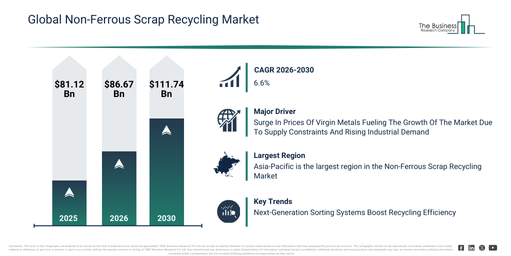
Non-Ferrous Scrap Recycling Market Revenue Growth On Track For A 6.6% CAGR Through 2030
The non-ferrous scrap recycling market has experienced significant growth in recent years. This market is anticipated to expand from $81.12 billion in 2025 to $86.67 billion by 2026, achieving a compound annual growth rate (CAGR) of 6.8%. Historically, this expansion has been driven by factors such as the rising demand for aluminum and copper within the construction and automotive industries, an increase in industrial scrap generation, the growing adoption of basic mechanical recycling methods, the expansion of electronics manufacturing boosting copper and nickel scrap, and a concerted effort to reduce the environmental impact of metal production.
The non-ferrous scrap recycling market size is projected to experience substantial expansion in the coming years. This market is anticipated to reach $111.74 billion by 2030, exhibiting a compound annual growth rate (CAGR) of 6.6%. Several factors are driving this anticipated growth, including heightened regulatory backing for circular economy efforts, increased demand for reprocessed metals in the automotive and electronics sectors, the broadening use of sophisticated hydrometallurgical and bioleaching techniques, escalating investments in facilities for scrap collection and processing, and the implementation of novel technologies for recovering high-purity metals. Key trends during this period are expected to encompass a greater uptake of aluminum and copper scrap recycling, an amplified emphasis on gathering post-consumer and industrial scrap, the advancement of pyrometallurgical and hydrometallurgical recycling methods, increasing capital allocation to bioleaching and proprietary recycling innovations, and the expanded application of reprocessed non-ferrous metals within the automotive and electronics industries.
Get A Free Sample Report With In-Depth Market Insights:
Non-Ferrous Scrap Recycling Market Growth Momentum: What Factors Are Shaping Demand?
The escalation in virgin metal prices is expected to drive the expansion of the non-ferrous scrap recycling market moving forward. Virgin metals are defined as newly extracted or primary metals, such as aluminum, copper, and tin, along with other non-ferrous materials, that have not undergone prior processing, refining, or recycling. The increase in virgin metal costs is attributed to supply constraints, stemming from trade restrictions, export prohibitions, and production disruptions in major producing countries, coupled with renewed demand for metals utilized in industrial and clean-energy applications. Increased adoption of non-ferrous scrap recycling addresses escalating metal prices by lessening reliance on virgin metal extraction, thereby securing a more stable and economical supply of raw materials and mitigating market volatility driven by resource scarcity. For example, in May 2024, the World Bank, a US-based intergovernmental organization, reported its metals and minerals price index saw a 9% month-on-month increase. Copper, tin, and aluminum prices are projected to rise by 5%, 4%, and 2% respectively, signaling sustained upward pressure on virgin metal expenses. Thus, the rising cost of virgin metals is a key factor propelling the growth of the non-ferrous scrap recycling market.
Non-Ferrous Scrap Recycling Market Segment Analysis And Revenue Potential
The non-ferrous scrap recycling market covered in this report is segmented –
1) By Material Type: Aluminum, Copper, Lead, Nickel, Zinc
2) By Source Of Scrap: Industrial Scrap, Post-Consumer Scrap, Construction And Demolition Scrap, Aerospace Scrap, Automotive Scrap, Electrical Scrap
3) By Recycling Process: Mechanical Recycling, Pyrometallurgical Recycling, Hydrometallurgical Recycling, Bioleaching, Other Proprietary Processes
4) By End-Use Industry: Automotive, Construction, Electronics And Electrical, Industrial Machinery, Other End-Use Industries
Subsegments:
1) By Aluminum: Cast Aluminum Scrap, Wrought Aluminum Scrap, Aluminum Foil Scrap, Aluminum Turnings And Borings, Used Beverage Cans (Ubc), Aluminum Dross And Skimmings
2) By Copper: Bare Bright Copper, Copper Turnings And Shavings, Insulated Copper Wire Scrap, Copper Radiators And Tubing
3) By Lead: Battery Scrap, Soft Lead Scrap, Wheel Weights, Cable Sheathing Lead Scrap, Lead Pipes And Sheets
4) By Nickel: Nickel Alloys Scrap, Stainless Steel Scrap, Nickel Catalyst Scrap, Nickel Plating Scrap, Nickel Battery Scrap
5) By Zinc: Zinc Die-Cast Scrap, Galvanized Steel Scrap, Zinc Sheet And Plate Scrap, Zinc Ash And Dross, Zinc Alloy Scrap
Non-Ferrous Scrap Recycling Market Trends Redefining Industry Growth
Major companies operating within the non-ferrous scrap recycling market are concentrating their efforts on innovating advanced sorting technology, such as AI-powered color sorting with object-level singulation, to attain ultra-high purity and recovery rates from mixed metal recycling streams. This AI-powered color sorting, featuring object-level singulation, employs artificial intelligence and precision RGB imaging to identify and separate individual metal fragments, even if they are overlapping or visually similar, by analyzing their color, shape, and size at the object level. As an instance, in September 2025, TOMRA Recycling, a Norway-based provider of sensor-based sorting solutions, introduced its FINDER COLOR system. This next-generation system combines an ultra-precise RGB camera with AI algorithms to deliver up to 20 TPH throughput and exceptional accuracy across diverse non-ferrous materials. Integrated with TOMRA’s X-TRACT and the cloud-based TOMRA Insight, FINDER COLOR significantly enhances data-driven efficiency, adaptability, and sustainability in color-based metal sorting.
Non-Ferrous Scrap Recycling Market Top Companies Driving Competitive Growth
Major companies operating in the non-ferrous scrap recycling market report are Glencore plc, Rio Tinto Group, Hindalco Industries Limited, Umicore SA/NV, Aurubis AG, Mitsubishi Materials Corporation, Boliden AB, Dowa Holdings Co. Ltd., Sims Limited, Chiho Environmental Group Limited, European Metal Recycling Limited (EMR), Remondis SE & Co. KG, Matalco Inc., Campine NV, Triple M Metal LP, ABR Recycling Kft., Harsco Corporation, Alter Trading Corporation, Toyota Tsusho America Inc., Commercial Metals Company, BL Duke Inc., GMH Gruppe GmbH & Co. KG, Trafigura Group Pte. Ltd., Steel Dynamics Inc.
View The Full Non-Ferrous Scrap Recycling Market Report:
Non-Ferrous Scrap Recycling Market Global Footprint: Which Region Leads The Industry?
Asia-Pacific was the largest region in the non-ferrous scrap recycling market in 2025. North America is expected to be the fastest-growing region in the forecast period. The regions covered in the non-ferrous scrap recycling market are Asia-Pacific, South East Asia, Western Europe, Eastern Europe, North America, South America, Middle East, Africa.
Reach Out To Our Team:
The Business Research Company: https://www.thebusinessresearchcompany.com/
Americas: +1 310-496-7795
Asia: +44 7882 955267 & +91 8897263534
Europe: +44 7882 955267
Email us at: marketing@tbrc.info
Follow us on:
LinkedIn: https://in.linkedin.com/company/the-business-research-company
YouTube: https://www.youtube.com/channel/UC24_fI0rV8cR5DxlCpgmyFQ
Global Market Model: https://www.thebusinessresearchcompany.com/global-market-model

Wasay has over a decade of experience in market research, data modelling, and analytics, with prior experience at GlobalData and Decision Tree Consulting Services. At The Business Research Company , he leads research operations across syndicated studies, customized consulting engagements, and the Global Market Model platform. His professional experience includes supporting organizations such as Boston Consulting Group, KPMG, and Ernst & Young. Wasay holds a degree in Electronics and Communications Engineering, postgraduate management qualifications from International Management Institute Belgium and Indian School of Business and Entrepreneurship, and completed the Integrated Program in Business Analytics from Indian Institute of Management Indore.