Built to provide research that’s more actionable and strategically valuable, The Business Research Company’s 2026 market reports include market attractiveness analysis, total addressable market sizing, company benchmarking matrices, interactive Excel dashboards, broader supply chain intelligence, emerging startup tracking, and in-depth product insights.
Rare Earth Metal Scintillator Market Value Analysis: What Growth Lies Ahead Over The Forecast Period?
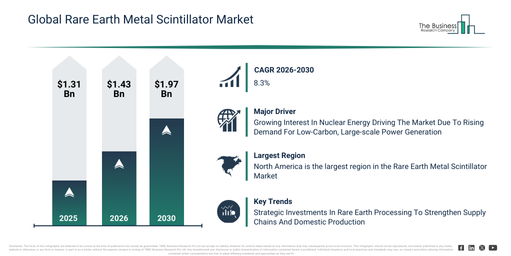
The rare earth metal scintillator market has experienced robust expansion over the past few years. Its size is projected to increase from $1.31 billion in 2025 to $1.43 billion by 2026, demonstrating a compound annual growth rate (CAGR) of 9.2%. Historically, this growth can be ascribed to several factors, including the increasing number of medical imaging equipment installations, the expansion of nuclear power generation capacity, heightened spending on defense and homeland security, innovations in radiation detection technologies, and the growing application of scintillators in scientific research.
The rare earth metal scintillator market is anticipated to experience substantial growth in the coming years, with its size projected to reach $1.97 billion by 2030, exhibiting a compound annual growth rate (CAGR) of 8.3%. This expansion during the forecast period can be ascribed to several factors, including the increasing demand for advanced diagnostic imaging systems, the growth observed in nuclear medicine and radiotherapy, rising investments in homeland security infrastructure, the development of next-generation scintillator materials, and the expansion of high energy physics experiments. Key trends influencing the forecast period encompass a rising demand for high-resolution medical imaging detectors, growing adoption in nuclear safety and radiation monitoring, an increasing utilization of rare earth scintillators in security screening systems, the expansion of scintillator applications in high energy physics research, and a heightened focus on materials offering high light yield and fast decay.
Get A Free Sample Report With In-Depth Market Insights:
Rare Earth Metal Scintillator Market Growth Backed By Core Demand Fundamentals
The increasing focus on nuclear energy is projected to stimulate the expansion of the rare earth metal scintillator market moving forward. Nuclear energy is defined as the power generated from nuclear fission or fusion reactions, typically harnessed in reactors for generating electricity or for propulsion. The rising appeal of nuclear energy is primarily due to its capability to provide large-scale, low-carbon electricity, thereby addressing increasing energy demands while minimizing greenhouse gas emissions. Rare earth metal scintillators are utilized in nuclear energy for detecting and monitoring radiation, upholding reactor safety, and measuring radioactive materials in power plants and waste management. For instance, in June 2025, the World Nuclear Association (WNA), a UK-based organization dedicated to promoting nuclear energy and supporting the global nuclear industry, projected that China’s nuclear power capacity would expand substantially, reaching 200 GWe by 2030 and 400–500 GWe by 2050. Thus, the escalating interest in nuclear energy is fueling the growth of the rare earth metal scintillator market.
Rare Earth Metal Scintillator Market Breakdown By Product Type And Application
The rare earth metal scintillator market covered in this report is segmented –
1) By Type: Sodium Iodide Scintillators, Cesium Iodide Scintillators, Gadolinium Oxysulphide Scintillators, Other Types
2) By Form Factor: Cylindrical, Crystalline, Polycrystalline, Other Form Factors
3) By Distribution Channel: Online Sales, Direct Sales, Distributors, Retail
4) By Application: Medical Imaging, Nuclear Power Plants, Homeland Security, High Energy Physics, Other Applications
5) By End-Use Industry: Healthcare, Defense And Security, Energy, Electronics, Other End-Use Industries
Subsegments:
1) By Sodium Iodide Scintillators: Thallium-Doped Sodium Iodide (NaI(Tl)), Pure Sodium Iodide (NaI)
2) By Cesium Iodide Scintillators: Thallium-Doped Cesium Iodide (CsI(Tl)), Sodium-Doped Cesium Iodide (CsI(Na)), Pure Cesium Iodide (CsI)
3) By Gadolinium Oxysulphide Scintillators: Terbium-Doped Gadolinium Oxysulphide (Gd2O2S:Tb), Praseodymium-Doped Gadolinium Oxysulphide (Gd2O2S:Pr)
4) By Plastic Scintillators: Polyvinyltoluene (PVT)-Based Scintillators, Polystyrene (PS)-Based Scintillators
5) By Other Types: Lutetium Oxyorthosilicate (Lu2SiO5, LSO), Bismuth Germanate (Bi4Ge3O12, BGO), Yttrium Aluminum Garnet (Y3Al5O12, YAG), Cerium-Doped Lanthanum Bromide (LaBr3:Ce)
Rare Earth Metal Scintillator Market Growth Trends Reshaping The Competitive Landscape
Major companies operating in the rare earth metal scintillator market are focusing on strategic investments, such as allocating resources to the processing of rare earth elements, in order to strengthen their supply chains, boost production efficiency, and address the growing demand from the healthcare, defense, and industrial sectors. Investing in rare earth element processing involves providing funding and advancing both technologies and facilities that extract, refine, and purify these crucial metals for integration into products like scintillators, magnets, and advanced electronic components. For instance, in March 2024, Prairies Economic Development Canada (PrairiesCan), a Canada-based federal agency, announced a substantial federal investment of over $16 million dedicated to expanding Saskatchewan’s capabilities in rare earth element processing at the Saskatchewan Research Council’s (SRC) Rare Earth Processing Facility in Saskatoon, which is the first such facility in Canada. This funding will enable SRC to acquire bastnaesite ore from Canadian sources and develop domestic processing capacity, allowing the facility to produce and refine rare earth metals vital for technologies such as electric vehicles and wind turbines.
Rare Earth Metal Scintillator Market Key Players Shaping Industry Direction
Major companies operating in the rare earth metal scintillator market report are Saint-Gobain S.A., Mitsubishi Chemical Corporation, Toshiba Corporation, Niterra Materials Corporation, Bruker Corporation, Hamamatsu Photonics K.K., Nihon Kessho Kogaku Co. Ltd., Hitachi Metals Ltd., Dynasil Corporation of America, InnoCare Optoelectronics Corporation, Inrad Optics Inc., Rexon Components Inc., Crytur s.r.o., Scintacor Ltd., Electron Tubes Limited, Crystal Photonics Inc., Amcrys-H Inc., Alpha Spectra Inc., Shanghai SICCAS High Technology Co. Ltd., Applied Scintillation Technologies LLC
View The Full Rare Earth Metal Scintillator Market Report:
Rare Earth Metal Scintillator Market Regional Analysis: Which Region Leads By Revenue?
North America was the largest region in the personalized genomics market in 2025. Asia-Pacific is expected to be the fastest-growing region in the forecast period. The regions covered in the rare earth metal scintillator market are Asia-Pacific, South East Asia, Western Europe, Eastern Europe, North America, South America, Middle East, Africa.
Reach Out To Our Team:
The Business Research Company: https://www.thebusinessresearchcompany.com/
Americas: +1 310-496-7795
Asia: +44 7882 955267 & +91 8897263534
Europe: +44 7882 955267
Email us at: marketing@tbrc.info
Follow us on:
LinkedIn: https://in.linkedin.com/company/the-business-research-company
YouTube: https://www.youtube.com/channel/UC24_fI0rV8cR5DxlCpgmyFQ
Global Market Model: https://www.thebusinessresearchcompany.com/global-market-model

Wasay has over a decade of experience in market research, data modelling, and analytics, with prior experience at GlobalData and Decision Tree Consulting Services. At The Business Research Company , he leads research operations across syndicated studies, customized consulting engagements, and the Global Market Model platform. His professional experience includes supporting organizations such as Boston Consulting Group, KPMG, and Ernst & Young. Wasay holds a degree in Electronics and Communications Engineering, postgraduate management qualifications from International Management Institute Belgium and Indian School of Business and Entrepreneurship, and completed the Integrated Program in Business Analytics from Indian Institute of Management Indore.