Enhanced with market attractiveness analysis, total addressable market evaluation, company benchmarking matrices, interactive Excel dashboards, expanded supply chain intelligence, emerging startup coverage, and detailed product insights, The Business Research Company’s 2026 market reports deliver more actionable and strategically valuable research.
Turboshaft Engine Market Expansion Outlook: What Revenue Opportunities Lie Ahead?
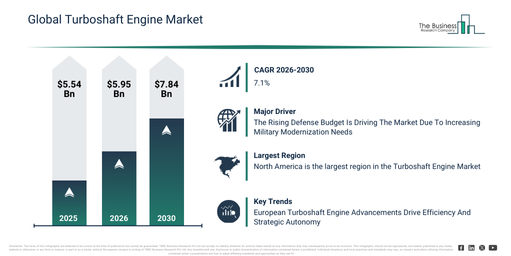
The turboshaft engine market is projected to experience robust expansion over the coming years, reaching a valuation of $7.84 billion by 2030, demonstrating a compound annual growth rate (CAGR) of 7.1%. This anticipated growth can be linked to several factors, including an increased need for urban air mobility and electric vertical take-off and landing (eVTOL) systems, the scaling up of defense rotorcraft initiatives, advancements in hybrid turboshaft engine technology, more stringent emission standards prompting engine enhancements, and wider adoption in maritime propulsion setups. Key trends during this period are expected to encompass an escalating requirement for turboshaft engines within growing civil and parapublic helicopter fleets, a greater uptake of modular and adaptable turboshaft engine architectures, an intensifying emphasis on longer time-between-overhaul (TBO) intervals and overall lifecycle cost efficiency, the broadened application of turboshafts in marine propulsion and industrial mechanical drive sectors, and a surge in consolidation and strategic alliances among engine original equipment manufacturers (OEMs) and airframe producers.
The anticipated expansion of the turboshaft engine market is significantly influenced by the increasing defense budget. Defense budgets represent the financial resources a nation’s government allocates for the planning, development, acquisition, maintenance, and operational readiness of its armed forces and associated infrastructure. The main impetus behind these growing budgets is the escalating intricacy of national security challenges, prompting governments to invest substantially in advanced technologies, training, and capabilities to ensure strategic deterrence and a strong defense stance. Turboshaft engines enhance the performance, efficiency, and reliability of military helicopters and other rotary-wing aircraft, aligning with the goals of modernized and well-funded defense initiatives. For example, as reported by the International Institute for Strategic Studies (IISS), a UK-based non-governmental think tank, in February 2025, global defense spending escalated from USD 2.24 trillion in 2023 to USD 2.46 trillion in 2024. This reflected a real-term growth acceleration to 7.4 percent in 2024, up from 6.5 percent in 2023 and 3.5 percent in 2022, leading to an average allocation of 1.9 percent of gross domestic product in 2024, an increase from 1.6 percent in 2022 and 1.8 percent in 2023. Consequently, the expanding defense budget is a key driver for the growth of the turboshaft engine market.
Download A Free Sample Report For Comprehensive Market Insights:
Turboshaft Engine Market Growth Momentum: Which Factors Are Influencing Demand?
Leading companies in the turboshaft engine market are increasingly focusing on strategic collaborations to develop sophisticated free power turbines and high-efficiency engine components. Their objectives include boosting performance, reducing fuel consumption, and meeting the rigorous reliability and safety standards required for modern military and civil helicopters. A free power turbine (FPT) is a distinct turbine within a turboshaft engine, operating independently of the engine’s gas generator, which extracts energy from exhaust gases to power an output shaft, such as a helicopter rotor, without direct mechanical linkage to the compressor or the turbine that produces the engine’s gas flow. For instance, in June 2025, Avio Aero, an Italy-based company specializing in aviation propulsion systems, partnered with Safran Helicopter Engines, a France-based manufacturer of helicopter engines, and MTU Aero Engines, a Germany-based manufacturer of commercial and military aircraft engines, to create next-generation military helicopter engines. This alliance is projected to yield advanced turboshaft engines that offer elevated power-to-weight ratios, improved fuel efficiency, resilient free power turbines, modular designs, and digital monitoring systems, thereby enabling simpler maintenance and enhanced helicopter performance while supporting European strategic autonomy.
Turboshaft Engine Market Segment Landscape: Which Areas Lead Market Development?
The turboshaft engine market covered in this report is segmented –
1) By Engine Type: Single-Spool Turboshaft Engines, Multi-Spool Turboshaft Engines, Turbocharged Turboshaft Engines
2) By Fuel Type: Aviation Turbine Fuel (ATF), Biofuels, Diesel, Jet Fuel
3) By Power Rating: Below 500 HP, 500–2000 HP, Above 2000 HP
4) By Application: Aerospace, Defense, Commercial Aviation, Industrial, Marine
5) By End-User: Commercial Operators, Military Or Government, Original Equipment Manufacturers (OEMs), Maintenance Repair And Overhaul (MRO) Providers
Subsegments:
1) By Single-Spool Turboshaft Engines: Light Duty Engines, Medium Duty Engines, Heavy Duty Engines
2) By Multi-Spool Turboshaft Engines: Twin Spool Engines, Triple Spool Engines, Variable Spool Engines
3) By Turbocharged Turboshaft Engines: Low Pressure Turbocharged Engines, Medium Pressure Turbocharged Engines, High Pressure Turbocharged Engines
Turboshaft Engine Market Industry Trends Shaping Future Revenue Growth
Leading companies in the turboshaft engine market are increasingly focusing on strategic collaborations to develop sophisticated free power turbines and high-efficiency engine components. Their objectives include boosting performance, reducing fuel consumption, and meeting the rigorous reliability and safety standards required for modern military and civil helicopters. A free power turbine (FPT) is a distinct turbine within a turboshaft engine, operating independently of the engine’s gas generator, which extracts energy from exhaust gases to power an output shaft, such as a helicopter rotor, without direct mechanical linkage to the compressor or the turbine that produces the engine’s gas flow. For instance, in June 2025, Avio Aero, an Italy-based company specializing in aviation propulsion systems, partnered with Safran Helicopter Engines, a France-based manufacturer of helicopter engines, and MTU Aero Engines, a Germany-based manufacturer of commercial and military aircraft engines, to create next-generation military helicopter engines. This alliance is projected to yield advanced turboshaft engines that offer elevated power-to-weight ratios, improved fuel efficiency, resilient free power turbines, modular designs, and digital monitoring systems, thereby enabling simpler maintenance and enhanced helicopter performance while supporting European strategic autonomy.
Turboshaft Engine Market Key Companies And Competitive Benchmarking
Major companies operating in the turboshaft engine market are Honeywell Aerospace Inc., GE Aerospace, Pratt & Whitney, Rolls-Royce Plc, Aero Engine Corporation of China, Kawasaki Heavy Industries (KHI), IHI Corporation, AVIC Engine Corporation, MTU Aero Engines AG, Safran Group, ITP Aero S.A. (Bain Capital), Harbin Engine Group Co. Ltd., PBS GROUP, TUSAS Engine Industries Inc., Avio Aero S.p.A., Jakadofsky GmbH, Klimov JSC, Konner S.r.l., Motor Sich JSC, Astro Mechanica
Access The Complete Turboshaft Engine Market Report:
Turboshaft Engine Market Leading Geography: Which Region Generates The Most Revenue?
North America was the largest region in the turboshaft engine market in 2025. Asia-Pacific is expected to be the fastest-growing region in the forecast period. The regions covered in the turboshaft engine market report are Asia-Pacific, South East Asia, Western Europe, Eastern Europe, North America, South America, Middle East, Africa.
Access a Customized Turboshaft Engine Market Report for Deeper Competitive Insights
https://www.thebusinessresearchcompany.com/customise?id=28857&type=smp
The Business Research Company: https://www.thebusinessresearchcompany.com/
Americas: +1 310-496-7795
Asia: +44 7882 955267 & +91 8897263534
Europe: +44 7882 955267
Email us at: marketing@tbrc.info
Follow us on:
LinkedIn: https://in.linkedin.com/company/the-business-research-company
YouTube: https://www.youtube.com/channel/UC24_fI0rV8cR5DxlCpgmyFQ
Global Market Model: https://www.thebusinessresearchcompany.com/global-market-model

Wasay has over a decade of experience in market research, data modelling, and analytics, with prior experience at GlobalData and Decision Tree Consulting Services. At The Business Research Company , he leads research operations across syndicated studies, customized consulting engagements, and the Global Market Model platform. His professional experience includes supporting organizations such as Boston Consulting Group, KPMG, and Ernst & Young. Wasay holds a degree in Electronics and Communications Engineering, postgraduate management qualifications from International Management Institute Belgium and Indian School of Business and Entrepreneurship, and completed the Integrated Program in Business Analytics from Indian Institute of Management Indore.