
Delivering more actionable and strategically valuable research, The Business Research Company’s 2026 market reports feature market attractiveness analysis, total addressable market evaluation, company benchmarking matrices, interactive Excel dashboards, expanded supply chain intelligence, emerging startup coverage, and detailed product insights.
Zero-Emission Aircraft Market Expansion From $32.28 Billion In 2026 To $56.05 Billion In 2030
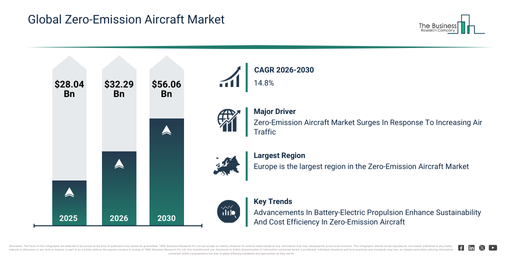
The zero-emission aircraft market is poised for significant expansion in the coming years. By 2030, this market is projected to reach $56.06 billion, demonstrating a compound annual growth rate (CAGR) of 14.8%. This anticipated growth is driven by several factors, including the increasing integration of hydrogen and battery-electric propulsion in regional and short-haul planes, heightened regulatory demands on airlines and manufacturers concerning emission targets, the expanding infrastructure for green hydrogen and charging to facilitate zero-emission flight, the creation of large commercial zero-emission aircraft to supersede traditional fleets, and an increase in collaborations between aerospace firms and energy companies to expedite the deployment of zero-emission aircraft. Key trends anticipated during this period encompass enhancements in hydrogen fuel storage technologies, the continuous development of lighter aircraft materials, the incorporation of advanced solar energy systems, increased research and development efforts in long-haul zero-emission aviation, and growing partnerships focused on hybrid propulsion innovations.
The increasing volume of air traffic is anticipated to stimulate the expansion of the zero-emission aircraft market moving forward. Air traffic generally refers to the movement of aircraft within designated airspace and at airports, covering various flight types such as commercial, cargo, and private aviation. The escalation in air traffic can be linked to several key drivers, including economic prosperity, globalization, and a rise in tourism. Zero-emission aircraft provide an environmentally friendlier option compared to traditional planes, addressing environmental concerns and making air travel more acceptable to both climate-conscious travelers and regulatory bodies. For instance, in August 2025, the International Air Transport Association (IATA) indicated that global passenger air traffic reached 9.8 billion passengers in 2025, marking a 3.7% increase from 2024 figures, with robust demand continuing across all major regions. Consequently, the rising air traffic is a significant factor driving the growth of the zero-emission aircraft market in the future.
Download A Free Sample Report For Comprehensive Market Insights:
Zero-Emission Aircraft Market Opportunity Drivers: What Is Creating New Revenue Potential?
Leading companies in the zero-emission aircraft market are concentrating on creating sophisticated solutions, such as battery-electric propulsion systems, with the goals of reducing carbon emissions, lowering operational expenses, and enhancing regional air mobility. Battery-electric propulsion describes an aircraft power system that utilizes onboard batteries to energize electric motors, thereby eliminating the requirement for conventional jet fuel and markedly diminishing environmental impact. For example, in May 2023, Aura Aero, a France-based aircraft manufacturer, presented its reconfigured 19-passenger hybrid-electric regional airliner project, the ERA. The updated setup now includes eight electric motors, an increase from the previous six, and features a modified tail design specifically optimized for regional operations. Poised to deliver greater efficiency and decreased operational costs, this aircraft is anticipated to halve current operating expenses compared to traditional fuel-powered aircraft, thereby strengthening technological evolution in the zero-emission aircraft market.
Zero-Emission Aircraft Market Segment Outlook: Which Categories Are Expanding The Fastest?
The zero-emission aircraft market covered in this report is segmented –
1) By Type: Turboprop Rear Bulkhead, Turbofan System, Blended Wing Body
2) By Source: Hydrogen, Electric, Solar
3) By Range: Short-Haul, Medium-Haul, Long-Haul
4) By Technology: Electric Motor Technology, Fuel Cell Technology, Hydrogen Fuel Storage, Power Management And Distribution Technology, Other Technology
5) By Application: Passenger Aircraft, Cargo Aircraft
Subsegments:
1) By Turboprop Rear Bulkhead: Structural Components, Engine Integration Systems, Aerodynamic Features
2) By Turbofan System: Engine Components, Fuel Efficiency Mechanisms, Noise Reduction Technologies
3) By Blended Wing Body: Aerodynamic Design Features, Structural Materials, Engine Placement Systems
Zero-Emission Aircraft Market Industry Trends: What Changes Are Reshaping Demand?
Leading companies in the zero-emission aircraft market are concentrating on creating sophisticated solutions, such as battery-electric propulsion systems, with the goals of reducing carbon emissions, lowering operational expenses, and enhancing regional air mobility. Battery-electric propulsion describes an aircraft power system that utilizes onboard batteries to energize electric motors, thereby eliminating the requirement for conventional jet fuel and markedly diminishing environmental impact. For example, in May 2023, Aura Aero, a France-based aircraft manufacturer, presented its reconfigured 19-passenger hybrid-electric regional airliner project, the ERA. The updated setup now includes eight electric motors, an increase from the previous six, and features a modified tail design specifically optimized for regional operations. Poised to deliver greater efficiency and decreased operational costs, this aircraft is anticipated to halve current operating expenses compared to traditional fuel-powered aircraft, thereby strengthening technological evolution in the zero-emission aircraft market.
Zero-Emission Aircraft Market Key Companies And Competitive Benchmarking
Major companies operating in the zero-emission aircraft market are AeroDelft, Airbus SE, Bye Aerospace, Eviation Aircraft, Joby Aviation, Lilium GmbH, Wright Electric, Boeing Company, Northrop Grumman Corporation, ZeroAvia Inc., MagniX, Zunum Aero, SkyDrive Inc., Pipistrel d.o.o., HyPoint Inc., Wisk Aero, XTI Aircraft Company, Rolls-Royce plc, Ampaire Inc., Alaka’i Technologies, Volocopter GmbH, Vertical Aerospace, H55, Heart Aerospace, Scaled Composites, Embraer SA, Faradair Aerospace Limited, Beta Technologies
Access The Complete Zero-Emission Aircraft Market Report:
Zero-Emission Aircraft Market Largest Region By Revenue And Market Share
Europe was the largest region in the zero-emission aircraft market in 2025. The regions covered in the zero-emission aircraft market report are Asia-Pacific, South East Asia, Western Europe, Eastern Europe, North America, South America, Middle East, Africa.
Access a Customized Zero-Emission Aircraft Market Report for Deeper Competitive Insights
https://www.thebusinessresearchcompany.com/customise?id=10329&type=smp
The Business Research Company: https://www.thebusinessresearchcompany.com/
Americas: +1 310-496-7795
Asia: +44 7882 955267 & +91 8897263534
Europe: +44 7882 955267
Email us at: marketing@tbrc.info
Follow us on:
LinkedIn: https://in.linkedin.com/company/the-business-research-company
YouTube: https://www.youtube.com/channel/UC24_fI0rV8cR5DxlCpgmyFQ
Global Market Model: https://www.thebusinessresearchcompany.com/global-market-model

Wasay has over a decade of experience in market research, data modelling, and analytics, with prior experience at GlobalData and Decision Tree Consulting Services. At The Business Research Company , he leads research operations across syndicated studies, customized consulting engagements, and the Global Market Model platform. His professional experience includes supporting organizations such as Boston Consulting Group, KPMG, and Ernst & Young. Wasay holds a degree in Electronics and Communications Engineering, postgraduate management qualifications from International Management Institute Belgium and Indian School of Business and Entrepreneurship, and completed the Integrated Program in Business Analytics from Indian Institute of Management Indore.
