
Enhanced with market attractiveness analysis, total addressable market evaluation, company benchmarking matrices, interactive Excel dashboards, expanded supply chain intelligence, emerging startup coverage, and detailed product insights, The Business Research Company’s 2026 market reports deliver more actionable and strategically valuable research.
Liquefied Natural Gas (LNG) Tank Insulation System Market Value Expansion And Long-Term Growth Outlook
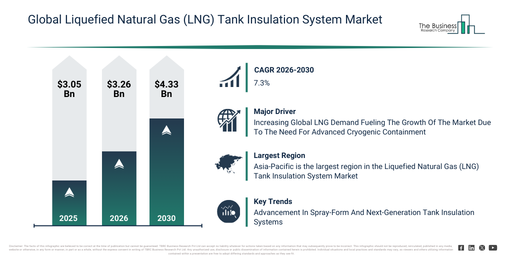
The market for liquefied natural gas (lng) tank insulation systems has experienced robust growth in recent years. This market is projected to expand from $3.05 billion in 2025 to $3.26 billion in 2026, demonstrating a compound annual growth rate (CAGR) of 7.1%. The historical expansion can be attributed to factors such as the growth of global lng trade, an increase in lng storage capacity, heightened construction of lng carriers, the escalating demand for energy security, and advancements in cryogenic engineering.
The liquefied natural gas (LNG) tank insulation system market size is anticipated to undergo significant expansion in the next few years. It is projected to climb to $4.33 billion by 2030, exhibiting a compound annual growth rate (CAGR) of 7.3%. This expansion during the forecast period is largely driven by increased investments in LNG terminals, the proliferation of floating storage and regasification units, a growing demand for low-emission energy transport, the rising adoption of advanced insulation composites, and a stronger focus on operational efficiency. Prominent trends throughout the forecast period include the increasing deployment of advanced cryogenic insulation materials, a greater utilization of multi-layer insulation systems, an enhanced focus on boil-off gas reduction solutions, the expansion of LNG infrastructure projects, and a heightened emphasis on long-term thermal efficiency.
Download A Free Sample Report For Comprehensive Market Insights:
Liquefied Natural Gas (LNG) Tank Insulation System Market Growth Momentum: Which Factors Are Influencing Demand?
The future expansion of the liquefied natural gas (LNG) tank insulation system market is anticipated to be fueled by the rising worldwide requirement for liquefied natural gas. LNG refers to natural gas chilled to around −162 degrees Celsius, transforming it into a liquid state, which substantially cuts down its volume, facilitating effective storage and long-haul transit. This surge in LNG demand stems from increasing worldwide energy consumption and the ongoing shift to cleaner energy sources over traditional coal and oil. The liquefied natural gas tank insulation system plays a crucial role in meeting the demand for LNG by offering vital cryogenic containment and sophisticated thermal insulation, which guarantee the secure storage, reduced boil-off, and safe transit of growing LNG quantities globally. A notable example is data from August 2024, where the International Institute of Refrigeration, an intergovernmental body located in France, reported that global LNG trade expanded by 2.1% from 2022 to 2023, reaching approximately 401.42 million tonnes (MT). Consequently, this heightened global need for liquefied natural gas directly drives the expansion of the liquefied natural gas (LNG) tank insulation system market.
Liquefied Natural Gas (LNG) Tank Insulation System Market Segments: Where Are The Largest Growth Opportunities?
The liquefied natural gas (lng) tank insulation system market covered in this report is segmented –
1) By Type: Spray Insulation; Panel Insulation; Blanket Insulation; Other Types
2) By Material: Polyurethane; Polyisocyanurate; Glass Wool; Perlite; Other Materials
3) By Application: Onshore Tanks; Offshore Tanks; Transport Tanks
4) By End-User: Oil And Gas; Marine; Industrial; Other End-User
Subsegments:
1) By Spray Insulation: Polyurethane Foam Spray; Polyisocyanurate Foam Spray; Cryogenic Spray Applied Insulation; Multi Layer Spray Coating
2) By Panel Insulation: Rigid Polyurethane Panels; Vacuum Insulated Panels; Glass Fiber Reinforced Panels; Composite Cryogenic Panels
3) By Blanket Insulation: Glass Wool Insulation Blankets; Mineral Wool Insulation Blankets; Perlite Based Insulation Blankets; Multi Layer Insulation Blankets
4) By Other Types: Expanded Perlite Insulation; Foam Glass Insulation; Aerogel Based Insulation; Composite Insulation Systems
Liquefied Natural Gas (LNG) Tank Insulation System Market Trends Reshaping Industry Growth
Leading companies active in the liquefied natural gas (LNG) tank insulation system market are concentrating on the development of high-performance insulation systems, such as spray foam and advanced cryogenic insulation systems. This focus aims to boost thermal efficiency, improve structural adaptability, and ensure the secure storage of ultra-low-temperature fuels in marine applications. Spray-form and advanced cryogenic insulation systems are defined as engineered insulation technologies applied directly to tank structures to reduce heat entry, minimize boil-off gas, enhance mechanical stability, and guarantee the safe containment of cryogenic fuels like liquefied natural gas (LNG) and ammonia at extremely low temperatures. For example, in December 2025, Nihon Shipyard Co., Ltd., a shipbuilding company from Japan, in collaboration with Hankuk Carbon Co., Ltd., a South Korea-based advanced materials manufacturer, introduced a spray-form tank insulation system for liquefied natural gas (LNG) and ammonia-fueled vessels, which received Approval in Principle (AiP) from ClassNK. This insulation system offers efficient thermal protection for cryogenic fuel tanks by minimizing heat ingress and boil-off gas. It supports the safe storage of liquefied natural gas (LNG) and ammonia under ultra-low-temperature conditions, while also enhancing design flexibility and structural integration for next-generation alternative-fuel vessels.
Liquefied Natural Gas (LNG) Tank Insulation System Market Major Participants And Competitive Dynamics
Major companies operating in the liquefied natural gas (lng) tank insulation system market are Compagnie de Saint-Gobain S.A., Mitsubishi Heavy Industries Ltd., Kawasaki Heavy Industries Ltd., Owens Corning, IHI Corporation, Kingspan Group plc, Chart Industries Inc., ROCKWOOL International A/S, NICHIAS Corporation, Armacell International S.A., Hankuk Carbon Co. Ltd., Gaztransport & Technigaz S.A., Aspen Aerogels Inc., INOX India Limited (INOXCVA), G+H Schallschutz GmbH (G+H Insulation India), Röchling SE & Co. KG, CIMC Enric Holdings Limited, Cryogas Equipment Private Limited, HDI Private Limited, and Qingdao Pingcheng LNG Equipment Co. Ltd.
Access The Complete Liquefied Natural Gas (LNG) Tank Insulation System Market Report:
Liquefied Natural Gas (LNG) Tank Insulation System Market Regional Analysis: Which Region Leads By Revenue?
Asia-Pacific was the largest region in the LNG tank insulation system market in 2025 and is expected to be the fastest-growing region in the forecast period. The regions covered in the liquefied natural gas (lng) tank insulation system market report are Asia-Pacific, South East Asia, Western Europe, Eastern Europe, North America, South America, Middle East, Africa.
Get in touch with us:
The Business Research Company: https://www.thebusinessresearchcompany.com/
Americas: +1 310-496-7795
Asia: +44 7882 955267 & +91 8897263534
Europe: +44 7882 955267
Email us at: marketing@tbrc.info
Follow us on:
LinkedIn: https://in.linkedin.com/company/the-business-research-company
YouTube: https://www.youtube.com/channel/UC24_fI0rV8cR5DxlCpgmyFQ
Global Market Model: https://www.thebusinessresearchcompany.com/global-market-model

Wasay has over a decade of experience in market research, data modelling, and analytics, with prior experience at GlobalData and Decision Tree Consulting Services. At The Business Research Company , he leads research operations across syndicated studies, customized consulting engagements, and the Global Market Model platform. His professional experience includes supporting organizations such as Boston Consulting Group, KPMG, and Ernst & Young. Wasay holds a degree in Electronics and Communications Engineering, postgraduate management qualifications from International Management Institute Belgium and Indian School of Business and Entrepreneurship, and completed the Integrated Program in Business Analytics from Indian Institute of Management Indore.