Built to provide research that’s more actionable and strategically valuable, The Business Research Company’s 2026 market reports include market attractiveness analysis, total addressable market sizing, company benchmarking matrices, interactive Excel dashboards, broader supply chain intelligence, emerging startup tracking, and in-depth product insights.
Disposable Incontinence Products Market Size And Revenue Outlook Through 2030
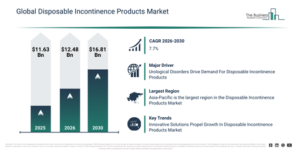
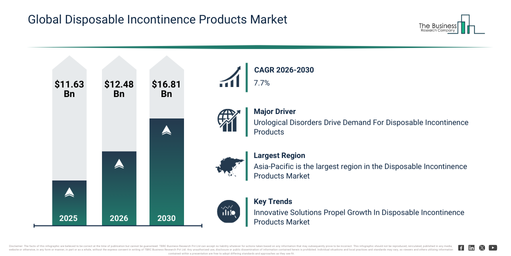
The disposable incontinence products market has demonstrated significant expansion in recent years. This market is expected to expand from $11.63 billion in 2025 to $12.48 billion in 2026, achieving a compound annual growth rate (CAGR) of 7.3%. Key drivers for this historical growth include global demographic shifts towards an older population, a greater incidence of urinary incontinence diagnoses, the proliferation of long-term care facilities, enhancements in absorbent material technologies, and the increasing acceptance of disposable incontinence products.
The market size for disposable incontinence products is projected to experience robust expansion in the coming years. It is expected to reach $16.81 billion by 2030, growing at a compound annual growth rate (CAGR) of 7.7%. This anticipated growth can be attributed to factors such as the increasing demand for home-based elderly care, a rising focus on sustainable disposable materials, the expansion of healthcare infrastructure in emerging markets, ongoing advancements in super absorbent polymers, and a greater emphasis on patient comfort and dignity. Key trends during the forecast period include a heightened demand for high-absorbency disposable products, the growing utilization of skin-friendly and breathable materials, an increased focus on comfort and discretion, the expansion of adult incontinence care solutions, and an enhanced commitment to product hygiene and safety.
Get A Free Sample Report With In-Depth Market Insights:
Disposable Incontinence Products Market Demand Drivers Opening New Revenue Streams
The increasing prevalence of urological disorders is projected to drive the expansion of the disposable incontinence products market in the coming years. Urologic disorders refer to conditions such as urinary tract infections, kidney stones, bladder control issues, and prostate problems. Adult incontinence products are designed to keep individuals dry and comfortable, allowing them to fully enjoy life’s everyday pleasures. The rising occurrence of urological disorders is anticipated to place a heavier demand on healthcare systems and underscore the necessity for effective prevention and treatment strategies. For instance, in October 2023, data from the National Health Service (NHS) England, a UK-based government department, revealed that in 2022/23, hospitals recorded 147, 285 admissions with a primary diagnosis of urinary tract infection (UTI). Individuals aged over 65 accounted for 56% of these cases, totaling 82, 392 admissions. The highest number of admissions occurred in the 80-84 age group, with 17, 280 cases. Therefore, the growing number of urological disorders is propelling the growth of the disposable incontinence products market going forward.
Disposable Incontinence Products Market Segmentation: How Does The Market Break Down By Category?
The disposable incontinence products market covered in this report is segmented –
1) By Product Type: Adult Diapers (Briefs), Disposable Protective Underwear (Pull-Ups), Incontinence Pads And Liners, Underpads
2) By Absorbency Level: Light Absorbency, Moderate Absorbency, Heavy Absorbency
3) By Incontinence Type: Stress Urinary Incontinence, Urge Urinary Incontinence, Overflow Incontinence, Functional Incontinence, Fecal Incontinence, Dual Incontinence
4) By Material Type: Super Absorbent Polymers (SAP), Nonwoven Fabrics, Fluff Pulp, Plastic Back Sheets, Bio-based And Sustainable Materials, Other Materials
5) By End User: Homecare And Individual Consumers, Hospitals, Nursing Homes, Long-Term Care Facilities, Other Healthcare Facilities
Subsegments:
1) By Adult Diapers (Briefs): Tape-Style Adult Diapers, All-in-One Briefs, Bariatric Adult Diapers, High-Absorbency And Overnight Diapers
2) By Disposable Protective Underwear (Pull-Ups): Standard Pull-Up Underwear, Premium And High-Absorbency Pull-Ups, Gender-Specific Pull-Ups (Men And Women), Discreet And Slim-Fit Pull-Ups
3) By Incontinence Pads And Liners: Light Incontinence Liners, Moderate Absorbency Pads, Heavy Absorbency Pads, Male Guards, Shaped And Contoured Pads
4) By Underpads: Disposable Bed Underpads, Chair And Wheelchair Underpads, Ultra-Absorbent Underpads, Breathable And Leak-Proof Underpads
Disposable Incontinence Products Market Trends Powering Strategic Industry Growth
Leading companies in the disposable incontinence products market are concentrating on developing innovative solutions, such as ultra-thin absorbent underpants, to bolster their market presence and deliver discreet, comfortable, and effective incontinence care. These extra-thin disposable underpants offer high absorbency in a slim, subtle design that fits under clothing without appearing bulky, while also featuring soft, cotton-like textures and antibacterial properties for enhanced comfort and hygiene. For instance, in May 2023, Nobel Hygiene Pvt Ltd, an India-based hygiene products company, launched UltraThinz, an extra-thin absorbent disposable underpant aimed at younger individuals experiencing light incontinence due to conditions like obesity, postpartum recovery, or menopause-related issues. UltraThinz is offered in two variants: a peach-colored version for women and a grey-colored version for men, addressing gender-specific needs. Its key attributes include a sleek, discreet design, high-quality absorption, a comfortable texture, and antibacterial properties; applications cover light incontinence management for adults prioritizing discretion and comfort; and benefits involve improved confidence, comfort, and hygiene without the bulk of conventional products.
Disposable Incontinence Products Market Industry Leaders And Competitive Landscape
Major companies operating in the disposable incontinence products market are Kimberly Clark Corporation, Essity AB, Unicharm Corporation, Kao Corporation, Ontex Group, First Quality Enterprises, Paul Hartmann AG, Abena Group, Drylock Technologies, Attindas Hygiene Partners, TZMO SA, Hengan International Group, Daio Paper Corporation, Chiaus Holdings, Nobel Hygiene, Principle Business Enterprises, Medline Industries, Edgewell Personal Care, Pigeon Corporation, Nitto Industries, DSG International
View The Full Disposable Incontinence Products Market Report:
Disposable Incontinence Products Market Regional Analysis And Leading Geography
Asia-Pacific was the largest region in the disposable incontinence products market in 2025. Asia-Pacific is expected to be the fastest-growing region in the global disposable incontinence products market during the forecast period. The regions covered in the disposable incontinence products market report are Asia-Pacific, South East Asia, Western Europe, Eastern Europe, North America, South America, Middle East, Africa.
Reach Out To Our Team:
The Business Research Company: https://www.thebusinessresearchcompany.com/
Americas: +1 310-496-7795
Asia: +44 7882 955267 & +91 8897263534
Europe: +44 7882 955267
Email us at: marketing@tbrc.info
Follow us on:
LinkedIn: https://in.linkedin.com/company/the-business-research-company
YouTube: https://www.youtube.com/channel/UC24_fI0rV8cR5DxlCpgmyFQ
Global Market Model: https://www.thebusinessresearchcompany.com/global-market-model

Wasay has over a decade of experience in market research, data modelling, and analytics, with prior experience at GlobalData and Decision Tree Consulting Services. At The Business Research Company , he leads research operations across syndicated studies, customized consulting engagements, and the Global Market Model platform. His professional experience includes supporting organizations such as Boston Consulting Group, KPMG, and Ernst & Young. Wasay holds a degree in Electronics and Communications Engineering, postgraduate management qualifications from International Management Institute Belgium and Indian School of Business and Entrepreneurship, and completed the Integrated Program in Business Analytics from Indian Institute of Management Indore.