Built to provide research that’s more actionable and strategically valuable, The Business Research Company’s 2026 market reports include market attractiveness analysis, total addressable market sizing, company benchmarking matrices, interactive Excel dashboards, broader supply chain intelligence, emerging startup tracking, and in-depth product insights.
Aramid Fiber Market Forecast: Value Set To Climb From $6.4 Billion To $9.72 Billion
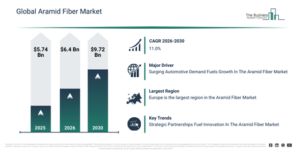
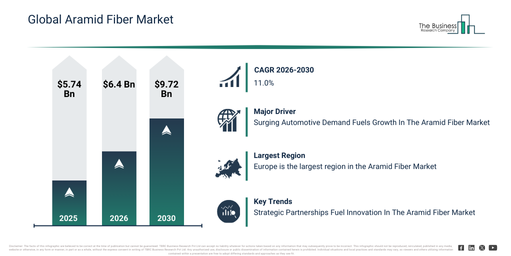
The aramid fiber market has experienced rapid expansion in recent years. It is projected to grow from $5.74 billion in 2025 to $6.4 billion in 2026, exhibiting a compound annual growth rate (CAGR) of 11.5%. The historical rise in this market can be attributed to increasing demand for defense and military equipment, greater adoption of composite materials, expanding aerospace manufacturing activities, a surge in the use of protective apparel, and ongoing technological advancements in fiber processing.
The aramid fiber market is poised for significant expansion in the coming years. By 2030, this market is projected to reach $9.72 billion, exhibiting a compound annual growth rate (CAGR) of 11.0%. This anticipated growth during the forecast period is driven by several factors, including the escalating demand for lightweight yet robust materials, the proliferation of electric and autonomous vehicles, heightened investments in advanced composite technologies, a stronger emphasis on fire-resistant materials, and the increased utilization of aramid fibers in industrial safety applications. Key trends anticipated over the forecast timeframe encompass the expanding integration of aramid fibers into lightweight composites, a surge in demand for high-performance protective textiles, their increasing deployment in aerospace and defense sectors, the broadened application of aramid reinforcement within automotive components, and a magnified emphasis on heat and impact resistance properties.
Get A Free Sample Report With In-Depth Market Insights:
Aramid Fiber Market Demand Drivers Opening New Revenue Streams
Stronger demand from the automotive sector is anticipated to boost the aramid fiber market’s expansion over the forecast period. Aramid fibers are utilized to reinforce a range of automotive components such as tires, powertrain components, turbocharger hoses, brake pads, belts, gaskets, clutches, seat textiles, electronics, seat sensors, and hybrid motor materials. For instance, in May 2025, according to the European Automobile Manufacturers’ Association (ACEA), a Belgium-based motor vehicle manufacturing company, South American car production rose by 1.7% in 2024 compared to 2023, primarily driven by Brazil, which experienced a 6.3% rise, producing approximately 1.9 million cars. Concurrently, global bus production reached 362,005 units last year, marking a 10.3% increase from 2023. Consequently, the escalating demand from the automotive sector is projected to drive the growth of the aramid fiber market.
Aramid Fiber Market Segment Analysis Spotlighting Growth Areas
The aramid fiber market covered in this report is segmented –
1) By Type: Para-Aramid Fiber, Meta-Aramid Fiber
2) By Application: Protective Fabrics, Frictional Materials, Tire Reinforcement, Rubber Reinforcement, Composites, Other Applications
3) By End Use Industry: Aerospace And Defense, Automotive, Sports Goods, Other End-Use Industries
Subsegments:
1) By Para-Aramid Fiber: Kevlar, Twaron
2) By Meta-Aramid Fiber: Nomex, Conex
Aramid Fiber Market Trends Powering Strategic Industry Growth
Leading firms within the Aramid Fiber sector are increasingly engaging in strategic collaborations to foster innovation, pool resources, and broaden their footprint in the market. An example of this is the August 2023 alliance between First Solar Inc., a US-based solar technology enterprise, and UbiQD Inc., a US-based producer of quantum dots solar cells (QDs) and nanocomposites. Through this joint venture, First Solar is committing capital to embed quantum dots directly within its solar panels, aiming to increase the production of electricity. The collaboration involves financial support from First Solar to aid the engineering and modification endeavors required to integrate UbiQD’s quantum-dot-enriched plastic film technology into their solar panel production.
Aramid Fiber Market Industry Leaders And Competitive Landscape
Major companies operating in the aramid fiber market are DuPont, Teijin Ltd, Kolon Industries Inc, Hyosung, Toray Industries Inc, Yantai Tayho Advanced Materials Co. Ltd., Kamenskvolokno JSC, Kermel, Taekwang Industrial, X-FIPER New Material Co. Ltd, China National Bluestar Co. Ltd, Sinopec Yizheng Chemical Fibre, Zhejiang Longsheng Group, Hebei Silicon Valley Chemical, Shandong Helon Aramid, Shenzhen Longpont, Jiangsu Anlun Chemical, Shandong Zhonglan Electronic Technology, SRO Aramid, Huvis Corp
View The Full Aramid Fiber Market Report:
Aramid Fiber Market Regional Analysis And Leading Geography
Europe was the largest region in the aramid fiber market in 2025. Asia-Pacific is expected to be the fastest-growing region in the forecast period. The regions covered in the aramid fiber market report are Asia-Pacific, South East Asia, Western Europe, Eastern Europe, North America, South America, Middle East, Africa.
Reach Out To Our Team:
The Business Research Company: https://www.thebusinessresearchcompany.com/
Americas: +1 310-496-7795
Asia: +44 7882 955267 & +91 8897263534
Europe: +44 7882 955267
Email us at: marketing@tbrc.info
Follow us on:
LinkedIn: https://in.linkedin.com/company/the-business-research-company
YouTube: https://www.youtube.com/channel/UC24_fI0rV8cR5DxlCpgmyFQ
Global Market Model: https://www.thebusinessresearchcompany.com/global-market-model

Wasay has over a decade of experience in market research, data modelling, and analytics, with prior experience at GlobalData and Decision Tree Consulting Services. At The Business Research Company , he leads research operations across syndicated studies, customized consulting engagements, and the Global Market Model platform. His professional experience includes supporting organizations such as Boston Consulting Group, KPMG, and Ernst & Young. Wasay holds a degree in Electronics and Communications Engineering, postgraduate management qualifications from International Management Institute Belgium and Indian School of Business and Entrepreneurship, and completed the Integrated Program in Business Analytics from Indian Institute of Management Indore.