Backed by market attractiveness analysis, total addressable market sizing, company benchmarking matrices, interactive Excel dashboards, wider supply chain intelligence, emerging startup coverage, and detailed product-level insights, The Business Research Company’s 2026 market reports are designed to offer research that is more actionable and strategically valuable than ever.
Leather Goods Market Revenue Outlook: What CAGR Lies Ahead Through 2030?
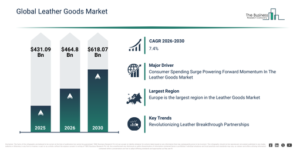
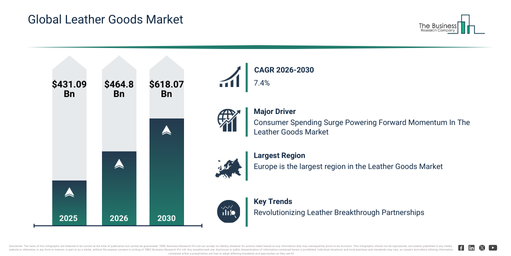
The leather goods market has demonstrated significant growth recently. It is forecast to grow from $431.09 billion in 2025 to $464.8 billion in 2026, achieving a compound annual growth rate (CAGR) of 7.8%. Historically, this expansion is attributed to several factors including a growing global demand for fashion accessories, the expansion of luxury consumption trends, the availability of skilled leather craftsmanship, rising disposable incomes in urban regions, and a strong brand heritage in leather products.
The leather goods market is projected to undergo significant expansion in the next few years, with its size expected to reach $618.07 billion in 2030, driven by a compound annual growth rate (CAGR) of 7.4%. This anticipated growth during the forecast period is due to an increased focus on eco-friendly tanning processes, the growing reach of online luxury retail, a rising demand for personalized leather goods, the expansion into emerging luxury markets, and higher adoption of digital branding strategies. Key trends for this period encompass an increasing demand for sustainable leather alternatives, the rising use of e-commerce and direct-to-consumer channels, a greater emphasis on premium and custom leather products, the expansion of brand authentication technologies, and enhanced utilization of digital design and prototyping.
Get A Free Sample Report With In-Depth Market Insights:
Leather Goods Market Growth Momentum: What Factors Are Shaping Demand?
Elevated consumer expenditure is projected to fuel the expansion of the leather goods market going forward. This spending refers to the total amount of money individuals or households spend on goods and services within a specific period. A rise in consumer spending encourages consumers to purchase premium products, including leather goods. For instance, in 2023, data from the U.S. Bureau of Economic Analysis, a US-based government agency, indicated that consumer spending in the United States grew to 15494.21 USD Billion in the third quarter of 2023 from 15343.60 USD Billion in the second quarter of 2023. Therefore, increasing consumer spending acts as a key driver for the leather goods market.
Leather Goods Market Breakdown By Product Type And Application
The leather goods market covered in this report is segmented –
1) By Leather Type: Full Grain Leather, Split Grain Leather, Genuine Leather, Faux Leather, Bonded Leather
2) By Product: Footwear, Handbags, Apparel, Luggage, Wallet, Belts, Other Products
3) By Grade: High-Grade, Mid-Grade
4) By Distribution Channel: Specialty Stores, Company Franchised Stores, E-Commerce, Supermarkets And Hypermarkets, Other Distribution Channels
5) By End- User: Men, Women, Kids
Subsegments:
1) By Full Grain Leather: Aniline Leather, Semi-Aniline Leather, Natural Grain Leather
2) By Split Grain Leather: Suede, Nubuck
3) By Genuine Leather: Corrected Grain Leather, Top-Grain Leather
4) By Faux Leather: Polyurethane (PU) Leather, Polyvinyl Chloride (PVC) Leather
5) By Bonded Leather: Reconstituted Leather, Leather Fiber Composite
Leather Goods Market Trends Redefining Industry Growth
Leading companies in the leather goods sector are engaging in partnerships to develop innovative leather products, seeking a competitive advantage in the market. Strategic partnerships involve businesses leveraging each other’s strengths and resources to achieve mutual benefits and success. For instance, in April 2023, Rashki, an India-based fashion brand, collaborated with Banofi Leather, an India-based leather company, to launch India’s first collection of handbags made from banana leather. These handbags are produced from banana crop waste, which is converted into a robust leather alternative through an innovative process developed by the Banofi team.
Leather Goods Market Key Participants And Competitive Landscape
Major companies operating in the leather goods market are Kering SA, Hermes International S.A., Louis Vuitton SE, Samsonite IP Holdings S.AR.L., Timberland LLC, Johnston And Murphy, Woodland, PRADA Spa, VIP Industries Ltd., VF Corp., LUCRIN Geneva, Nappa Dori, Saddles India Pvt. Ltd., Alma Leather, American Leather Operations LLC, Belstaff, Bottega Veneta, Brunello Cucinelli, Burberry, Capri Holdings Limited, Chanel, Coach, Fendi, Giorgio Armani, Gucci, Jack Georges
View The Full Leather Goods Market Report:
Leather Goods Market Geographic Analysis: Where Is Demand Rising Fastest?
Europe was the largest region in the leather goods market in 2025. Asia-Pacific is expected to be the fastest-growing region in the leather goods market report during the forecast period. The regions covered in the leather goods market report are Asia-Pacific, South East Asia, Western Europe, Eastern Europe, North America, South America, Middle East, Africa.
Reach Out To Our Team:
The Business Research Company: https://www.thebusinessresearchcompany.com/
Americas: +1 310-496-7795
Asia: +44 7882 955267 & +91 8897263534
Europe: +44 7882 955267
Email us at: marketing@tbrc.info
Follow us on:
LinkedIn: https://in.linkedin.com/company/the-business-research-company
YouTube: https://www.youtube.com/channel/UC24_fI0rV8cR5DxlCpgmyFQ
Global Market Model: https://www.thebusinessresearchcompany.com/global-market-model

Wasay has over a decade of experience in market research, data modelling, and analytics, with prior experience at GlobalData and Decision Tree Consulting Services. At The Business Research Company , he leads research operations across syndicated studies, customized consulting engagements, and the Global Market Model platform. His professional experience includes supporting organizations such as Boston Consulting Group, KPMG, and Ernst & Young. Wasay holds a degree in Electronics and Communications Engineering, postgraduate management qualifications from International Management Institute Belgium and Indian School of Business and Entrepreneurship, and completed the Integrated Program in Business Analytics from Indian Institute of Management Indore.