Featuring market attractiveness scoring, total addressable market sizing, company benchmarking matrices, interactive Excel dashboards, deeper supply chain intelligence, emerging startup tracking, and granular product-level insights, The Business Research Company’s 2026 market reports are built to deliver research that is both more actionable and more strategically valuable.
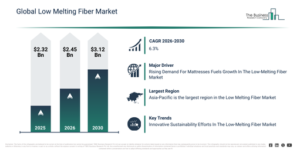
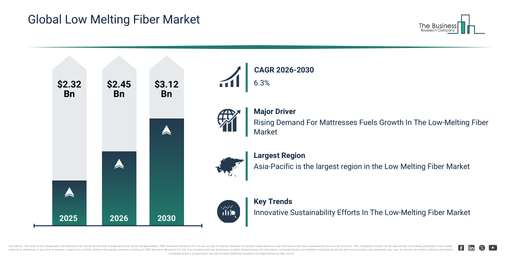
Low Melting Fiber Market Growth From $2.45 Billion In 2026 To $3.12 Billion By 2030 At A CAGR Of 6.3%
The low melting fiber market size has shown robust growth recently. It is anticipated to expand from $2.32 billion in 2025 to $2.45 billion in 2026, achieving a compound annual growth rate (CAGR) of 5.5%. The market’s historic expansion can be linked to factors such as the rise in automotive interior manufacturing, the burgeoning bedding and furniture industries, the widespread adoption of nonwoven textile technologies, the accessibility of polymer-based fibers, and the increasing utilization of thermal bonding techniques.
The low melting fiber market size is projected to experience robust expansion over the coming years. Its valuation is anticipated to reach $3.12 billion by 2030, demonstrating a compound annual growth rate (CAGR) of 6.3%. This expansion during the forecast period is attributable to several factors, including the rising demand for lightweight materials in vehicles, a heightened emphasis on sustainable textile options, the broadening scope of electric vehicle interior uses, increased application in construction insulation, and greater investments directed towards advanced fiber technologies. Key trends identified for the forecast timeframe encompass the expanding utilization of lightweight bonding fibers, an uptick in demand from automotive interior sectors, increased integration into mattress and cushion production, the proliferation of thermally bonded nonwovens, and a sharpened focus on materials that are recyclable.
Get A Free Sample Report With In-Depth Market Insights:
Low Melting Fiber Market Growth Factors Behind Sustained Expansion
The expanding requirement for mattresses is anticipated to fuel the advancement of the low-melting fiber market in the future. A mattress serves as a padded surface for sleep and relaxation, generally made from diverse materials and offered in varying dimensions and degrees of firmness. Low-melting fiber constitutes an essential element in mattress production. Its distinct characteristics improve mattress functionality, offering enhanced comfort, support, and longevity due to superior bonding achieved during the manufacturing process. As an illustration, in June 2023, data from Mattress Clarity, a US-based firm focused on mattress evaluations and comparisons, indicated that the mattress sector was valued at $50.61 billion in 2022 and is projected to expand to $52.45 billion by 2024. Furthermore, by 2030, this industry’s worth is forecasted to hit $78.34 billion. Consequently, the rising need for mattresses will stimulate the expansion of the low-melting fiber market.
Low Melting Fiber Market Segmentation: How Does The Market Break Down By Category?
The low melting fiber market covered in this report is segmented –
1) By Type: Melting Point Below 130 Degrees Celsius, Melting Point Above 130 Degrees Celsius
2) By Structure Type: Sheath Or Core, Side By Side
3) By Application: Automotive Industry, Construction, Bedding Industry, Other Applications
Subsegments:
1) By Melting Point Below 130 Degrees Celsius: Polyethylene (PE) Fibers, Polypropylene (PP) Fibers
2) By Melting Point Above 130 Degrees Celsius: Polyamide (PA) Fibers, Polyester Fibers, Polyethylene Terephthalate (PET) Fibers
Low Melting Fiber Market Industry Trends Fueling Future Revenue Growth
Leading companies in the low-melting fiber market are concentrating on developing sustainable solutions to maintain their position within the industry. These sustainable solutions encompass environmentally friendly practices and materials designed to reduce resource consumption, minimize waste, and lessen the environmental impact from both production and usage. For example, in August 2024, Unifi, Inc., a US-based producer of recycled and synthetic goods, introduced white-dyeable filament yarn and ThermaLoop insulation. The white-dyeable filament yarn is a high-performance polyester created from 100% recycled feedstock, with at least 50% sourced from textile waste, meeting virgin-quality benchmarks and integrating FiberPrint tracer technology for U-Trust certification. ThermaLoop insulation offers innovative insulating options in down-like fiber, fibreball, and padding styles, engineered with Repreve low melt fiber for enhanced thermal efficiency. Its black insulation version demonstrates the variety of textile waste that can be used as feedstock, thereby fostering sustainable practices throughout supply chains. Together, these offerings contribute to Unifi’s objective of recycling 1.5 billion t-shirts’ worth of textile waste by 2030.
Low Melting Fiber Market Company Landscape And Competitive Strategy
Major companies operating in the low melting fiber market are BASF SE, Mitsubishi Chemical Corporation, Saudi Arabia’s Basic Industries Corporation (SABIC), Asahi Kasei Corporation, Sumitomo Chemical Company Limited, Evonik Industries AG, DuPont De Nemours Inc., Eastman Chemical Company, Lanxess Corporation, Formosa Plastics Corporation, Far Eastern New Century, Teijin Limited, Nan Ya Plastics Corporation, Kuraray Co. Ltd., Hyosung Corporation, Toyobo Co. Ltd., Taekwang Industrial Co. Ltd., Huvis Corporation, Xiamen Xianglu Chemical Fiber Co. Ltd., Kolon Industries, Fiber Visions Corporation, Thai Poly Acrylic, Toray Chemical Korea Inc., Zhejiang Hengyi Group Co. Ltd.
View The Full Low Melting Fiber Market Report:
Low Melting Fiber Market Largest Region: Which Geography Holds The Biggest Share?
Asia-Pacific was the largest region in the low melting fiber market in 2025. The regions covered in the low melting fiber market report are Asia-Pacific, South East Asia, Western Europe, Eastern Europe, North America, South America, Middle East, Africa.
Reach Out To Our Team:
The Business Research Company: https://www.thebusinessresearchcompany.com/
Americas: +1 310-496-7795
Asia: +44 7882 955267 & +91 8897263534
Europe: +44 7882 955267
Email us at: marketing@tbrc.info
Follow us on:
LinkedIn: https://in.linkedin.com/company/the-business-research-company
YouTube: https://www.youtube.com/channel/UC24_fI0rV8cR5DxlCpgmyFQ
Global Market Model: https://www.thebusinessresearchcompany.com/global-market-model

Wasay has over a decade of experience in market research, data modelling, and analytics, with prior experience at GlobalData and Decision Tree Consulting Services. At The Business Research Company , he leads research operations across syndicated studies, customized consulting engagements, and the Global Market Model platform. His professional experience includes supporting organizations such as Boston Consulting Group, KPMG, and Ernst & Young. Wasay holds a degree in Electronics and Communications Engineering, postgraduate management qualifications from International Management Institute Belgium and Indian School of Business and Entrepreneurship, and completed the Integrated Program in Business Analytics from Indian Institute of Management Indore.