Backed by market attractiveness analysis, total addressable market sizing, company benchmarking matrices, interactive Excel dashboards, wider supply chain intelligence, emerging startup coverage, and detailed product-level insights, The Business Research Company’s 2026 market reports are designed to offer research that is more actionable and strategically valuable than ever.
Phase Change Materials Market Set To Climb From $2.56 Billion In 2026 To $4.84 Billion By 2030
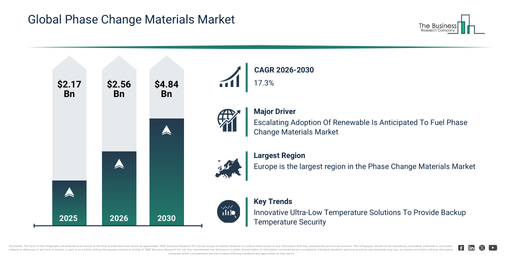
The market size for phase change materials has expanded significantly in recent years. It is projected to climb from $2.17 billion in 2025 to $2.56 billion in 2026, exhibiting a compound annual growth rate (CAGR) of 18.1%. The growth observed in prior periods can be attributed to the increase in renewable energy installations, the expansion of construction activities, the growing demand for temperature-controlled logistics, the early adoption of latent heat storage systems, and the availability of both organic and inorganic pcms.
The phase change materials market is anticipated to experience substantial growth in the upcoming period. Its valuation is set to reach $4.84 billion by 2030, demonstrating a compound annual growth rate (CAGR) of 17.3%. This expansion during the forecast timeframe is attributable to several factors, such as greater capital allocation towards energy-efficient structures, an uptick in the use of thermal management for electric vehicles, an expanding cold chain network, a heightened emphasis on renewable energy storage solutions, and the broader application of advanced encapsulation methods. Key developments anticipated in this period encompass the greater embrace of thermal energy storage systems, increased incorporation of PCMs into building materials, their expanded utilization in cold chain packaging, the widening scope of PCM applications in electronics cooling, and a renewed emphasis on energy efficiency.
Get A Free Sample Report With In-Depth Market Insights:
Phase Change Materials Market Demand Drivers: What’s Powering Industry Growth?
The increasing integration of renewable energy is anticipated to fuel the phase change materials market in the future. Renewable energy sources are defined as those that do not deplete upon use and can naturally replenish within a human lifespan. Phase Change Materials find application in renewable energy systems by storing and releasing thermal energy, thereby enhancing both efficiency and sustainability. For example, in June 2023, data from the International Energy Agency (IEA), a France-based energy organization, indicated that net renewable electricity capacity additions from PV distributed systems reached 136.2 GW in 2023, an increase from 107.4 GW in 2022. Similarly, PV utility capacity also saw an increase, growing from 112.6 GW in 2022 to 150.8 GW in 2023. Therefore, the expanding adoption of renewable energy is a primary driver for the phase change materials market.
Phase Change Materials Market Segment Landscape And Growth Outlook
The phase change materials market covered in this report is segmented –
1) By Material Type: Organic, Inorganic, Bio-Based
2) By Encapsulation Technology: Macro, Micro, Molecular
3) By Product: Paraffin, Non-Paraffin, Salt Hydrates, Eutectics
4) By End-User: Building And Construction, Packaging, Textiles, Electronics, Transportation, Other End-Users
Subsegments:
1) By Organic: Paraffin-Based Materials, Fatty Acids, Esters
2) By Inorganic: Salt Hydrates, Metallic Compounds, Water-Based Materials
3) By Bio-Based: Plant-Based Materials, Animal-Based Materials, Biopolymers
Phase Change Materials Market Innovation Trends: What Developments Are Reshaping The Industry?
Leading companies in the phase change materials market are introducing innovative ultra-low temperature solutions to ensure backup temperature security and provide an alternative to dry ice. Ultra-low temperature solutions refer to systems and technologies designed to maintain temperatures significantly below standard freezing points. For instance, in March 2023, BioLife Solutions Inc, a US-based supplier of class-defining cell and gene therapy, launched Ultraguard, which is the first -70°C phase change material (PCM) that is non-toxic, non-hazardous, and non-flammable. This PCM offers ultra-low temperature (ULT) protection. Ultraguard can serve as a backup when ULT freezers lose power and as a benchtop storage solution for biological materials, presenting an alternative to dry ice.
Phase Change Materials Market Leading Companies And Competitive Benchmarking
Major companies operating in the phase change materials market are Rubitherm Technologies GmbH, PCM Products Ltd., Phase Change Energy Solutions Inc., Puretemp LLC, Pluss Advanced Technologies Ltd., Entropy Solutions LLC, Outlast Technologies Inc., Climator Sweden AB, Cryopak Industries Inc., Cold Chain Technologies LLC, Phase Change Materials Products Ltd., Henan Shijixiang Enterprise Co. Ltd., Smart Materials Corporation, Advanced Cooling Technologies Inc., Thermal Energy System Specialists LLC, Laird Technologies Inc., Microtek Laboratories Inc., Encapsys LLC, AdvanSource Biomaterials Corporation, Insolcorp Ltd.
View The Full Phase Change Materials Market Report:
Phase Change Materials Market Largest Region By Revenue And Market Share
Europe was the largest region in the phase change materials market in 2025. The regions covered in the phase change materials market report are Asia-Pacific, South East Asia, Western Europe, Eastern Europe, North America, South America, Middle East, Africa.
Reach Out To Our Team:
The Business Research Company: https://www.thebusinessresearchcompany.com/
Americas: +1 310-496-7795
Asia: +44 7882 955267 & +91 8897263534
Europe: +44 7882 955267
Email us at: marketing@tbrc.info
Follow us on:
LinkedIn: https://in.linkedin.com/company/the-business-research-company
YouTube: https://www.youtube.com/channel/UC24_fI0rV8cR5DxlCpgmyFQ
Global Market Model: https://www.thebusinessresearchcompany.com/global-market-model

Wasay has over a decade of experience in market research, data modelling, and analytics, with prior experience at GlobalData and Decision Tree Consulting Services. At The Business Research Company , he leads research operations across syndicated studies, customized consulting engagements, and the Global Market Model platform. His professional experience includes supporting organizations such as Boston Consulting Group, KPMG, and Ernst & Young. Wasay holds a degree in Electronics and Communications Engineering, postgraduate management qualifications from International Management Institute Belgium and Indian School of Business and Entrepreneurship, and completed the Integrated Program in Business Analytics from Indian Institute of Management Indore.