Backed by market attractiveness analysis, total addressable market sizing, company benchmarking matrices, interactive Excel dashboards, wider supply chain intelligence, emerging startup coverage, and detailed product-level insights, The Business Research Company’s 2026 market reports are designed to offer research that is more actionable and strategically valuable than ever.
Plastic Compounding Market Revenue Growth On Track For A 7.4% CAGR Through 2030
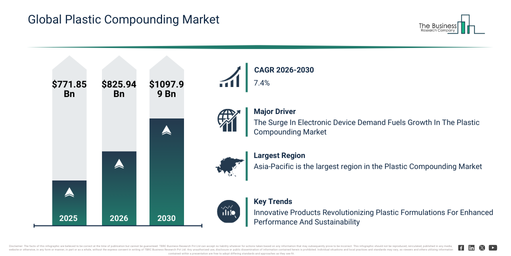
The plastic compounding market has experienced substantial growth in recent years. This market is projected to expand from $771.85 billion in 2025 to reach $825.94 billion by 2026, demonstrating a compound annual growth rate (CAGR) of 7.0%. Historically, this expansion can be ascribed to several factors, including the broadened application of plastics in industrial settings, the rise in demand for lightweight materials in the automotive sector, a greater need for long-lasting consumer goods, the increased implementation of polymer modification techniques, and advancements in extrusion and blending machinery.
The plastic compounding market is projected to experience substantial expansion over the upcoming years. This market is set to reach $1097.99 billion by 2030, exhibiting a compound annual growth rate (CAGR) of 7.4%. This expansion during the forecast period is driven by factors such as the greater adoption of sustainable plastic formulations, an escalating demand for electric vehicle-compatible compounds, the broadening of circular economy plastics, a heightened emphasis on flame-retardant and high-strength compounds, and increased investments in advanced compounding technologies. Key trends anticipated for the forecast period encompass a growing demand for customized polymer compounds, increased utilization of recycled and bio-based feedstocks, the expanding use of high-performance engineering plastics, a wider array of automotive and electrical compounding applications, and a greater emphasis on ensuring material consistency and quality control.
Get A Free Sample Report With In-Depth Market Insights:
Plastic Compounding Market Development Factors: What’s Supporting Demand?
A growing need for electronic devices is projected to stimulate demand for the plastic compounding market in the coming years. Electronic devices encompass a diverse array of gadgets and equipment powered by electricity or electronic systems, designed for various applications including communication, computation, and entertainment. In these devices, plastic compounding customizes materials to meet specific requirements such as heat resistance and electrical insulation, enabling the creation of smaller, more durable components. This customization enhances device performance and offers protection against environmental factors. For example, in May 2023, the Japan Electronics and Information Technology Industries Association, a Japan-based trade association, reported that Japan’s total electronic equipment production reached $52, 36, 535 million (¥771, 457 million). Additionally, consumer electronics production escalated to $2, 178, 430 million (¥32, 099 million) in May 2023, up from $1, 714, 724 million (¥25, 268 million) in May 2022. Thus, the escalating demand for electronic devices is a key factor driving the expansion of the plastic compounding market.
Plastic Compounding Market Segment Analysis Spotlighting Growth Areas
The plastic compounding market covered in this report is segmented –
1) By Product: Polyethylene (PE), Polypropylene (PP), Poly Vinyl Chloride (PVC), Polystyrene (PS), Polyethylene Terephthalate (PET), Polybutylene Terephthalate (PBT), Polyamide (PA)
2) By Source: Fossil-Based, Bio-Based, Recycled
3) By Application: Automotive And Transportation, Infrastructure And Construction, Electrical And Electronics, Packaging, Consumer Goods And Lifestyle, Industrial Machinery, Other Applications
Subsegments:
1) By Polyethylene (PE): Low-Density Polyethylene (LDPE), High-Density Polyethylene (HDPE), Linear Low-Density Polyethylene (LLDPE)
2) By Polypropylene (PP): Homopolymer Polypropylene, Copolymer Polypropylene
3) By Poly Vinyl Chloride (PVC): Rigid Poly Vinyl Chloride (PVC), Flexible Poly Vinyl Chloride (PVC)
4) By Polystyrene (PS): General Purpose Polystyrene (GPPS), High Impact Polystyrene (HIPS)
5) By Polyethylene Terephthalate (PET): Polyethylene Terephthalate (PET) Resin, Recycled Polyethylene Terephthalate (rPET)
6) By Polybutylene Terephthalate (PBT): Polybutylene Terephthalate (PBT) Resins, Modified Polybutylene Terephthalate (PBT)
7) By Polyamide (PA): Nylon 6, Nylon 6,6, Other Polyamides
Plastic Compounding Market Transformation Trends: What Innovations Are Driving Change?
Leading companies in the plastic compounding market are concentrating on creating cutting-edge plastic compositions to satisfy varied industry demands for superior performance, eco-friendliness, and utility. These innovative plastic formulations comprise novel combinations of materials and additives engineered to uplift performance, sustainability, and functionality across a multitude of industrial applications. For example, in May 2023, Evonik Industries AG, a Germany-based specialty chemicals company, unveiled a broad spectrum of additives under the brand TEGO Cycle, assisting its clients in refining processes and elevating the ultimate quality of recycled plastics. This new brand collection groups together products that boost efficiency and improve the quality of recycled polymers and finished plastics. Developed to minimize energy consumption during the mechanical recycling process, the TEGO Cycle range of additives also enhances the quality of polymers, thereby enabling the plastics value chain to evolve into a value cycle.
Plastic Compounding Market Competitive Landscape: Who Leads The Industry?
Major companies operating in the plastic compounding market are Adell Plastics Inc., Asahi Kasei Corporation, Celanese Corporation, DuPont de Nemours Inc., Solvay SA, Saudi Basic Industries Corporation (SABIC), LyondellBasell Industries Holdings B.V., Dow Inc., RTP Company, Avient Corporation, Polyvisions Inc., Kingfa Science & Technology Co. Ltd., Kraton Corporation, Kuraray Co. Ltd., Polykemi AB, Citadel Plastics, DSM N.V., Arkema Group, Sumitomo Bakelite Co. Ltd., Nova Polymers Inc., Europlas (PVCu) Ltd., A. Schulman Inc., Teknor Apex Company, Cabot Corporation, Tosaf Group, Mexichem Specialty Compounds Ltd., Ravago Manufacturing Americas, Plastics Color Corporation, AmeriLux International LLC, Astra Polymers Compounding Co. Ltd.
View The Full Plastic Compounding Market Report:
Plastic Compounding Market Geographic Landscape: Which Region Leads Industry Growth?
Asia-Pacific was the largest region in the plastic compounding market in 2025. North America is expected to be the fastest-growing region in the global plastic compounding market during the forecast period. The regions covered in the plastic compounding market report are Asia-Pacific, South East Asia, Western Europe, Eastern Europe, North America, South America, Middle East, Africa.
Reach Out To Our Team:
The Business Research Company: https://www.thebusinessresearchcompany.com/
Americas: +1 310-496-7795
Asia: +44 7882 955267 & +91 8897263534
Europe: +44 7882 955267
Email us at: marketing@tbrc.info
Follow us on:
LinkedIn: https://in.linkedin.com/company/the-business-research-company
YouTube: https://www.youtube.com/channel/UC24_fI0rV8cR5DxlCpgmyFQ
Global Market Model: https://www.thebusinessresearchcompany.com/global-market-model

Wasay has over a decade of experience in market research, data modelling, and analytics, with prior experience at GlobalData and Decision Tree Consulting Services. At The Business Research Company , he leads research operations across syndicated studies, customized consulting engagements, and the Global Market Model platform. His professional experience includes supporting organizations such as Boston Consulting Group, KPMG, and Ernst & Young. Wasay holds a degree in Electronics and Communications Engineering, postgraduate management qualifications from International Management Institute Belgium and Indian School of Business and Entrepreneurship, and completed the Integrated Program in Business Analytics from Indian Institute of Management Indore.