Built to provide research that’s more actionable and strategically valuable, The Business Research Company’s 2026 market reports include market attractiveness analysis, total addressable market sizing, company benchmarking matrices, interactive Excel dashboards, broader supply chain intelligence, emerging startup tracking, and in-depth product insights.
Plastics Modifiers Market Growth From $6.07 Billion In 2026 To $8.27 Billion By 2030 At A CAGR Of 8.1%
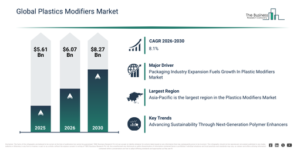
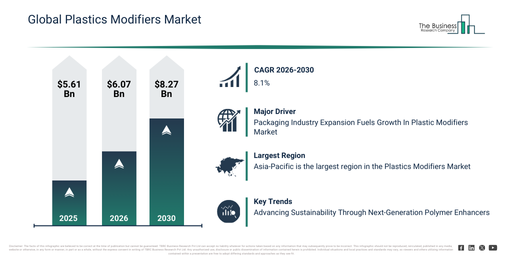
The plastics modifiers market has demonstrated strong expansion recently. It is projected to expand from $5.61 billion in 2025 to $6.07 billion in 2026, with a compound annual growth rate (CAGR) of 8.1%. This historical growth can be attributed to several factors including the expansion of plastics manufacturing capacity, an increasing use of additives in construction plastics, the growth of automotive plastic applications, rising demand for flexible packaging materials, and the availability of diversified modifier chemistries.
The plastics modifiers market is projected to experience substantial expansion in the coming years. It is anticipated to reach a valuation of $8.27 billion by 2030, exhibiting a compound annual growth rate (CAGR) of 8.1%. This projected growth during the forecast period is fueled by factors such as the escalating demand for high-performance engineering plastics, a heightened emphasis on recyclable modifier formulations, the expanding use of plastic components in electric vehicles, increasing investments in advanced polymer additives, and the wider adoption of specialty plastic compounds. Key trends expected during the forecast period encompass a surging demand for high-impact plastic modifiers, the increasing utilization of performance-enhancing additives, the broader implementation of PVC modification solutions, an expansion in the application of modifiers within lightweight automotive plastics, and a strengthened focus on material durability.
Get A Free Sample Report With In-Depth Market Insights:
Plastics Modifiers Market Expansion Drivers: What’s Shaping Future Growth?
The projected expansion of the packaging sector is anticipated to fuel the advancement of the plastic modifiers market in the future. This industry segment is dedicated to producing, fabricating, and distributing materials and receptacles that protect and present products for both commercial and logistical applications. The packaging industry is experiencing growth, driven by the surge in e-commerce and innovations in sustainable packaging solutions. Plastic modifiers contribute to the packaging industry by enhancing the flexibility, resilience, and impact resistance of plastic materials, which in turn leads to superior packaging strength, improved barrier characteristics, and better recyclability. As an illustration, the Flexible Packaging Association, a US-based trade group for producers and providers of flexible packaging, reported in August 2024 that the total US flexible packaging industry’s annual sales were estimated at $42.9 billion for 2023, reflecting a 3.4% increase from $41.5 billion in 2022. Consequently, the growth of the packaging sector is propelling the plastic modifiers market.
Plastics Modifiers Market Segment Analysis Spotlighting Growth Areas
The plastics modifiers market covered in this report is segmented –
1) By Type: Acrylonitrile Butadiene Styrene, Acrylic Impact Modifiers, Acrylonitrile Styrene Acrylate, Methacrylate Butadiene Styrene, Ethylene Propylene Diene Monomer, Chlorinated Polyethylene, Other Types
2) By Plastic Type: Polyvinyl Chloride, Nylon, Polybutylene Terephthalate, Engineering Plastics, Other Plastic Types
3) By End User: Automotive, Construction, Consumer Goods, Packaging, Other End Users
Subsegments:
1) By Acrylonitrile Butadiene Styrene: General Purpose Acrylonitrile Butadiene Styrene (ABS), High Impact Acrylonitrile Butadiene Styrene (ABS), Flame Retardant Acrylonitrile Butadiene Styrene (ABS)
2) By Acrylic Impact Modifiers: Methyl Methacrylate (MMA) Modifiers, Butyl Acrylate Modifiers, Ethyl Acrylate Modifiers
3) By Acrylonitrile Styrene Acrylate: Standard Acrylonitrile Styrene Acrylate (ASA), High Heat Acrylonitrile Styrene Acrylate (ASA), Flame Retardant Acrylonitrile Styrene Acrylate (ASA)
4) By Methacrylate Butadiene Styrene: General Purpose Methacrylate Butadiene Styrene (MBS), High Performance Methacrylate Butadiene Styrene (MBS), Impact Resistant Methacrylate Butadiene Styrene (MBS)
5) By Ethylene Propylene Diene Monomer: Ethylene Propylene Diene Monomer (EPDM) Rubber Modifiers, Ethylene Propylene Diene Monomer (EPDM) Impact Modifiers, Ethylene Propylene Diene Monomer (EPDM) Processing Aids
6) By Chlorinated Polyethylene: Chlorinated Polyethylene (CPE) For Plastics, Chlorinated Polyethylene (CPE) For Rubber, Flame Retardant Chlorinated Polyethylene (CPE)
7) By Other Types: Polyethylene Glycol (PEG) Modifiers, Polypropylene Modifiers, Plasticizers
Plastics Modifiers Market Strategic Trends: What Defines The Next Growth Phase?
Leading companies in the plastics modifiers market are actively creating sustainable polymer modifiers to improve the performance and ecological impact of plastic materials, addressing the growing need for environmentally conscious options across diverse industries. These sustainable polymer modifiers boost plastic capabilities while fostering eco-friendly solutions, thereby meeting the rising demand for greener materials. As an illustration, in January 2024, UBQ Materials, an Israel-based cleantech manufacturing company, introduced its Sustainability Product Portfolio, a worldwide collection of bio-based material alternatives, sustainability additives, and modifiers produced using its proprietary waste-to-materials technology. This portfolio includes items like UBQ ClimaPos, a climate-positive additive that can help shift a product’s carbon footprint towards neutrality even at minimal loading. It also offers modifiers and enhancers such as UBQ Nclozur for odor reduction and UBQ Impact for enhanced impact resistance when incorporated into common polymer matrices. The company asserts that these solutions enable manufacturers, ranging from consumer-goods producers to firms in building, automotive, and logistics, to integrate circularity, waste diversion, and carbon reduction alongside sustained or improved performance and processability.
Plastics Modifiers Market Competitive Overview And Top Companies
Major companies operating in the plastics modifiers market are BASF SE, The Dow Chemical Company, Saudi Basic Industries Corporation (SABIC), 3M Company, Mitsubishi Chemical Corporation, LG Chem Ltd., Sumitomo Chemical Co. Ltd., Covestro AG, Solvay S.A., DuPont de Nemours Inc., Arkema S.A., LANXESS AG, Formosa Plastics Corporation, Albemarle Corporation, Tosoh Corporation, Clariant AG, Kaneka Corporation, Cabot Corporation, SI Group Inc., Ampacet Corporation, Songwon Industrial Co. Ltd., RTP Company, Akdeniz Chemson Additives AG, Sundow Polymers Co. Ltd., Shandong Novista Chemicals Co. Ltd.
View The Full Plastics Modifiers Market Report:
Plastics Modifiers Market Top Region: Where Does Most Revenue Come From?
Asia-Pacific was the largest region in the plastics modifiers market in 2025, and is expected to be the fastest-growing region in the forecast period. The regions covered in the plastics modifiers market report are Asia-Pacific, South East Asia, Western Europe, Eastern Europe, North America, South America, Middle East, Africa.
Reach Out To Our Team:
The Business Research Company: https://www.thebusinessresearchcompany.com/
Americas: +1 310-496-7795
Asia: +44 7882 955267 & +91 8897263534
Europe: +44 7882 955267
Email us at: marketing@tbrc.info
Follow us on:
LinkedIn: https://in.linkedin.com/company/the-business-research-company
YouTube: https://www.youtube.com/channel/UC24_fI0rV8cR5DxlCpgmyFQ
Global Market Model: https://www.thebusinessresearchcompany.com/global-market-model

Wasay has over a decade of experience in market research, data modelling, and analytics, with prior experience at GlobalData and Decision Tree Consulting Services. At The Business Research Company , he leads research operations across syndicated studies, customized consulting engagements, and the Global Market Model platform. His professional experience includes supporting organizations such as Boston Consulting Group, KPMG, and Ernst & Young. Wasay holds a degree in Electronics and Communications Engineering, postgraduate management qualifications from International Management Institute Belgium and Indian School of Business and Entrepreneurship, and completed the Integrated Program in Business Analytics from Indian Institute of Management Indore.