Backed by market attractiveness analysis, total addressable market sizing, company benchmarking matrices, interactive Excel dashboards, wider supply chain intelligence, emerging startup coverage, and detailed product-level insights, The Business Research Company’s 2026 market reports are designed to offer research that is more actionable and strategically valuable than ever.
Reconstituted Wood Market Size Outlook: How Quickly Will Revenue Expand Through 2030?
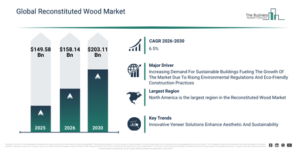
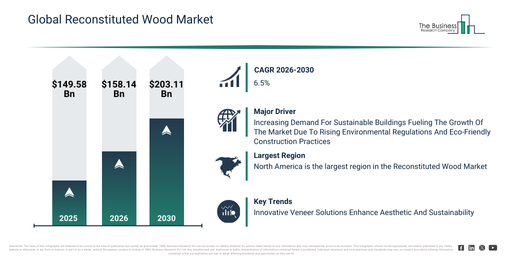
The reconstituted wood market has experienced substantial expansion in recent years. It is anticipated to increase from $149.58 billion in 2025 to $158.14 billion in 2026, demonstrating a compound annual growth rate (CAGR) of 5.7%. This historical growth can be attributed to factors such as the broadening of furniture and interior applications, a rise in demand for construction materials, better utilization of wood residues, the integration of composite wood technologies, and the availability of advanced adhesive systems.
The reconstituted wood market is set to experience substantial expansion over the next few years, with its size projected to reach $203.11 billion in 2030, exhibiting a compound annual growth rate (CAGR) of 6.5%. This growth during the forecast period is primarily driven by the escalating demand for sustainable building materials, a growing adoption of low-emission adhesives, the increased application of engineered wood in structural projects, a heightened emphasis on circular material usage, and its rising integration into modular construction. Significant trends anticipated during this period include a wider utilization of engineered wood panels, an increasing need for wood products with uniform density, its expanding presence in furniture manufacturing, the broader implementation of sustainable wood utilization practices, and a sharpened focus on material efficiency.
Get A Free Sample Report With In-Depth Market Insights:
Reconstituted Wood Market Growth Drivers: What’s Behind The Acceleration?
The burgeoning demand for eco-friendly structures is anticipated to fuel the expansion of the reconstituted wood market in the future. These sustainable buildings are environmentally conscious constructions crafted to lessen their impact on the environment, decrease consumption of energy and resources, and enhance the well-being of occupants. The heightened demand for such buildings stems from more stringent environmental policies targeting the reduction of carbon emissions within the construction industry. Reconstituted wood supports sustainable construction through the incorporation of recycled wood, thereby diminishing the requirement for virgin solid timber. This material provides resilient and economical building options, concurrently lessening its ecological footprint and encouraging efficient resource utilization. For example, data from February 2024, provided by the US Green Building Council – a US-based non-profit organization advocating for eco-friendly construction and creator of the LEED certification system for green building – indicated a 9% increase in LEED certifications during 2023 compared to the prior year, alongside an extra 21 certifications for single-family homes. Furthermore, new LEED project registrations saw a significant leap of 51%, signaling notable expansion. Consequently, the escalating demand for sustainable buildings is a key factor propelling the expansion of the reconstituted wood market.
Reconstituted Wood Market Segment Analysis: What Are The Core Market Categories?
The reconstituted wood market covered in this report is segmented –
1) By Product Type: Particleboard, Medium Density Fiberboard (MDF), High Density Fiberboard (HDF), Oriented Strand Board (OSB), Plywood, Laminated Veneer Lumber (LVL), Cross-Laminated Timber (CLT), Other Product Types
2) By Adhesive Type: Urea-Formaldehyde (UF), Phenol-Formaldehyde (PF), Melamine-Formaldehyde (MF), Methylene Diphenyl Diisocyanate (MDI), Bio-Based Adhesives, Other Adhesive Types
3) By Surface Treatment: Raw Or Unfinished, Laminated, Veneered, Coated, Other Surface Treatments
4) By Distribution Channel: Direct Sales, Distributors Or Wholesalers, Retail Stores, E-Commerce, Other Distribution Channels
5) By End-Use: Construction, Furniture Manufacturing, Flooring, Packaging, Transportation, Other End-Users
Subsegments:
1) By Particleboard: Standard Particleboard, Fire-Resistant Particleboard, Moisture-Resistant Particleboard
2) By Medium Density Fiberboard (MDF): Standard Medium Density Fiberboard, Moisture-Resistant Medium Density Fiberboard, Fire-Retardant Medium Density Fiberboard
3) By High Density Fiberboard (HDF): Flooring Grade High Density Fiberboard, Door Skin High Density Fiberboard, Decorative High Density Fiberboard
4) By Oriented Strand Board (OSB): Oriented Strand Board-1, Oriented Strand Board-2, Oriented Strand Board-3
5) By Plywood: Softwood Plywood, Hardwood Plywood, Tropical Plywood
6) By Laminated Veneer Lumber (LVL): Laminated Veneer Lumber Beams, Laminated Veneer Lumber Headers, Laminated Veneer Lumber Rim Boards
7) By Cross-Laminated Timber (CLT): Residential Cross-Laminated Timber Panels, Non-Residential Cross-Laminated Timber Panels, Customized Cross-Laminated Timber Solutions
8) By Other Product Types: Hardboard, Waferboard, Composite Wood Panels
Reconstituted Wood Market Trends: What’s Defining The Industry’s Next Phase?
Companies operating in the reconstituted wood market are prioritizing the development of innovative and sustainable products, such as reconstituted veneer doors and drawers, to enhance aesthetic quality, minimize environmental effects, and offer budget-friendly options. Reconstituted veneer doors and drawers refer to furniture components made by adhering engineered wood veneers to substrates like medium-density fiberboard (MDF) or particleboard, effectively replicating the appearance of natural wood while ensuring affordability and ecological responsibility. As an illustration, in August 2023, Meridian Products, a US-based custom plastic injection molding company, launched its inaugural line of reconstituted veneer doors and drawers. These products are manufactured from engineered sheets of real, renewable wood and closely resemble the look of premium and rare wood species. This new product line successfully combines the elegance of natural wood with the robust durability and cost-effectiveness of engineered materials. The reconstituted veneer technology ensures uniform grain patterns, fewer imperfections, and presents a more environmentally conscious alternative to traditional solid wood, thereby reducing waste during production.
Reconstituted Wood Market Competitive Landscape: Which Companies Lead The Industry?
Major companies operating in the reconstituted wood market are Daiken Corporation, West Fraser Timber Co. Ltd., Georgia-Pacific LLC, Boise Cascade Company, Canfor Corporation, Fritz EGGER GmbH & Co. OG, Kronospan Holdings Limited, Celulosa Arauco y Constitución S.A., Roseburg Forest Products Co., Tolko Industries Ltd., Dongwha Enterprise Co. Ltd., Pfleiderer Group S.A., Action TESA Pvt. Ltd., Masisa S.A., Greenpanel Industries Ltd., Norbord Inc., Lampert Lumber Co., Uniboard Canada Inc., Rushil Décor Ltd., Sierra Pine Milling Co., Nelson Pine Industries Ltd., Swiss Krono Group, Duratex S.A.
View The Full Reconstituted Wood Market Report:
Reconstituted Wood Market Regional Breakdown: Where Is Demand Concentrated?
North America was the largest region in the reconstituted wood market in 2025. The regions covered in the reconstituted wood market report are Asia-Pacific, South East Asia, Western Europe, Eastern Europe, North America, South America, Middle East, Africa.
Reach Out To Our Team:
The Business Research Company: https://www.thebusinessresearchcompany.com/
Americas: +1 310-496-7795
Asia: +44 7882 955267 & +91 8897263534
Europe: +44 7882 955267
Email us at: marketing@tbrc.info
Follow us on:
LinkedIn: https://in.linkedin.com/company/the-business-research-company
YouTube: https://www.youtube.com/channel/UC24_fI0rV8cR5DxlCpgmyFQ
Global Market Model: https://www.thebusinessresearchcompany.com/global-market-model

Wasay has over a decade of experience in market research, data modelling, and analytics, with prior experience at GlobalData and Decision Tree Consulting Services. At The Business Research Company , he leads research operations across syndicated studies, customized consulting engagements, and the Global Market Model platform. His professional experience includes supporting organizations such as Boston Consulting Group, KPMG, and Ernst & Young. Wasay holds a degree in Electronics and Communications Engineering, postgraduate management qualifications from International Management Institute Belgium and Indian School of Business and Entrepreneurship, and completed the Integrated Program in Business Analytics from Indian Institute of Management Indore.