Built to provide research that’s more actionable and strategically valuable, The Business Research Company’s 2026 market reports include market attractiveness analysis, total addressable market sizing, company benchmarking matrices, interactive Excel dashboards, broader supply chain intelligence, emerging startup tracking, and in-depth product insights.
Smart Mosquito Trap Market Size Outlook: How Quickly Will Revenue Expand Through 2030?
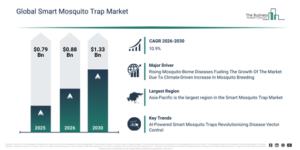
The smart mosquito trap market size has seen swift expansion in recent years. It is anticipated to ascend from $0.79 billion in 2025 to $0.88 billion in 2026, demonstrating a compound annual growth rate (CAGR) of 11.4%. This historical growth can be attributed to several factors, including the increasing prevalence of mosquito-borne diseases, the expansion of urban pest control programs, the growth in residential mosquito management solutions, the rising use of UV and CO2 trapping technologies, and the availability of smart sensor technologies.
The smart mosquito trap market is anticipated to experience substantial growth over the next few years, with projections indicating it will reach $1.33 billion in 2030, exhibiting a compound annual growth rate (CAGR) of 10.9%. This expansion during the forecast period is driven by factors such as the increasing adoption of smart city health infrastructure, rising investments in disease prevention technologies, the broadening of climate-driven vector monitoring efforts, a growing demand for eco-friendly pest control methods, and advancements in AI-based insect identification. Prominent trends throughout this period include the increased deployment of AI-based mosquito detection systems, the expanding use of connected vector surveillance devices, the wider application of data-driven pest control solutions, a rising embrace of chemical-free mosquito control, and an enhanced focus on public health monitoring.
Get A Free Sample Report With In-Depth Market Insights:
Smart Mosquito Trap Market Industry Drivers: What’s Behind The Revenue Growth?
The rising occurrence of mosquito-borne illnesses is anticipated to propel the expansion of the smart mosquito trap market in the coming period. These diseases are infections resulting from bacteria, viruses, or parasites transmitted to humans via the bite of infected mosquitoes. The increased prevalence of such diseases stems from climate change, with higher temperatures hastening mosquito reproduction and broadening their distribution, consequently elevating disease transmission. Smart mosquito traps contribute to combating these illnesses by diminishing mosquito numbers and allowing for prompt identification of disease-carrying species, thus decreasing the likelihood of conditions like dengue, malaria, and Zika virus. For instance, the World Health Organization, a specialized agency based in Switzerland, reported in December 2024 that approximately 263 million malaria cases and 597,000 associated fatalities were recorded globally in 2023, marking an increase of roughly 11 million cases compared to 2022. Consequently, the growing incidence of mosquito-borne diseases is fueling the growth of the smart mosquito trap market.
Smart Mosquito Trap Market Segment Breakdown: Which Categories Lead On Revenue?
The smart mosquito trap market covered in this report is segmented –
1) By Product Type: Electric Mosquito Traps, Ultraviolet Light Mosquito Traps, Carbon Dioxide-Based Mosquito Traps, Other Product Type
2) By Distribution Channel: Online Stores, Supermarkets Or Hypermarkets, Specialty Stores, Other Distribution Channel
3) By End User: Households, Hotels And Resorts, Hospitals And Clinics, Agriculture, Other End User
Subsegments:
1) By Electric Mosquito Traps: Indoor Electric Mosquito Traps, Outdoor Electric Mosquito Traps, Battery-Operated Electric Traps, Plug-in Electric Traps
2) By Ultraviolet Light Mosquito Traps: Wall-Mounted Ultraviolet Light Mosquito Traps, Tabletop Ultraviolet Light Mosquito Traps, Solar-Powered Ultraviolet Light Traps, Ultraviolet Light Traps with Fan Suction Mechanism
3) By Carbon Dioxide-Based Mosquito Traps: Propane-Fueled Carbon Dioxide Traps, Octenol-Enhanced Carbon Dioxide Traps, Electric Carbon Dioxide Generator Traps, Hybrid Carbon Dioxide and Ultraviolet Light Traps
4) By Other Product Types: Smart App-Connected Mosquito Traps, Sticky Pad-Based Mosquito Traps, Water-Based Traps, Acoustic Frequency Mosquito Repellent Traps
#Smart Mosquito Trap Market Growth Trends: What’s Shaping The Future Outlook?
Major companies operating in the smart mosquito trap market are focusing on developing technologically advanced solutions, such as AI-powered smart mosquito traps, to improve species-specific targeting, enhance trapping efficiency, and enable remote monitoring through connected devices. AI-powered smart mosquito traps refer to intelligent pest control devices that utilize artificial intelligence to detect and identify mosquito species in real time, allowing for targeted and efficient capture. For instance, in July 2025, the University of South Florida, a US-based public university, launched an artificial intelligence-powered smart mosquito trap that identifies disease-carrying mosquitoes, such as the malaria-transmitting Anopheles stephensi, in real time. The trap uses cameras to photograph mosquitoes drawn onto a sticky pad, then uploads the images to the cloud, where AI algorithms quickly analyze them to determine the species and potential disease risk. This rapid identification supports timely alerts to public health officials for effective mosquito control.
Smart Mosquito Trap Market Competitive Analysis Of Leading Industry Participants
Major companies operating in the smart mosquito trap market are Biogents AG, Dynatrap, Woodstream Corporation, GreenStrike, Flowtron Outdoor Products, Thermacell Inc., ASPECTEK, Katchy, PestWest Electronics, Koolatron, EnviroSafe Pest Control, FVOAI, Lepotec Smart Devices, Qista SAS, Bzigo Technologies Ltd., In2Care BV, Moskiteer Limited, Moskeet, ZITTO by Bway Innovation, Mosqitter, Mega-Catch, Vector Control Technologies, Greenyellow Electric Technology, Culicidae Mosquito Control
View The Full Smart Mosquito Trap Market Report:
Smart Mosquito Trap Market Geographic Spread And Regional Opportunities
Asia-Pacific was the largest region in the smart mosquito trap market in 2025. The regions covered in the smart mosquito trap market report are Asia-Pacific, South East Asia, Western Europe, Eastern Europe, North America, South America, Middle East, Africa.
Reach Out To Our Team:
The Business Research Company: https://www.thebusinessresearchcompany.com/
Americas: +1 310-496-7795
Asia: +44 7882 955267 & +91 8897263534
Europe: +44 7882 955267
Email us at: marketing@tbrc.info
Follow us on:
LinkedIn: https://in.linkedin.com/company/the-business-research-company
YouTube: https://www.youtube.com/channel/UC24_fI0rV8cR5DxlCpgmyFQ
Global Market Model: https://www.thebusinessresearchcompany.com/global-market-model

Wasay has over a decade of experience in market research, data modelling, and analytics, with prior experience at GlobalData and Decision Tree Consulting Services. At The Business Research Company , he leads research operations across syndicated studies, customized consulting engagements, and the Global Market Model platform. His professional experience includes supporting organizations such as Boston Consulting Group, KPMG, and Ernst & Young. Wasay holds a degree in Electronics and Communications Engineering, postgraduate management qualifications from International Management Institute Belgium and Indian School of Business and Entrepreneurship, and completed the Integrated Program in Business Analytics from Indian Institute of Management Indore.