Backed by market attractiveness analysis, total addressable market sizing, company benchmarking matrices, interactive Excel dashboards, wider supply chain intelligence, emerging startup coverage, and detailed product-level insights, The Business Research Company’s 2026 market reports are designed to offer research that is more actionable and strategically valuable than ever.
3D Printing Materials Market Poised To Hit $8.99 Billion By 2030 With A 22.5% CAGR
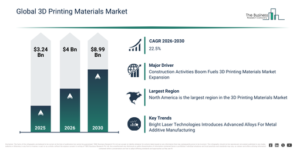
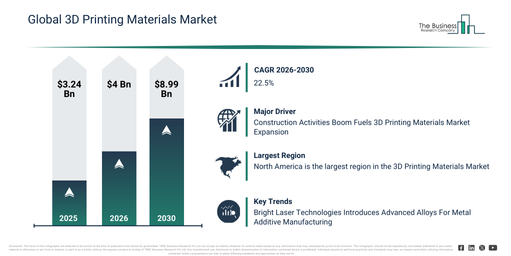
The 3D printing materials market size has experienced significant expansion in recent years. It is anticipated to increase from $3.24 billion in 2025 to $4 billion in 2026, demonstrating a compound annual growth rate (CAGR) of 23.6%. The historical growth can be linked to factors such as the rise of prototyping activities across various industries, the growing implementation of additive manufacturing, the availability of a wide array of material formulations, the expansion of small-batch manufacturing, and greater investments in industrial 3D printing.
The 3D printing materials market size is anticipated to experience substantial growth in the upcoming years. It is forecast to expand to $8.99 billion in 2030, driven by a compound annual growth rate (CAGR) of 22.5%. This projected expansion during the forecast period is fueled by several factors, including an escalating demand for aerospace and automotive grade materials, a heightened focus on lightweight components, the broadening of healthcare 3D printing applications, an increasing embrace of sustainable materials, and ongoing innovation in material science. Furthermore, significant trends for this period involve a rising demand for high-performance printing materials, the increasing adoption of metal and composite 3D printing materials, a growing preference for sustainable and recyclable filaments, the expansion of industrial-grade printing applications, and a reinforced emphasis on material strength and durability.
Get A Free Sample Report With In-Depth Market Insights:
3D Printing Materials Market Growth Backed By Core Demand Fundamentals
The expansion of construction endeavors is anticipated to boost the growth of the 3D printing materials market in the future. Construction activities encompass the creation, erection, or assembly of structures, infrastructure, or facilities, utilizing diverse materials, equipment, and labor. 3D printing materials find application in these activities for fabricating walls, floors, and other structural elements of buildings, as well as for producing lightweight components such as roofs and facades. For instance, in July 2024, according to the US Census Bureau, a US-based government agency, the value of construction operations rose from $2.01 trillion in May 2023 to $2.14 trillion in May 2024. Consequently, the increasing construction activities are driving the growth of the 3D printing materials market.
3D Printing Materials Market Segmentation: How Does The Market Break Down By Category?
The 3D printing materials market covered in this report is segmented –
1) By Type: Polymers, Metal, Ceramic, Other Types
2) By Technology: Fused Deposition Modeling (FDM), Selective Laser Sintering (SLS), Stereolithography (SLA), Direct Metal Laser Sintering (DMLS), Other Technologies
3) By Form: Powder, Filament, Liquid
4) By End-Use Industry: Automotive, Healthcare, Aerospace And Defense, Consumer Goods, Construction, Other End-Users
Subsegments:
1) By Polymers: Thermoplastics, Photopolymers, Thermoplastic Elastomers (TPE), Nylon
2) By Metal: Stainless Steel, Aluminum, Titanium, Nickel Alloys, Cobalt Chrome
3) By Ceramic: Alumina, Zirconia, Silica
4) By Other Types: Composites, Biomaterials, Sand
3D Printing Materials Market Growth Trends Reshaping The Competitive Landscape
Leading companies in the 3D printing materials market are heavily invested in developing innovative solutions, notably titanium alloys for 3D printing. These developments aim to significantly improve the durability, impact resistance, and heat stability of printed products, thereby extending their applicability across a range of industries, including automotive, aerospace, and healthcare. Titanium alloys for 3D printing are defined as specialized metallic materials, predominantly titanium, often combined with elements such as aluminum, vanadium, or molybdenum, to impart enhanced properties like strength, corrosion resistance, and lightweight characteristics. For example, in July 2024, Bright Laser Technologies, a China-based supplier of complete turnkey solutions for metal additive manufacturing, introduced two new advanced materials for additive manufacturing: BLT-AlAM500, a high-strength aluminum alloy, and BLT-Ti65, a high-temperature titanium alloy. The BLT-AlAM500 is specifically engineered for aerospace applications, delivering exceptional strength and thermal stability while simultaneously addressing frequent 3D printing issues such as cracking and low density. This particular alloy achieves impressive tensile strengths and enables considerable weight reduction in components.
3D Printing Materials Market Competitive Overview And Top Companies
Major companies operating in the 3D printing materials market are Stratasys Ltd., 3D Systems Corporation, Arcam AB, The ExOne Company GmbH, Koninklijke DSM N.V., EnvisionTEC GmbH, EOS GmbH Electro Optical Systems, Höganäs AB, LPW Technology Ltd., Advanced Powders and Coatings Inc., Formlabs Inc., Toner Plastics Inc., Taulman 3D LLC, Dutch Filaments B.V., Arkema S.A., Evonik Industries AG, BASF SE (Badische Anilin- und Sodafabrik), Henkel AG & Co. KGaA, Solvay S.A., Sandvik AB, Saudi Basic Industries Corporation (SABIC), Covestro AG, Dow Inc., LG Chem Ltd., Kuraray Co. Ltd., colorFabb B.V., Integrated Fibres Limited
View The Full 3D Printing Materials Market Report:
3D Printing Materials Market Top Region: Where Does Most Revenue Come From?
North America was the largest region in the 3D printing materials market in 2025. Asia-Pacific is expected to be the fastest-growing region in the 3D printing materials market share during the forecast period. The regions covered in the 3D printing materials market report are Asia-Pacific, South East Asia, Western Europe, Eastern Europe, North America, South America, Middle East, Africa.
Reach Out To Our Team:
The Business Research Company: https://www.thebusinessresearchcompany.com/
Americas: +1 310-496-7795
Asia: +44 7882 955267 & +91 8897263534
Europe: +44 7882 955267
Email us at: marketing@tbrc.info
Follow us on:
LinkedIn: https://in.linkedin.com/company/the-business-research-company
YouTube: https://www.youtube.com/channel/UC24_fI0rV8cR5DxlCpgmyFQ
Global Market Model: https://www.thebusinessresearchcompany.com/global-market-model

Wasay has over a decade of experience in market research, data modelling, and analytics, with prior experience at GlobalData and Decision Tree Consulting Services. At The Business Research Company , he leads research operations across syndicated studies, customized consulting engagements, and the Global Market Model platform. His professional experience includes supporting organizations such as Boston Consulting Group, KPMG, and Ernst & Young. Wasay holds a degree in Electronics and Communications Engineering, postgraduate management qualifications from International Management Institute Belgium and Indian School of Business and Entrepreneurship, and completed the Integrated Program in Business Analytics from Indian Institute of Management Indore.