
Through market attractiveness analysis, total addressable market evaluation, company benchmarking matrices, interactive Excel dashboards, expanded supply chain intelligence, emerging startup coverage, and detailed product insights, The Business Research Company’s 2026 market reports provide more actionable and strategically valuable research.
Apparel Market Forecast: What Market Value Is Expected By 2030?
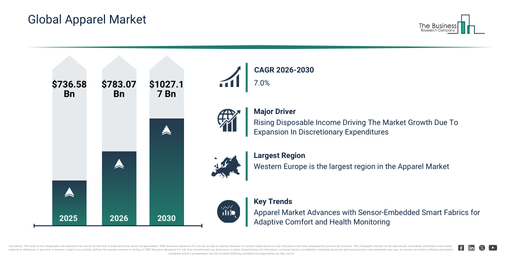
The apparel market has demonstrated robust growth in its size over recent years. It is projected to expand from $736.58 billion in 2025 to $783.07 billion in 2026, achieving a compound annual growth rate (CAGR) of 6.3%. The growth observed in prior periods can be attributed to several factors, including the expansion of global textile manufacturing, increased disposable income levels, the development of organized retail apparel, escalating urbanization trends, and the presence of low-cost manufacturing hubs.
The apparel market size is anticipated to demonstrate significant growth in the coming years. It is projected to expand to $1027.17 billion by 2030, exhibiting a compound annual growth rate (CAGR) of 7.0%. This growth during the forecast period can be attributed to several factors, including an escalating demand for eco-friendly clothing, the enlargement of digital fashion platforms, the increasing utilization of data-driven design processes, a growing embrace of direct-to-consumer business models, and the expanding influence of social commerce. Prominent trends observed in the forecast period are a rising demand for sustainable apparel materials, the increasing adoption of fast fashion production methodologies, the broadening of online apparel sales channels, a heightened focus on customization and innovations in fit, and an enhanced emphasis on brand-led collections.
Download A Free Sample Report For Comprehensive Market Insights:
Apparel Market Growth Factors Supporting Long-Term Expansion
An anticipated increase in disposable income is projected to stimulate the expansion of the apparel market moving ahead. This income represents the funds households retain for expenditure and savings once income taxes have been subtracted. Its growth is fueled by economic resurgence and modest wage increments, with enhanced labor market stability and declining inflation rates empowering households with greater purchasing power. Consequently, greater disposable income allows consumers to dedicate additional resources to discretionary purchases, including apparel and fashion goods. As an illustration, the U.S. Bureau of Economic Analysis, a US-based government agency, reported in October 2024 that personal income climbed by $71.6 billion, or 0.3 percent, in September. Disposable personal income (DPI), which is personal income less personal current taxes, expanded by $57.4 billion (0.3 percent). Personal consumption expenditures (PCE) saw an increase of $105.8 billion, marking a 0.5 percent rise. Thus, the upward trend in disposable income is a key factor propelling the expansion of the apparel market.
#Apparel Market Segment Landscape And Growth Potential
The apparel market covered in this report is segmented –
1) By Type: Women’s Apparel, Men’s Apparel
2) By Fiber: Man-Made Fibers, Cotton Fibers, Animal-Based Fibers, Plant-Based Fibers
3) By Distribution Channel: Offline Retail, Online Retail
Subsegments:
1) By Women’s Apparel: Formal Topwear, Formal Bottomwear, Dresses & One-Piece Occasion Wear, Ethnic & Traditional Wear, Evening & Party Wear, Occasion-Specific Outerwear
2) By Men’s Apparel: Formal Shirts & Topwear, Formal Trousers & Bottomwear, Suits, Blazers & Tailored Formal Wear, Ethnic & Traditional Wear, Ceremonial & Occasion Wear, Occasion-Specific Outerwear
Apparel Market Industry Trends Shaping Future Revenue Growth
Leading businesses within the apparel market are increasingly prioritizing technological innovations, including smart fabrics with embedded sensors for real-time physiological and thermal tracking, to satisfy the growing need for health-conscious performance wear, adaptable comfort, and integrated fashion-tech solutions. Smart fabric monitoring involves textile materials, either woven or knitted, that incorporate sensors and conductive threads to constantly measure physiological or environmental data, thereby eliminating the reliance on separate wearable devices or conventional textiles. For example, in March 2025, VOORMI, a US-based outdoor clothing company, unveiled the Mij smart tshirt, a washable biometric item of clothing developed with Mij sensor embedded textile technology, capable of real-time body thermal load detection and mapping of thermal stress throughout the entire body. The Mij shirt features wireless sensors directly integrated into its fabric, enabling it to track how the wearer’s body reacts to heat and physical exertion; it offers warnings about thermal stress before it becomes critical, aids athletes, first responders, and outdoor laborers, and delivers practical data via a complementary application, all while retaining the feel and appearance of a standard performance T-shirt. This development highlights the apparel market’s progression beyond mere comfort or style, embracing intelligent, health, and performance-focused attire to address the rising demand for adaptive wearables and data-driven personal wellness.
Apparel Market Competitive Landscape: Who Are The Leading Companies?
Major companies operating in the apparel market are NIKE Inc, Adidas AG, PVH Corp, Christian Dior SE, Hanesbrands Inc, VF Corporation, Levi Strauss & Co, Kering SA, Ralph Lauren Corporation, Samsung C&T Corporation, Aditya Birla Fashion and Retail Limited, Shanshan Group Co, United Arrows, Matsuoka Corp, Heilan Group, Youngor Group, Bosideng Corporation, Fujian Septwolves Industry Co Ltd, Shimamura, Uniqlo, Nishimatsuya, Allen Solly, Louis Philippe, Peter England, Van Heusen, Fabindia, Decathlon, Under Armour, H&M, Zara, Primark, Marks & Spencer, Next, Lee, Diesel, Wrangler, Guess, Tommy Hilfiger, Calvin Klein, Brooks Brothers, American Eagle Outfitters, Abercrombie & Fitch, Old Navy, Gap, Michael Kors, Coach, Gildan Activewear, Chanel, Urban Outfitters, MANGO, Truworths Group
Access The Complete Apparel Market Report:
Apparel Market Geographic Landscape: Which Region Dominates Industry Growth?
Western Europe was the largest region in the apparel market in 2025. Asia-Pacific was the second-largest region in the apparel market. The regions covered in the apparel market report are Asia-Pacific, South East Asia, Western Europe, Eastern Europe, North America, South America, Middle East, Africa.
Get in touch with us:
The Business Research Company: https://www.thebusinessresearchcompany.com/
Americas: +1 310-496-7795
Asia: +44 7882 955267 & +91 8897263534
Europe: +44 7882 955267
Email us at: marketing@tbrc.info
Follow us on:
LinkedIn: https://in.linkedin.com/company/the-business-research-company
YouTube: https://www.youtube.com/channel/UC24_fI0rV8cR5DxlCpgmyFQ
Global Market Model: https://www.thebusinessresearchcompany.com/global-market-model

Wasay has over a decade of experience in market research, data modelling, and analytics, with prior experience at GlobalData and Decision Tree Consulting Services. At The Business Research Company , he leads research operations across syndicated studies, customized consulting engagements, and the Global Market Model platform. His professional experience includes supporting organizations such as Boston Consulting Group, KPMG, and Ernst & Young. Wasay holds a degree in Electronics and Communications Engineering, postgraduate management qualifications from International Management Institute Belgium and Indian School of Business and Entrepreneurship, and completed the Integrated Program in Business Analytics from Indian Institute of Management Indore.