
Delivering more actionable and strategically valuable research, The Business Research Company’s 2026 market reports feature market attractiveness analysis, total addressable market evaluation, company benchmarking matrices, interactive Excel dashboards, expanded supply chain intelligence, emerging startup coverage, and detailed product insights.
Engineered Wood Market Value Analysis: What Growth Is Expected Over The Forecast Period?
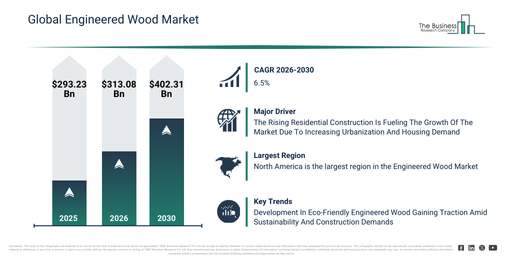
The engineered wood market has experienced substantial growth in recent years. This market is projected to expand from $293.23 billion in 2025 to reach $313.08 billion by 2026, demonstrating a compound annual growth rate (CAGR) of 6.8%. Historically, this expansion can be linked to factors such as the increasing scale of residential and commercial construction projects, advancements in wood processing technologies, a rise in the adoption of composite wood panels, the availability of plantation timber resources, and a surging need for economical building materials.
The engineered wood market is projected for robust expansion in the coming years. It is anticipated to reach $402.31 billion by 2030, exhibiting a compound annual growth rate (CAGR) of 6.5%. This growth over the forecast period stems from factors such as a heightened demand for eco-friendly construction materials, the growing uptake of modular and prefabricated structures, the proliferation of green building certifications, expanded application of engineered wood in infrastructure projects, and advancements in wood composite technologies. Key trends for the upcoming period encompass the wider integration of engineered wood in building, increased utilization of cross-laminated timber structures, a surging need for lightweight structural panels, the broadened availability of prefabricated building components, and a greater emphasis on material durability and steadiness.
Download A Free Sample Report For Comprehensive Market Insights:
Engineered Wood Market Demand Drivers: What Is Fueling Industry Growth?
The expanding residential construction sector is anticipated to drive the future growth of the engineered wood market. Residential construction encompasses the building or enhancement of living spaces such as homes, apartments, and condominiums for human occupancy. The increase in residential construction is attributed to rising urbanization, which in turn boosts the demand for housing in developing cities as more individuals relocate to urban areas. Engineered wood enhances residential construction due to its strength, durability, and stability, making it well-suited for framing, flooring, roofing, and paneling applications. It also provides greater resistance to warping compared to solid wood, ensuring cost-effective and long-lasting performance. For instance, in June 2024, according to the United States Census Bureau, a US-based government administration, privately owned housing completions in May reached a seasonally adjusted annual rate of 1,514,000, which was a 1.0% increase from the 1,499,000 reported in May 2023. Thus, the escalating residential construction is fueling the growth of the engineered wood market.
Engineered Wood Market Segment Analysis Highlighting Growth Areas
The engineered wood market covered in this report is segmented –
1) By Type: Plywood, Medium Density Fiberboard (MDF), Cross Laminated Timber (CLT), Laminated Veneer Lumber (LVL), Oriented Strand Board (OSB), Glue Laminated Timber (Glulam), Particle Board
2) By Application: Construction, Flooring, Furniture, Packaging, Transport, Other Applications
3) By End-User: Non-Residential, Residential, Industrial
Subsegments:
1) By Plywood: Softwood Plywood, Hardwood Plywood, Tropical Plywood, Aircraft Plywood, Decorative Plywood
2) By Medium Density Fiberboard (MDF): Standard Medium Density Fiberboard (MDF), Moisture-Resistant Medium Density Fiberboard (MDF), Fire-Retardant Medium Density Fiberboard (MDF), Ultralight Medium Density Fiberboard (MDF), Veneered Medium Density Fiberboard (MDF)
3) By Cross-Laminated Timber (CLT): Adhesive-Bonded Cross-Laminated Timber (CLT), Mechanically Fastened Cross-Laminated Timber (CLT), Custom-Panel Cross-Laminated Timber (CLT), Nail-Laminated Cross-Laminated Timber (CLT)
4) By Laminated Veneer Lumber (LVL): Structural Laminated Veneer Lumber (LVL), Industrial Laminated Veneer Lumber (LVL), Edge-Laminated Laminated Veneer Lumber (LVL), Parallel Strand Laminated Veneer Lumber (LVL)
5) By Oriented Strand Board (OSB): Oriented Strand Board (OSB)/1, Oriented Strand Board (OSB)/2, Oriented Strand Board (OSB)/3, Oriented Strand Board (OSB)/4
6) By Glue Laminated Timber (Glulam): Straight Glulam, Curved Glulam, Custom Glulam Beams, Architectural Glulam
7) By Particle Board: Raw Particle Board, Pre-Laminated Particle Board, Fire-Retardant Particle Board, Moisture-Resistant Particle Board, Cement-Bonded Particle Board
Engineered Wood Market Strategic Trends: What Is Defining The Next Phase Of Growth?
Key companies in the engineered wood sector are prioritizing the creation of advanced items, notably eco-friendly engineered wood, to satisfy evolving environmental mandates and construction requirements. Environmentally conscious engineered wood provides a sustainable alternative to solid wood, manufactured with recycled constituents and low-emission bonding agents through streamlined processes. It aids in preserving woodlands, diminishes refuse, and delivers resilient, adaptable solutions for both building and furnishings. For example, in May 2025, SPAN FLOORS, an India-based producer of luxury wood flooring, introduced its high-quality engineered wood flooring designed for staircases. This offers a sophisticated replacement for customary materials like marble. The fresh assortment unites the inherent warmth and allure of genuine wood with sophisticated multi-layered construction, enhancing stability, longevity, and security, making it suitable for areas with heavy foot traffic and various environmental circumstances. Produced from ethically obtained timber, the range is intended to elevate the visual appeal and coziness of modern Indian residences while promoting sustainable living.
Engineered Wood Market Leading Companies: Who Holds Significant Market Presence?
Major companies operating in the engineered wood market are Stora Enso, UFP Industries Inc., Georgia-Pacific, Boise Cascade Company, West Fraser Timber Co., Louisiana-Pacific Corporation, Roseburg Forest Products, Tolko Industries Ltd., Pfleiderer Group, Mayr-Melnhof Holz Holding AG, Setra Group, Sveza Group, Mercer Mass Timber LLC, Nordic Structures, Huber Engineered Woods LLC, Hasslacher Holding GmbH, Kronoplus Limited, Swiss Krono Group, Binderholz GmbH, SPAN FLOORS, Lamiwood Designer Floor
Access The Complete Engineered Wood Market Report:
Engineered Wood Market Leading Geography: Which Region Generates The Most Revenue?
North America was the largest region in the engineered wood market in 2025. Asia-Pacific is expected to be the fastest-growing region in the forecast period. The regions covered in the engineered wood market report are Asia-Pacific, South East Asia, Western Europe, Eastern Europe, North America, South America, Middle East, Africa.
Get in touch with us:
The Business Research Company: https://www.thebusinessresearchcompany.com/
Americas: +1 310-496-7795
Asia: +44 7882 955267 & +91 8897263534
Europe: +44 7882 955267
Email us at: marketing@tbrc.info
Follow us on:
LinkedIn: https://in.linkedin.com/company/the-business-research-company
YouTube: https://www.youtube.com/channel/UC24_fI0rV8cR5DxlCpgmyFQ
Global Market Model: https://www.thebusinessresearchcompany.com/global-market-model

Wasay has over a decade of experience in market research, data modelling, and analytics, with prior experience at GlobalData and Decision Tree Consulting Services. At The Business Research Company , he leads research operations across syndicated studies, customized consulting engagements, and the Global Market Model platform. His professional experience includes supporting organizations such as Boston Consulting Group, KPMG, and Ernst & Young. Wasay holds a degree in Electronics and Communications Engineering, postgraduate management qualifications from International Management Institute Belgium and Indian School of Business and Entrepreneurship, and completed the Integrated Program in Business Analytics from Indian Institute of Management Indore.