Featuring market attractiveness scoring, total addressable market sizing, company benchmarking matrices, interactive Excel dashboards, deeper supply chain intelligence, emerging startup tracking, and granular product-level insights, The Business Research Company’s 2026 market reports are built to deliver research that is both more actionable and more strategically valuable.
Fast Fashion Market Value Growth And Long-Term Outlook
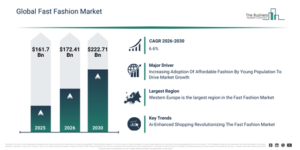
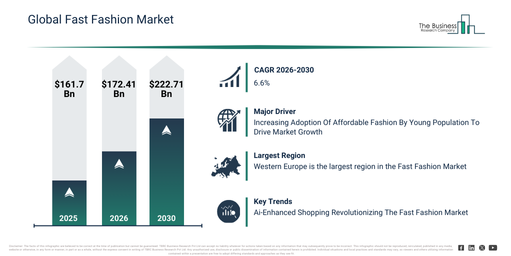
The fast fashion market has experienced substantial expansion in recent years. It is projected to grow from $161.7 billion in 2025 to $172.41 billion in 2026, demonstrating a compound annual growth rate (CAGR) of 6.6%. The historical growth of this market can be attributed to the rise in global apparel consumption, the expansion of international fashion retail chains, the increasing influence of fashion weeks and runways, the availability of low-cost manufacturing hubs, and a growing demand for fashion driven by youth.
The fast fashion market is projected to experience robust expansion over the coming years. Its valuation is anticipated to reach $222.71 billion by 2030, demonstrating a compound annual growth rate (CAGR) of 6.6%. This expansion during the forecast period is fueled by several factors, including the greater uptake of AI-driven demand forecasting, an increasing emphasis on sustainable fast fashion practices, the broadening of online fashion retail channels, a surge in the application of nearshoring tactics, and a heightened need for apparel collections that respond quickly to trends. Key developments expected within this period encompass the escalating embrace of data-centric trend forecasting, accelerated apparel speed-to-market cycles, deeper incorporation of digital design and sampling utilities, the widening of omnichannel retail approaches, and a stronger concentration on production models that optimize costs.
Get A Free Sample Report With In-Depth Market Insights:
Fast Fashion Market Demand Drivers Opening New Revenue Streams
The expanding youth demographic’s increasing preference for affordable apparel is expected to significantly drive the fast fashion market forward. Individuals typically aged 15 to 24, comprising the youth population, are highly susceptible to changing fashion trends, social media, and celebrity culture, which fuels their demand for stylish yet cost-effective clothing. The steady rise in the global youth population contributes to higher consumption of fast-fashion products, as these young consumers seek out unique, trendy, and budget-friendly clothes that align with the latest fashion movements. Fast fashion brands address this by rapidly translating recent styles from international fashion weeks into mass-produced, low-cost apparel, ensuring quick access to current trends. United Nations estimates project the world’s youth population to grow by 7.9% to 1.3 million by 2030. This attraction of the youth to unique, trendy, and affordable clothes is prompting apparel manufacturers to focus on delivering fashion items reflecting the most recent trends presented at Fashion Week, thereby boosting the fast fashion market. The increasing penetration of social media platforms is anticipated to fuel the growth of the fast fashion market. These platforms, which are websites or mobile applications, enable users to connect and share content such as photos, videos, and messages. Social media facilitates the rapid spread of fashion information, enhances trend awareness, and encourages user-generated content and real-time engagement. It also supports influencer marketing, flash sales, and limited editions. Furthermore, social commerce, customer feedback, data collection for personalization, and the potential for viral trends all contribute to the expansion of the fast fashion industry. For example, a report from the Office of Communications (Ofcom), a UK-based government body, indicated in November 2024 that Reddit had become the fastest-growing major social media platform in the UK by June 2024, reaching over half of online adults, specifically 24.6 million users, or 52% of the population. Its audience increased by 47% year-on-year, surpassing X (formerly Twitter) and LinkedIn to become the fifth-largest platform. Growth was particularly pronounced among younger adults, with 71% of 18-24-year-olds and 63% of 25-34-year-olds using Reddit, an increase from 58% and 49% respectively in the previous year. Consequently, the rising penetration of social media platforms is driving the growth of the fast fashion market.
Fast Fashion Market Segment Performance And Emerging Opportunities
The fast fashion market covered in this report is segmented –
1) By Gender: Men’s Wear, Women’s Wear
2) By Distribution Channel: Brand-Owned Retail Stores, Online Or E-Commerce Platforms, Multi-Brand Retailers, Franchise Stores, Wholesale And Distributors
3) By Application: Casual Wear, Work or Formal Wear, Sportswear and Activewear, Outerwear, Intimate and Loungewear, Accessories and Footwear, Kids and Teen Wear, Seasonal and Occasion Wear
Subsegments:
1) By Men’s Wear: Casual Wear, Trend-Led Formal Wear, Athleisure & Active-Inspired Wear, Fast-Fashion Outerwear, Denim Wear, Trend Accessories
2) By Women’s Wear: Casual Wear, Dresses & Jumpsuits, Trend-Led Formal Wear, Athleisure & Active-Inspired Wear, Fast-Fashion Outerwear, Denim Wear, Trend Accessories
Fast Fashion Market Trends Powering Strategic Industry Growth
Leading companies in the fast fashion market are integrating artificial intelligence into their applications to maintain a competitive advantage. For example, in August 2023, Sizekick GmbH, a Germany-based software development company, introduced sizing AI specifically for fashion e-commerce stores. This AI-powered technology utilizes precise individual body measurements to recommend the accurate clothing sizes, intending to eliminate size uncertainty and lower return rates in online shopping. It presents two size recommendation choices: BodyFinder, which suggests realistic body shapes, and BodyScanner, which allows users to scan their bodies via a smartphone. This technology seeks to minimize size-related returns and has attracted considerable interest from industry leaders and brand collaborations.
Fast Fashion Market Key Players Shaping Industry Direction
Major companies operating in the fast fashion market are Inditex (Zara), H&M Group, The Gap Inc., Fast Retailing (Uniqlo), Associated British Foods plc (Primark), ASOS Plc, Mango, New Look, C&A, Forever 21, Cotton On Group, Topshop, Bershka, Boohoo Group, LPP SA., Aeropostale, American Eagle Outfitters, Old Navy, Hollister, Next, Urban Outfitters, Esprit, Esprit Holdings Limited, United Arrows Ltd., Allen Solly, Future Lifestyle Fashions, Jack Wills, Colin’s, Zumiez, Colcci, MoroZoni, Houpa, Zadea Group, Osman Jamjoom Group
View The Full Fast Fashion Market Report:
Fast Fashion Market Regional Analysis: Which Geography Leads On Revenue?
Western Europe was the largest region in the fast fashion market in 2025. Asia-Pacific was the second largest region in the global fast fashion market share. The regions covered in the fast fashion market report are Asia-Pacific, South East Asia, Western Europe, Eastern Europe, North America, South America, Middle East, Africa.
Reach Out To Our Team:
The Business Research Company: https://www.thebusinessresearchcompany.com/
Americas: +1 310-496-7795
Asia: +44 7882 955267 & +91 8897263534
Europe: +44 7882 955267
Email us at: marketing@tbrc.info
Follow us on:
LinkedIn: https://in.linkedin.com/company/the-business-research-company
YouTube: https://www.youtube.com/channel/UC24_fI0rV8cR5DxlCpgmyFQ
Global Market Model: https://www.thebusinessresearchcompany.com/global-market-model

Wasay has over a decade of experience in market research, data modelling, and analytics, with prior experience at GlobalData and Decision Tree Consulting Services. At The Business Research Company , he leads research operations across syndicated studies, customized consulting engagements, and the Global Market Model platform. His professional experience includes supporting organizations such as Boston Consulting Group, KPMG, and Ernst & Young. Wasay holds a degree in Electronics and Communications Engineering, postgraduate management qualifications from International Management Institute Belgium and Indian School of Business and Entrepreneurship, and completed the Integrated Program in Business Analytics from Indian Institute of Management Indore.