Featuring market attractiveness scoring, total addressable market sizing, company benchmarking matrices, interactive Excel dashboards, deeper supply chain intelligence, emerging startup tracking, and granular product-level insights, The Business Research Company’s 2026 market reports are built to deliver research that is both more actionable and more strategically valuable.
Glass Fiber Reinforced Plastic (GFRP) Composites Market Poised To Hit $39.85 Billion By 2030 With A 7.3% CAGR
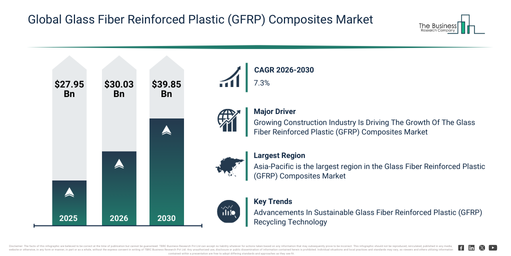
The glass fiber reinforced plastic (gfrp) composites market size has seen strong growth in recent years. It is forecast to increase from $27.95 billion in 2025 to $30.03 billion in 2026, achieving a compound annual growth rate (CAGR) of 7.4%. This historical expansion can be linked to the growth of construction and infrastructure projects, the increasing application of composites in transportation, a heightened demand for corrosion-resistant materials, advancements in resin and fiber technologies, and the rising adoption of composite manufacturing processes.
The glass fiber reinforced plastic (gfrp) composites market size is poised for significant expansion over the next few years. It is expected to reach $39.85 billion in 2030, growing at a compound annual growth rate (CAGR) of 7.3%. This projected growth is driven by factors such as an escalating demand for lightweight components in electric vehicles, an increase in renewable energy installations, broader adoption of composites in aerospace and defense industries, growing investments in advanced manufacturing processes, and innovations in recyclable composite materials. Dominant trends during the forecast period include the increasing incorporation of lightweight composite materials, the expanded utilization of gfrp in structural capacities, the widespread implementation of automated composite manufacturing techniques, an enhanced focus on corrosion-resistant materials, and the integration of components featuring a high strength-to-weight ratio.
Get A Free Sample Report With In-Depth Market Insights:
Glass Fiber Reinforced Plastic (GFRP) Composites Market Growth Drivers: What’s Behind The Acceleration?
The expansion of the construction sector is anticipated to drive the demand for the glass fiber-reinforced plastic (GFRP) composite market in the future. This industry encompasses all endeavors related to erecting and constructing infrastructure and various edifices. Urbanization acts as a catalyst for building projects, as increasing urban populations necessitate additional housing, infrastructure, and commercial premises, thereby sustaining continuous construction endeavors. Glass fiber reinforced plastic (GFRP) composites are recognized for their light weight and resilience, offering excellent resistance to corrosion and prolonging the functional life of structures. This material effectively strengthens concrete, improves adaptability in design, and prevents both rust and electromagnetic interference. As an illustration, in February 2025, data from the US Census Bureau, a US-based government statistical agency, indicated that construction expenditure in 2024 reached approximately US$ 2, 154.4 billion. This figure represented a 6.5% increase compared to the roughly US$ 2, 023.7 billion recorded in 2023. Consequently, the expanding construction industry is fueling the rise of the glass fiber reinforced plastic (GFRP) composites market.
Glass Fiber Reinforced Plastic (GFRP) Composites Market Breakdown By Product Type And Application
The glass fiber reinforced plastic (gfrp) composites market covered in this report is segmented –
1) By Resin Type: Thermoplastic, Polyurethane, Polyester, Epoxy, Vinyl Ester, Other Resin Types
2) By Glass Type: S-Glass, C-Glass, E-Glass, Other Glass Types
3) By Manufacturing Process: Compression Molding, Injection Molding, Layup, Filament Winding, Pultrusion, Resin Transfer Molding (RTM) And Vacuum-Assisted Resin Transfer Molding (VARTM), Other Manufacturing Processes
4) By End-User: Transportation, Renewable Energy, Electric And Electronics, Military And Defense, Telecommunication, Building And Construction, Other End-Users
Subsegments:
1) By Thermoplastic: Polypropylene (PP), Polyamide (PA), Polyethylene (PE), Polyvinyl Chloride (PVC), Acrylonitrile Butadiene Styrene (ABS)
2) By Polyurethane: Rigid Polyurethane Composites, Flexible Polyurethane Composites, Polyurethane Foam Composites
3) By Polyester: Unsaturated Polyester Resin (UPR), Isophthalic Polyester, Orthophthalic Polyester
4) By Epoxy: Bisphenol-A (BPA) Epoxy Resin, Novolac Epoxy Resin, Specialty Epoxy Resin For Composites
5) By Vinyl Ester: Standard Vinyl Ester Resin, Specialty Vinyl Ester Resin, Vinyl Ester Resin For Corrosion Resistance
6) By Other Resin Types: Phenolic Resin, Bismaleimide (BMI) Resin, Polyimide Resin, Cyanate Ester Resin
Glass Fiber Reinforced Plastic (GFRP) Composites Market Trends: What’s Defining The Industry’s Next Phase?
Companies operating significantly within the glass fiber reinforced plastic (GFRP) composites market are developing advanced solutions related to glass fiber reinforced plastic (GFRP) recycling technology to enhance sustainability and mitigate environmental impact. The objective of glass fiber-reinforced plastic recycling technology is to recover and reuse glass fibers from discarded GFRP materials, thereby addressing environmental concerns by facilitating the efficient recycling of both fibers and resins. For example, in October 2023, Toray Industries Inc., a Japan-based textile industry company, launched its Glass fiber-reinforced polyphenylene sulfide (GFRP-PPS) recycling technology. This innovation offers equivalent mechanical strength to virgin PPS, even with 50% or more recycled content. The company utilizes proprietary compounding techniques to combine PPS resin with specific reinforcing fibers, which effectively reduces glass fiber shortening and breaking during the recycling process. Additionally, the product cuts CO2 emissions by at least 40 percent. Its remarkable heat and chemical resistance makes it suitable for various industrial applications, including electronic components and electric vehicle parts.
Glass Fiber Reinforced Plastic (GFRP) Composites Market Top Companies Driving Competitive Growth
Major companies operating in the glass fiber reinforced plastic (gfrp) composites market are Reliance Industries, Mitsubishi Chemical Group Corporation, Asahi Kasei Corporation, Toray Industries Inc., Owens Corning, Celanese Corporation, Huntsman International LLC, Hexcel Corporation, SGL Carbon SE, Saint-Gobain Group, Röchling SE & Co. KG, 3B-the Fiberglass Company, Pultrall Inc., Advanced Composites Inc., Jiuding New Material Co. Ltd., Tuf-Bar Inc., Tribeni Fiber Pvt Ltd., Stromberg Architectural, Everest Composites Pvt. Ltd., RG Fibrotech Private Limited, Chongqing Dujiang Composites Co. Ltd.
View The Full Glass Fiber Reinforced Plastic (GFRP) Composites Market Report:
Glass Fiber Reinforced Plastic (GFRP) Composites Market Global Footprint: Which Region Leads The Industry?
Asia-Pacific was the largest region in the glass fiber reinforced plastic (GFRP) composites market in 2025. Asia-Pacific is expected to be the fastest-growing region in the forecast period. The regions covered in the glass fiber reinforced plastic (gfrp) composites market report are Asia-Pacific, South East Asia, Western Europe, Eastern Europe, North America, South America, Middle East, Africa.
Reach Out To Our Team:
The Business Research Company: https://www.thebusinessresearchcompany.com/
Americas: +1 310-496-7795
Asia: +44 7882 955267 & +91 8897263534
Europe: +44 7882 955267
Email us at: marketing@tbrc.info
Follow us on:
LinkedIn: https://in.linkedin.com/company/the-business-research-company
YouTube: https://www.youtube.com/channel/UC24_fI0rV8cR5DxlCpgmyFQ
Global Market Model: https://www.thebusinessresearchcompany.com/global-market-model

Wasay has over a decade of experience in market research, data modelling, and analytics, with prior experience at GlobalData and Decision Tree Consulting Services. At The Business Research Company , he leads research operations across syndicated studies, customized consulting engagements, and the Global Market Model platform. His professional experience includes supporting organizations such as Boston Consulting Group, KPMG, and Ernst & Young. Wasay holds a degree in Electronics and Communications Engineering, postgraduate management qualifications from International Management Institute Belgium and Indian School of Business and Entrepreneurship, and completed the Integrated Program in Business Analytics from Indian Institute of Management Indore.