
Backed by market attractiveness analysis, total addressable market sizing, company benchmarking matrices, interactive Excel dashboards, wider supply chain intelligence, emerging startup coverage, and detailed product-level insights, The Business Research Company’s 2026 market reports are designed to offer research that is more actionable and strategically valuable than ever.
Plastic Porous Medical Devices Market CAGR Outlook And Future Development
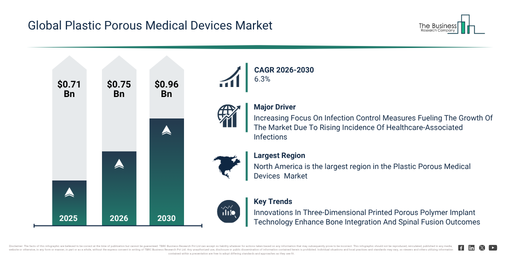
The plastic porous medical devices market size has seen significant expansion in recent years. This market is projected to grow from $0.71 billion in 2025 to $0.76 billion in 2026, at a compound annual growth rate (CAGR) of 6.1%. The growth witnessed during the historic period stems from factors such as growing demand for minimally invasive medical devices, increasing prevalence of chronic diseases, rising adoption of advanced wound management products, expanding use of diagnostic devices, and an increasing focus on infection prevention.
The plastic porous medical devices market size is projected for substantial expansion over the upcoming years. This market is set to reach $0.96 billion by 2030, exhibiting a compound annual growth rate (CAGR) of 6.3%. This anticipated growth during the forecast period stems from factors such as the increasing need for implantable medical components, greater investment in sophisticated biomaterials, the rising embrace of precision drug delivery systems, an expanding requirement for high-performance filtration technologies, and enhanced healthcare infrastructure development. Key developments expected within this period involve the greater adoption of high-porosity medical components, a growing call for advanced fluid management solutions, an increased application of biocompatible porous polymer materials, the broadening of contamination control technologies in medical devices, and the intensified creation of customized porous medical components.
Get A Free Sample Report With In-Depth Market Insights:
Plastic Porous Medical Devices Market Growth Drivers: What’s Behind The Acceleration?
The anticipated expansion of the plastic porous medical devices market going forward is linked to an escalating emphasis on infection control measures. These measures represent the strategies employed by healthcare institutions to avert the spread of pathogens among both patients and healthcare personnel. Hospitals and clinics are intensifying their concentration on these practices, given that a growing occurrence of healthcare-associated infections contributes to higher patient morbidity, mortality, and increased treatment expenses. Plastic porous medical devices contribute to infection control by facilitating regulated fluid drainage, enhancing tissue breathability, and minimizing bacterial accumulation on device surfaces. As an illustration, data from January 2026, provided by the Centers for Disease Control and Prevention, a US-based service organization dedicated to public health protection, indicates that roughly 1 in 31 hospital patients in the United States experiences at least one healthcare-associated infection daily. Consequently, the heightened attention to infection control protocols is a significant factor propelling the expansion of the plastic porous medical devices market.
Plastic Porous Medical Devices Market Segment Landscape And Growth Outlook
The plastic porous medical devices market covered in this report is segmented –
1) By Product Type: Porous Plastic Filters, Porous Plastic Vents, Porous Catheter Components, Porous Drug Delivery Components
2) By Functionality: Fluid Filtration And Separation, Venting And Pressure Equalization, Diagnostic Wicking And Capillary Flow, Tissue Ingrowth And Scaffolding
3) By Material: Ultra High Molecular Weight Polyethylene, Polyether Ether Ketone, Polytetrafluoroethylene, Other Biocompatible Thermoplastics
4) By Application: Orthopedic, Cardiovascular, Drug Delivery And Diagnostics, Wound Management
5) By End User: Medical Device Manufacturers, Hospitals, Diagnostic Laboratories, Ambulatory Surgical Centers
Subsegments:
1) By Porous Plastic Filters: Sintered Polyethylene Filters, Sintered Polytetrafluoroethylene Filters, Hydrophobic Filters, Hydrophilic Filters, Depth Filtration Filters
2) By Porous Plastic Vents: Hydrophobic Membrane Vents, Pressure Equalization Vents, Sterile Barrier Vents, Protective Vent Plugs, Air Flow Vents
3) By Porous Catheter Components: Catheter Vent Plugs, Porous Catheter Tips, Flow Control Inserts, Fluid Distribution Components, Catheter Filter Elements
4) By Porous Drug Delivery Components: Controlled Release Reservoirs, Porous Drug Diffusion Components, Implantable Drug Delivery Components, Transdermal Drug Delivery Components, Injectable Drug Delivery Components
Plastic Porous Medical Devices Market Trends: What’s Defining The Industry’s Next Phase?
Leading companies within the plastic porous medical devices sector are concentrating on developing advanced technologies, such as 3D-printed porous PEEK (Polyether Ether Ketone) interbody technology, with the goals of improving implant performance, fostering biological integration, and creating next-generation polymer-based medical solutions. This 3D-printed porous PEEK interbody technology represents a sophisticated additive manufacturing approach that yields patient-specific polymer implants featuring controlled, interconnected porous structures. These designs are intended to support bone ingrowth, enhance implant stability, and emulate natural bone-like mechanical properties. For example, in June 2025, Curiteva, a US-based medical device company, introduced the Inspire Trabecular PEEK Standalone ALIF System, marking it as the first 3D-printed standalone PEEK implant to integrate HAFUSE surface technology for promoting cell attachment and bone integration. The implant itself incorporates a fully interconnected porous lattice structure, which contributes to elevated biological performance and enables better biomechanical load sharing when compared to conventional titanium implants.
Plastic Porous Medical Devices Market Competitive Landscape: Who Leads The Industry?
Major companies operating in the plastic porous medical devices market report are Porex Corporation, Saint-Gobain Life Sciences, Wilbert Lee Gore & Associates Inc., Freudenberg Medical, Medtronic plc, Porvair Filtration Group, Cobetter Filtration Equipment Co. Ltd., Ahlstrom, Teleflex Incorporated, GenPore, Atex Technologies Inc., Interstate Specialty Products Inc., Poriferous LLC, Pore Technology Inc., Sansuk Industries
View The Full Plastic Porous Medical Devices Market Report:
Plastic Porous Medical Devices Market Regional Split: Which Areas Are Fueling Growth?
North America was the largest region in the plastic porous medical devices market in 2025. Asia-Pacific is expected to be the fastest-growing region in the forecast period. The regions covered in the plastic porous medical devices market report are Asia-Pacific, South East Asia, Western Europe, Eastern Europe, North America, South America, Middle East, Africa.
Reach Out To Our Team:
The Business Research Company: https://www.thebusinessresearchcompany.com/
Americas: +1 310-496-7795
Asia: +44 7882 955267 & +91 8897263534
Europe: +44 7882 955267
Email us at: marketing@tbrc.info
Follow us on:
LinkedIn: https://in.linkedin.com/company/the-business-research-company
YouTube: https://www.youtube.com/channel/UC24_fI0rV8cR5DxlCpgmyFQ
Global Market Model: https://www.thebusinessresearchcompany.com/global-market-model

Wasay has over a decade of experience in market research, data modelling, and analytics, with prior experience at GlobalData and Decision Tree Consulting Services. At The Business Research Company , he leads research operations across syndicated studies, customized consulting engagements, and the Global Market Model platform. His professional experience includes supporting organizations such as Boston Consulting Group, KPMG, and Ernst & Young. Wasay holds a degree in Electronics and Communications Engineering, postgraduate management qualifications from International Management Institute Belgium and Indian School of Business and Entrepreneurship, and completed the Integrated Program in Business Analytics from Indian Institute of Management Indore.