
Through market attractiveness analysis, total addressable market evaluation, company benchmarking matrices, interactive Excel dashboards, expanded supply chain intelligence, emerging startup coverage, and detailed product insights, The Business Research Company’s 2026 market reports provide more actionable and strategically valuable research.
Prefab Wood Building Market Value Analysis: What Growth Is Expected Over The Forecast Period?
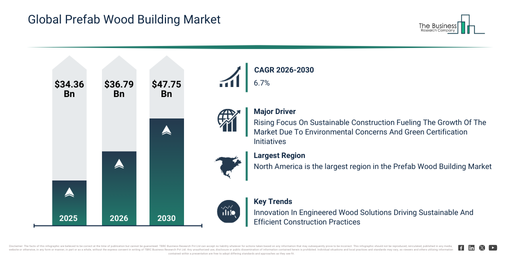
The prefab wood building market size has demonstrated robust expansion over recent years. It is anticipated to increase from $34.36 billion in 2025 to $36.79 billion in 2026, registering a compound annual growth rate (CAGR) of 7.0%. This growth observed in the historic period can be linked to the expansion of residential housing demand, increasing labor shortages in construction, the adoption of prefabrication techniques, the rising use of engineered wood products, and the availability of factory-built wood components.
The prefab wood building market is expected to experience significant growth over the next few years. It is projected to expand to $47.75 billion by 2030, exhibiting a compound annual growth rate (CAGR) of 6.7%. This expansion during the forecast period can be attributed to increased investments in sustainable building practices, a rising demand for low-carbon construction materials, the growth of multi-family residential projects, an expanding application of modular construction, and greater adoption in commercial buildings. Noteworthy trends in the forecast period include the increasing incorporation of off-site wood construction methods, a growing demand for rapid-assembly building solutions, a developing preference for engineered timber structures, an expansion in modular residential projects, and an intensified focus on construction efficiency.
Download A Free Sample Report For Comprehensive Market Insights:
Prefab Wood Building Market Growth Factors Supporting Long-Term Expansion
The increasing need for sustainable construction is projected to boost the growth of the prefab wood building market in the coming years. Sustainable construction involves developing buildings and infrastructure in a manner that lessens environmental harm, utilizes resources efficiently, and fosters long-term ecological well-being. This rise in sustainable construction is attributed to mounting environmental concerns, as governments and industries increasingly prioritize cutting carbon emissions and preserving natural resources to combat climate change. Prefab wood buildings contribute to sustainable construction by minimizing material waste and reducing on-site construction duration, resulting in a lower environmental impact and more effective resource utilization. For instance, in December 2024, a report by the Green Building Council, an Australia-based government agency, indicated that the Australian building sector achieved a significant milestone, surpassing 1,000 buildings, fitouts, and precincts awarded green star certification for their sustainability achievements in 2024. Additionally, the volume of submissions for these certifications has doubled from 2023 levels, with more than 120 project applications and over 150 inquiries recorded in just three months. Hence, the rising demand for sustainable construction is propelling the expansion of the prefab wood building market.
Prefab Wood Building Market Segment Performance And Strategic Opportunities
The prefab wood building market covered in this report is segmented –
1) By Panel Systems: Cross-Laminated Timber Panels, Nail-Laminated Timber Panels, Dowel-Laminated Timber Panels, Glue-Laminated Timber Columns And Beams
2) By Application: Single Family Residential, Multi-Family Residential, Office, Hospitality
3) By End User: Private Sector, Public Sector
Subsegments:
1) By Cross-Laminated Timber Panels: Layer Counts, Laminations Orientation, Panel Configurations
2) By Nail‑Laminated Timber (NLT) Panels: Board Thicknesses, Board Widths, Fastening Methods
3) By Dowel‑Laminated Timber (DLT) Panels: Lumber Stack With Hardwood Dowels, All-Wood System, Variants
4) By Glue-Laminated Timber Columns And Beams: Member Shape, Orientation, Appearance Grades
Prefab Wood Building Market Industry Trends Shaping Future Revenue Growth
Leading companies in the prefabricated wood building market are concentrating on developing innovative solutions, such as cross-laminated timber products, to facilitate quicker and cleaner on-site assembly. Cross-laminated timber products are created by layering pieces of wood in alternating directions and bonding them together to form durable and stable panels utilized in construction. For instance, in February 2025, Cambium, a US-based company focused on sustainable urban wood utilization, introduced Carbon Smart Wood for mass timber, a cross-laminated timber (CLT) product made from reclaimed wood. Carbon Smart CLT stands out due to its emphasis on carbon reduction, material traceability, and the use of engineered wood to foster sustainable construction. It is produced from reclaimed wood, acquired through a connected network of arborists, sawmills, and producers, which improves supply chain efficiency. The product fulfills rigorous structural demands while storing about one metric ton of CO₂ per cubic meter, making it a lower-carbon alternative compared to steel and concrete. Carbon Smart CLT contributes to a circular economy and integrates seamlessly into current construction practices.
Prefab Wood Building Market Key Players: Which Companies Shape Industry Competition?
Major companies operating in the prefab wood building market are Clayton Homes, Skyline Champion Corporation, American Homestar, Palm Harbor Homes Inc., Morgan Building Systems Inc., Honkarakenne, Wick Buildings Inc., American Modular Systems, Southland Log Homes, Lindal Cedar Homes, Lester Building Systems , Fertighaus Weiss GmbH, Tumbleweed Houses, Wausau Homes, Praxis Modular, Perpetual Homes Inc., D.R. Johnson Wood Innovations LLC, Green‑R‑Panel LLC, Hixwood Structures, Appalachian Log Structures Inc.
Access The Complete Prefab Wood Building Market Report:
#Prefab Wood Building Market Largest Region: Which Geography Holds The Highest Market Share?
North America was the largest region in the prefab wood building Market in 2025. Asia‑Pacific is expected to be the fastest-growing region in the forecast period. The regions covered in the prefab wood building market report are Asia-Pacific, South East Asia, Western Europe, Eastern Europe, North America, South America, Middle East, Africa.
Get in touch with us:
The Business Research Company: https://www.thebusinessresearchcompany.com/
Americas: +1 310-496-7795
Asia: +44 7882 955267 & +91 8897263534
Europe: +44 7882 955267
Email us at: marketing@tbrc.info
Follow us on:
LinkedIn: https://in.linkedin.com/company/the-business-research-company
YouTube: https://www.youtube.com/channel/UC24_fI0rV8cR5DxlCpgmyFQ
Global Market Model: https://www.thebusinessresearchcompany.com/global-market-model

Wasay has over a decade of experience in market research, data modelling, and analytics, with prior experience at GlobalData and Decision Tree Consulting Services. At The Business Research Company , he leads research operations across syndicated studies, customized consulting engagements, and the Global Market Model platform. His professional experience includes supporting organizations such as Boston Consulting Group, KPMG, and Ernst & Young. Wasay holds a degree in Electronics and Communications Engineering, postgraduate management qualifications from International Management Institute Belgium and Indian School of Business and Entrepreneurship, and completed the Integrated Program in Business Analytics from Indian Institute of Management Indore.