Backed by market attractiveness analysis, total addressable market sizing, company benchmarking matrices, interactive Excel dashboards, wider supply chain intelligence, emerging startup coverage, and detailed product-level insights, The Business Research Company’s 2026 market reports are designed to offer research that is more actionable and strategically valuable than ever.
Q-NOVA Recycled Nylon Market Growth Potential: How Will Market Size Shift Through 2030?
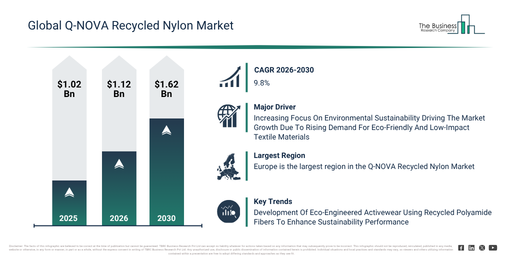
The Q-NOVA recycled nylon market has demonstrated strong growth in recent years. It is anticipated to expand from $1.02 billion in 2025 to $1.12 billion in 2026, achieving a compound annual growth rate (CAGR) of 9.6%. This historical growth can be linked to several factors, including the increasing generation of textile waste from fast fashion cycles, the rising use of synthetic fibers in apparel manufacturing, an increase in industrial nylon demand across the automotive and consumer goods industries, the expansion of global apparel manufacturing hubs, and growing environmental awareness within textile supply chains.
The market for Q-NOVA recycled nylon is projected to experience substantial expansion over the coming years, reaching $1.62 billion by 2030, exhibiting a compound annual growth rate (CAGR) of 9.8%. This anticipated growth during the forecast period is driven by several factors, including stricter sustainability regulations concerning virgin polymer manufacturing, a rising demand for sourcing circular and recycled materials, the proliferation of sustainable fashion labels and environmentally aware brands, advancements in mechanical recycling efficiency through technology, and an increase in corporate commitments towards net-zero emissions and ESG (Environmental, Social, and Governance) targets within textile supply chains. Key trends identified for this period encompass the increasing integration of circular textile materials in apparel production, a heightened need for synthetic fiber alternatives with lower environmental impact in the fashion sector, an expansion in recycled performance fibers utilized for activewear, the broadening of closed-loop textile recycling infrastructures throughout global supply chains, and the intensified application of mechanically recycled nylon in both automotive interiors and specialized technical textiles.
Get A Free Sample Report With In-Depth Market Insights:
Q-NOVA Recycled Nylon Market Growth Drivers: What’s Behind The Acceleration?
A heightened emphasis on environmental sustainability is anticipated to drive the expansion of the Q-Nova recycled nylon market in the foreseeable future. Environmental sustainability involves the judicious utilization and stewardship of natural resources to mitigate ecological damage and lessen the enduring environmental footprint of industrial activities. This escalating focus on environmental responsibility is primarily fueled by rising regulatory demands, with governments and global entities enacting more stringent rules and criteria. These aim to decrease dependence on virgin fossil-derived materials and facilitate a shift towards circular, less impactful alternatives. This move towards environmental sustainability prompts producers and brands to incorporate recycled materials, such as Q-Nova recycled nylon, given its reduced carbon footprint and its role in redirecting waste from landfills and oceans when contrasted with traditional nylon manufacturing. For example, in October 2024, the European Commission, an administrative body located in Belgium, reported that by September 2024, close to 3,000 licenses had been issued, encompassing 98,977 products within the EU market. Since March 2024, an additional 240 licenses were granted (marking a 9% increase), and 3,220 more products obtained the label (a 3% rise). Relative to September of the prior year, approximately 10,000 more products now feature this label, signifying robust growth across most EU Ecolabel product categories. Consequently, the growing attention to environmental sustainability is propelling the Q-Nova recycled nylon market’s growth.
Q-NOVA Recycled Nylon Market Segment Breakdown: Which Categories Lead On Revenue?
The Q-NOVA recycled nylon market covered in this report is segmented –
1) By Product Type: Staple Fiber, Filament Yarn, Other Product Types
2) By Production Process: Mechanical Recycling Process, Specialty Variant Production, Other Production Processes
3) By Distribution Channel: Direct Sales, Distributors And Wholesalers, Online Retail, Other Distribution Channels
4) By Application: Activewear And Sportswear, Lingerie And Intimates, Hosiery And Legwear, Swimwear, Ready To Wear Apparel, Other Applications
5) By End User: Textile Industry, Automotive Industry, Consumer Goods, Other End Users
Subsegments:
1) By Staple Fiber: Virgin Equivalent Fiber, Regenerated Textile Fiber, Industrial Grade Fiber, High Strength Fiber, Fine Denier Fiber
2) By Filament Yarn: Fully Drawn Yarn, Partially Oriented Yarn, Textured Filament Yarn, Air Textured Yarn, High Tenacity Yarn
3) By Other Product Types: Nonwoven Fabric Material, Engineering Plastic Material, Composite Reinforcement Material, Injection Molding Material, Extrusion Grade Material
Q-NOVA Recycled Nylon Market Trends: What’s Defining The Industry’s Next Phase?
Major companies operating in the Q-NOVA recycled nylon market are strategically focusing on creating recycled polyamide fibers, including eco-engineered activewear lines, to elevate sustainability performance, lessen environmental harm, and meet the increasing consumer need for high-performance, eco-conscious textile solutions. Eco-engineered activewear lines describe performance apparel collections designed utilizing sustainable materials and environmentally responsible production methods. For instance, in April 2025, Run & Relax, a Sweden-based activewear brand, introduced its Spring/Summer 2025 collection featuring Q-NOVA to improve sustainability, reduce its environmental footprint, and offer high-quality garments made from recycled polyamide fibers. The SS25 activewear line provides high-performance fabrics derived from pre-consumer waste. It delivers lightweight comfort, breathability, and durability while significantly reducing environmental impact through lower CO₂ emissions and water consumption.
Q-NOVA Recycled Nylon Market Key Players Shaping Industry Direction
Major companies operating in the q-nova recycled nylon market are Fulgar S.p.A.
View The Full Q-NOVA Recycled Nylon Market Report:
Q-NOVA Recycled Nylon Market Regional Analysis: Which Geography Leads On Revenue?
Europe was the largest region in the Q-NOVA recycled nylon market in 2025. Asia-Pacific is expected to be the fastest-growing region in the forecast period. The regions covered in the Q-NOVA recycled nylon market report are Asia-Pacific, South East Asia, Western Europe, Eastern Europe, North America, South America, Middle East, Africa.
Reach Out To Our Team:
The Business Research Company: https://www.thebusinessresearchcompany.com/
Americas: +1 310-496-7795
Asia: +44 7882 955267 & +91 8897263534
Europe: +44 7882 955267
Email us at: marketing@tbrc.info
Follow us on:
LinkedIn: https://in.linkedin.com/company/the-business-research-company
YouTube: https://www.youtube.com/channel/UC24_fI0rV8cR5DxlCpgmyFQ
Global Market Model: https://www.thebusinessresearchcompany.com/global-market-model

Wasay has over a decade of experience in market research, data modelling, and analytics, with prior experience at GlobalData and Decision Tree Consulting Services. At The Business Research Company , he leads research operations across syndicated studies, customized consulting engagements, and the Global Market Model platform. His professional experience includes supporting organizations such as Boston Consulting Group, KPMG, and Ernst & Young. Wasay holds a degree in Electronics and Communications Engineering, postgraduate management qualifications from International Management Institute Belgium and Indian School of Business and Entrepreneurship, and completed the Integrated Program in Business Analytics from Indian Institute of Management Indore.