
Backed by market attractiveness analysis, total addressable market sizing, company benchmarking matrices, interactive Excel dashboards, wider supply chain intelligence, emerging startup coverage, and detailed product-level insights, The Business Research Company’s 2026 market reports are designed to offer research that is more actionable and strategically valuable than ever.
Rubber Compound Market Size, Value And Growth Trajectory Through 2030
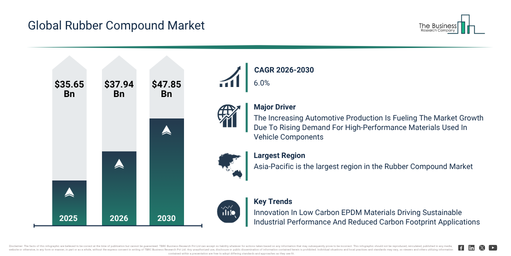
The rubber compound market has experienced substantial growth in recent years. This market is projected to expand from $35.65 billion in 2025 to $37.94 billion in 2026, exhibiting a compound annual growth rate (CAGR) of 6.4%. The historical growth can be attributed to several factors, including increasing automotive production and the demand for rubber components, growing industrial manufacturing activities, rising construction and infrastructure development, an increasing demand for durable and high-performance materials, and the expanding applications in the electrical and electronics sectors.
The rubber compound market is projected to experience substantial expansion over the next few years. It is expected to reach $47.85 billion in 2030, growing at a compound annual growth rate (CAGR) of 6.0%. This growth during the forecast period is attributed to the increasing adoption of sustainable rubber formulations, rising demand for lightweight and efficient automotive materials, the development of advanced specialty rubber compounds, increasing demand for electric vehicle rubber components, and a growing focus on improved material performance and lifecycle durability. Key trends for this period include the increasing adoption of high-performance rubber compounds, a growing demand for bio-based and sustainable rubber formulations, the rising development of advanced rubber additive technologies, an increasing focus on enhanced durability and heat-resistant rubber materials, and a growing demand for customized rubber compound solutions.
Get A Free Sample Report With In-Depth Market Insights:
Rubber Compound Market Opportunity Drivers: What’s Unlocking New Revenue Potential?
A rise in automotive manufacturing is projected to boost the expansion of the rubber compound market moving ahead. This refers to the high-volume creation of motor vehicles, encompassing passenger cars, commercial vehicles, and electric vehicles. The growth in automotive output stems from increasing consumer desire for personal mobility, as a greater number of individuals favor possessing or utilizing private vehicles for convenient, adaptable, and efficient travel over public transport alternatives. In automotive manufacturing, rubber compound supplies crucial materials for tires, seals, hoses, gaskets, and vibration-dampening parts, thereby improving vehicle durability, safety, comfort, and performance, which allows producers to create dependable and superior vehicles in large quantities. For example, in April 2026, data from the International Organization of Motor Vehicle Manufacturers, a trade association based in France, indicated that worldwide vehicle production escalated from 92.7 million units in 2024 to 96.4 million units in 2025, signifying a 3.9% increment. Concurrently, global sales climbed from 95.3 million to 99.8 million units, an increase of 4.7%. Consequently, the expanding automotive manufacturing sector is propelling the growth of the rubber compound market.
Rubber Compound Market Segment Trends And Revenue Contributors
The rubber compound market covered in this report is segmented –
1) By Product Type: Synthetic Rubber, Natural Rubber
2) By Product Form: Solid Rubber, Liquid Rubber, Powdered Rubber
3) By Rubber Type: Silicone Rubber, Fluoro Rubber, Butyronitrile Rubber, Ethylene Propylene Diene Monomer Rubber, Chloroprene Rubber
4) By Processing Method: Compression Molding, Injection Molding
5) By End Use Industry: Automotive, Industrial Manufacturing, Construction, Electrical And Electronics
Subsegments:
1) By Synthetic Rubber: Styrene Butadiene Rubber, Polybutadiene Rubber, Nitrile Butadiene Rubber, Chloroprene Rubber
2) By Natural Rubber: Ribbed Smoked Sheet Rubber, Technically Specified Natural Rubber, Latex Concentrate Rubber, Crepe Rubber
Rubber Compound Market Innovation Trends Shaping Future Development
Key players in the rubber compound market are prioritizing the creation of novel products, particularly low carbon footprint EPDM rubber compounds, with the aim of improving sustainability, ensuring consistent performance, and meeting environmental regulations in various industrial uses. These low carbon footprint EPDM rubber compounds are ethylene propylene diene monomer elastomers that utilize bio-based or recycled feedstocks rather than fossil-derived materials. This approach assists in lowering emissions, promoting sustainability, and preserving performance levels in sealing and industrial applications. As an illustration, in April 2026, Trelleborg Sealing Solutions, a Sweden-based sealing and polymer solutions company, introduced EPDM rubber grades with a reduced carbon footprint. These grades were engineered to substantially decrease product carbon emissions while offering performance comparable to traditional materials. The production of these EPDM compounds involves non-fossil, bio-circular feedstocks obtained from renewable origins, including used cooking oil, straw, forestry residue, and tall oil. These materials achieve up to 55 percent reduction in product carbon footprint and are ideal for applications such as O-rings, gaskets, and engineered sealing components, finding use throughout the automotive, industrial, energy, and construction sectors. This advancement underscores the increasing trend towards sustainable rubber compound development, propelled by circular economy principles and more stringent environmental regulations.
Rubber Compound Market Competitive Landscape: Which Companies Lead The Industry?
Major companies operating in the rubber compound market are Continental AG, Shin-Etsu Chemical Co. Ltd., Ravago Manufacturing Americas LLC, Wacker Chemie AG, Hutchinson SA, Cooper Standard Automotive Inc., HEXPOL Compounding, Teknor Apex Company, Mesnac Co. Ltd., RTP Company, Myers Industries Inc., KRAIBURG Holding GmbH & Co. KG, Kossan Rubber Industries Bhd, AirBoss of America Corp., Polymer-Technik Elbe GmbH, Rubberlite Inc., Zenith Industrial Rubber Products Pvt. Ltd., Condor Compounds GmbH, Chang Horing Rubber Co. Ltd., ENA Advanced Rubber Technologies, Polycomp B.V., CS Rubber Industry Co. Ltd., Trident Rubber Pvt. Ltd.
View The Full Rubber Compound Market Report:
Rubber Compound Market Regional Outlook: Where Is Opportunity Concentrated?
Asia-Pacific was the largest region in the rubber compound market in 2025. Asia-Pacific is expected to be the fastest-growing region in the forecast period. The regions covered in the rubber compound market report are Asia-Pacific, South East Asia, Western Europe, Eastern Europe, North America, South America, Middle East, Africa.
Reach Out To Our Team:
The Business Research Company: https://www.thebusinessresearchcompany.com/
Americas: +1 310-496-7795
Asia: +44 7882 955267 & +91 8897263534
Europe: +44 7882 955267
Email us at: marketing@tbrc.info
Follow us on:
LinkedIn: https://in.linkedin.com/company/the-business-research-company
YouTube: https://www.youtube.com/channel/UC24_fI0rV8cR5DxlCpgmyFQ
Global Market Model: https://www.thebusinessresearchcompany.com/global-market-model

Wasay has over a decade of experience in market research, data modelling, and analytics, with prior experience at GlobalData and Decision Tree Consulting Services. At The Business Research Company , he leads research operations across syndicated studies, customized consulting engagements, and the Global Market Model platform. His professional experience includes supporting organizations such as Boston Consulting Group, KPMG, and Ernst & Young. Wasay holds a degree in Electronics and Communications Engineering, postgraduate management qualifications from International Management Institute Belgium and Indian School of Business and Entrepreneurship, and completed the Integrated Program in Business Analytics from Indian Institute of Management Indore.