
Through market attractiveness analysis, total addressable market evaluation, company benchmarking matrices, interactive Excel dashboards, expanded supply chain intelligence, emerging startup coverage, and detailed product insights, The Business Research Company’s 2026 market reports provide more actionable and strategically valuable research.
Textile Market Value Analysis: What Growth Is Expected Over The Forecast Period?
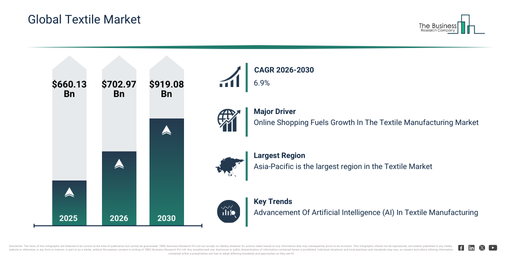
The textile market size has seen robust growth in recent years. It is anticipated to expand from $660.13 billion in 2025 to $702.97 billion in 2026, achieving a compound annual growth rate (CAGR) of 6.5%. This historical growth can be attributed to several factors, including the expansion of global apparel manufacturing, an increase in household consumption of textiles, the availability of diverse raw fiber sources, a rising demand for home furnishings, and the development of large-scale textile mills.
The textile market size is projected to experience substantial growth in the coming years, with an expected rise to $919.08 billion by 2030, driven by a compound annual growth rate (CAGR) of 6.9%. This anticipated growth during the forecast period can be attributed to several factors, including increasing demand for eco-friendly apparel, the expansion of technical textiles into industrial applications, growing investments in smart textile manufacturing, a rising focus on the circular textile economy, and the increasing adoption of digital manufacturing technologies. Key trends identified for this period include the growing embrace of sustainable and organic fibers, an escalating demand for technical and performance textiles, the broadening application of digital textile printing, an increasing utilization of recycled and bio-based materials, and an enhanced emphasis on supply chain traceability.
Download A Free Sample Report For Comprehensive Market Insights:
Textile Market Growth Factors Supporting Long-Term Expansion
The growing prevalence of online shopping is anticipated to fuel the expansion of the textile sector moving ahead. This involves consumers acquiring clothing, textiles, and related items via internet platforms rather than physical retail outlets. This surge is primarily driven by wider internet availability, enabling more individuals to effortlessly explore, compare, and acquire goods from any location. The increasing embrace of online shopping benefits the textile industry by boosting demand for a broader range of textiles and finished apparel. It also empowers producers and sellers to access an expanded customer base, present varied assortments, and swiftly adapt to evolving fashion dynamics. For example, data from February 2024, provided by the U.S. Census Bureau, a US-based government agency, indicated that total e-commerce sales in 2023 reached an estimated $1, 118.7 billion, representing a 7.6 percent (±1.2%) rise compared to 2022. Consequently, the expanding trend of online purchasing is a key factor propelling the textile market’s growth.
Textile Market Segment Analysis And Revenue Opportunities
The textile market covered in this report is segmented –
1) By Type: Fabrics, Yarn, Fiber And Thread, Home Furnishings And Floor Coverings, Textile And Fabric Finishing And Fabric Coating Mills, Other Textile Product Mills
2) By Material: Cotton, Jute, Silk, Synthetics, Wool
3) By Process: Woven, Non-Woven
Subsegments:
1) By Fabrics: Woven Fabrics, Knitted Fabrics, Non-Woven Fabrics
2) By Yarn: Spun Yarns, Filament Yarns, Specialty Yarns
3) By Fiber And Thread: Natural Fibers, Synthetic Fibers, Threads For Sewing And Embroidery
4) By Home Furnishings And Floor Coverings: Upholstery Fabrics, Curtains And Draperies, Rugs And Carpets
5) By Textile And Fabric Finishing And Fabric Coating Mills: Dyeing And Printing Services, Fabric Finishing Processes, Coating For Performance Textiles
6) By Other Textile Product Mills: Technical Textiles, Non-Apparel Textiles
Textile Market Innovation Trends: Which Developments Are Transforming The Industry?
Major companies operating in the textile market are increasingly focusing on developing innovative solutions, such as artificial intelligence (AI)-powered platforms, to enhance production efficiency and improve product quality. These AI-driven platforms for textile manufacturing contribute to optimizing production processes, reducing material waste, and enabling automated quality inspection of fabrics. For instance, in October 2024, Lectra, a France-based technology company, unveiled Valia Fashion. Lectra’s Valia Fashion platform is notable for seamlessly connecting, automating, and streamlining every stage of apparel production, from order processing to fabric cutting. It optimizes material usage and facilitates the digital transformation of fashion companies, supporting their transition towards Industry 4.0. By eliminating barriers between industrialization and production processes, Valia Fashion revolutionizes the fashion ecosystem, enabling brands, manufacturers, and subcontractors to meet their evolving requirements more effectively.
Textile Market Leading Players Shaping Industry Direction
Major companies operating in the textile market are Toray Industries Inc., Mohawk Industries Inc., Far Eastern New Century, Tex Tech Industries, Beaulieu International Group, Santana Textiles LLC, Yarnz, Australian Textile Mills ATM, Bruck Textiles, Spunchem International, Mattex Yarns, Arvind Ltd., Bombay Rayon Fashions Limited, Luthai Textile, Huafu, Siltex Brasil Ltda, Jiangsu Sunshine Co Ltd., Huafang Group Co Ltd., Shangtex Holding Co Ltd., Shijiazhuang Changshan Textile Co Ltd., Lenzing, Coats, Ugurteks, Ardalanish Mill, European Spinning Group, AMANN Group, Simba Textile Mills Pty Ltd., Shandong Jining Ruyi Woolen Textile Co Ltd., Fabreex, United Textiles, Domarex SC, Santista Argentina SA, Unifi Inc., Vardhman Textiles, Dunmore Corp, Fabrico, The Yarn Room, Bally Ribbon Mills, Paramount Texteis, Pettenati Industria Textil SA, National Spinning Co, Hyosung TNC, Fabricato SA, Reliance Industries Limited, Saudi Spinning & Textile Mill, Fiacao Sao Bento SA, Town End Alpacas, Como Luxury Fabrics, Textil Sao Joao, Weiqiao Textile Company Limited, Aratex Group, Shandong Demian Incorporated Company, Fibertex South Africa, Elasticos Yarns, Trelleborg Engineered Coated Fabrics, AlSaraTex Co., Integrated Fibres Limited
Access The Complete Textile Market Report:
Textile Market Leading Geography: Which Region Generates The Most Revenue?
Asia-Pacific was the largest region in the textile market in 2025. Western Europe was the second largest region in the textile market. The regions covered in the textile market report are Asia-Pacific, South East Asia, Western Europe, Eastern Europe, North America, South America, Middle East, Africa.
Get in touch with us:
The Business Research Company: https://www.thebusinessresearchcompany.com/
Americas: +1 310-496-7795
Asia: +44 7882 955267 & +91 8897263534
Europe: +44 7882 955267
Email us at: marketing@tbrc.info
Follow us on:
LinkedIn: https://in.linkedin.com/company/the-business-research-company
YouTube: https://www.youtube.com/channel/UC24_fI0rV8cR5DxlCpgmyFQ
Global Market Model: https://www.thebusinessresearchcompany.com/global-market-model

Wasay has over a decade of experience in market research, data modelling, and analytics, with prior experience at GlobalData and Decision Tree Consulting Services. At The Business Research Company , he leads research operations across syndicated studies, customized consulting engagements, and the Global Market Model platform. His professional experience includes supporting organizations such as Boston Consulting Group, KPMG, and Ernst & Young. Wasay holds a degree in Electronics and Communications Engineering, postgraduate management qualifications from International Management Institute Belgium and Indian School of Business and Entrepreneurship, and completed the Integrated Program in Business Analytics from Indian Institute of Management Indore.