
Backed by market attractiveness analysis, total addressable market sizing, company benchmarking matrices, interactive Excel dashboards, wider supply chain intelligence, emerging startup coverage, and detailed product-level insights, The Business Research Company’s 2026 market reports are designed to offer research that is more actionable and strategically valuable than ever.
Vulcanised Solid Rubber Market Growth Analysis: How Will Revenue Trend Over The Forecast Period?
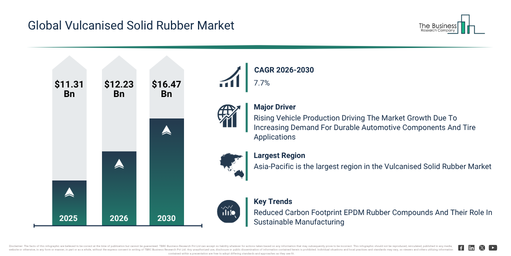
The vulcanised solid rubber market has experienced significant expansion in recent years. It is anticipated to grow from $11.31 billion in 2025 to $12.23 billion in 2026, achieving a compound annual growth rate (CAGR) of 8.2%. The historical increase in market size can be attributed to the increasing demand for durable industrial components, the rising adoption of rubber products in automotive applications, growing industrial machinery production, increasing infrastructure development activities, and the expanding use of rubber seals and protective components.
The vulcanised solid rubber market size is predicted to undergo significant expansion in the forthcoming years. It is foreseen to attain $16.47 billion by 2030, demonstrating a compound annual growth rate (CAGR) of 7.7%. This expansion during the forecast period is attributable to an escalating demand for sustainable rubber materials, the increasing adoption of electric vehicles which necessitate advanced rubber components, a rise in automation across rubber manufacturing processes, a growing requirement for high performance elastomer solutions, and broadening applications within the healthcare and electronics industries. Prominent trends throughout this period include the increased uptake of high performance vulcanised rubber materials, a rising need for rubber components resistant to heat and chemicals, the ongoing development of advanced rubber compounding technologies, an expanded application of durable rubber solutions in industrial sectors, and a heightened focus on lightweight and long life rubber products.
Get A Free Sample Report With In-Depth Market Insights:
Vulcanised Solid Rubber Market Growth Drivers: What’s Behind The Acceleration?
The anticipated future expansion of the vulcanised solid rubber market is closely linked to the increasing output of vehicles. This production encompasses the fabrication of diverse automobiles, such as passenger vehicles, commercial transporters, and motorcycles, achieved by assembling various parts like engines, chassis, tires, and interior fittings. The rise in vehicle manufacturing is driven by expanding urbanization, which in turn fuels greater demand for private automobiles and commercial transportation for purposes like daily travel, freight distribution, and public transit. Vulcanised solid rubber improves robustness, flexibility, thermal stability, and capacity to bear loads. These characteristics make it highly suitable for automotive and industrial uses where enduring, dependable, and abrasion-resistant material qualities are crucial for parts like tires, seals, mounts, and vibration absorption systems functioning in demanding environments. An example illustrates this trend: in April 2026, data from the International Organization of Motor Vehicle Manufacturers, a trade association based in France, showed that worldwide vehicle production escalated from 92.7 million units in 2024 to 96.4 million units in 2025, representing a 3.9% increase. Simultaneously, global sales ascended from 95.3 million to 99.8 million units, indicating a 4.7% growth. Consequently, the expansion of vehicle production is a key factor propelling the growth within the vulcanised solid rubber market.
Vulcanised Solid Rubber Market Segments: Where Is Growth Concentrated?
The vulcanised solid rubber market covered in this report is segmented –
1) By Product Type: Natural Rubber Products, Styrene Butadiene Rubber Products, Butadiene Rubber Products, Ethylene Propylene Diene Monomer Rubber Products, Nitrile Rubber Products, Chloroprene Rubber Products, Silicone Rubber Products
2) By Hardness: Soft Vulcanised Solid Rubber, Medium Hardness Vulcanised Solid Rubber, Hard Vulcanised Solid Rubber
3) By Manufacturing Type: Compression Molding, Transfer Molding, Injection Molding, Extrusion, Calendering
4) By Application Type: Automotive And Transportation, Industrial Machinery And Equipment, Construction And Infrastructure, Electrical And Electronics, Healthcare And Medical Devices, Consumer Goods
Subsegments:
1) By Natural Rubber Products: General Purpose Vulcanised Natural Rubber Products, High Tensile Strength Natural Rubber Products, Industrial Grade Vulcanised Natural Rubber Products, Wear Resistant Natural Rubber Components
2) By Styrene Butadiene Rubber Products: High Abrasion Resistance Styrene Butadiene Rubber Products, Automotive Grade Vulcanised Styrene Butadiene Rubber Products, Industrial Styrene Butadiene Rubber Sheets And Molded Products, General Purpose Styrene Butadiene Rubber Products
3) By Butadiene Rubber Products: High Elasticity Butadiene Rubber Products, Low Temperature Resistant Butadiene Rubber Products, Tire Grade Vulcanised Butadiene Rubber Products, Industrial Butadiene Rubber Molded Components
4) By Ethylene Propylene Diene Monomer Rubber Products: Weather Resistant Ethylene Propylene Diene Monomer Rubber Products, Heat Resistant Vulcanised Ethylene Propylene Diene Monomer Products, Automotive Ethylene Propylene Diene Monomer Sealing Products, Electrical Insulation Ethylene Propylene Diene Monomer Components
5) By Nitrile Rubber Products: Oil Resistant Nitrile Rubber Products, Fuel Resistant Vulcanised Nitrile Rubber Products, Industrial Seals And Gaskets Nitrile Rubber Products, High Performance Nitrile Rubber Elastomers
6) By Chloroprene Rubber Products: Flame Resistant Chloroprene Rubber Products, Weather Resistant Chloroprene Rubber Products, Industrial Grade Vulcanised Chloroprene Rubber Products, Adhesive And Coating Based Chloroprene Rubber Products
7) By Silicone Rubber Products: High Temperature Resistant Silicone Rubber Products, Medical Grade Silicone Rubber Products, Electrical Insulation Silicone Rubber Products, Food Grade Vulcanised Silicone Rubber Products
Vulcanised Solid Rubber Market Trends: What’s Defining The Industry’s Next Phase?
Leading companies operating within the vulcanised solid rubber market are increasingly focused on developing innovative offerings, such as EPDM rubber compounds with a reduced carbon footprint, to improve sustainability, enhance material performance, and cut lifecycle emissions in various industrial elastomer applications. These particular EPDM rubber compounds are modified ethylene propylene diene monomer elastomers, produced using bio-based or recycled raw materials rather than entirely fossil-based inputs, which helps to lower lifecycle greenhouse gas emissions while preserving the same sealing performance, durability, and weather resistance as traditional EPDM rubber employed in industrial and automotive uses. For example, in April 2026, Trelleborg AB, a Sweden-based engineering polymer solutions company, introduced EPDM rubber grades featuring a reduced carbon footprint, specifically designed for critical sealing applications across the automotive, industrial, and energy sectors. These new materials deliver up to 55% lower product carbon footprint while maintaining performance comparable to conventional EPDM elastomers, with their formulations achieving these reductions through bio-based raw material sourcing and the integration of recycled carbon black. Such compounds are utilized in products like O-rings, gaskets, and engineered seals for engines, valves, pumps, HVAC systems, and construction equipment, assisting industries in their transition towards lower-emission material solutions without compromising reliability or mechanical performance. This development highlights the growing shift in the vulcanised solid rubber market towards circular, bio-based, and low-carbon elastomer technologies.
Vulcanised Solid Rubber Market Key Participants And Competitive Landscape
Major companies operating in the vulcanised solid rubber market are Arkema S.A., Bridgestone Corporation, Freudenberg SE, HEXPOL AB, Hutchinson S.A., Kumho Petrochemical Co. Ltd., LANXESS AG, Sumitomo Rubber Industries Ltd., Synthos S.A., The Goodyear Tire & Rubber Company, The Yokohama Rubber Co. Ltd., Trelleborg AB, TSRC Corporation, Versalis S.p.A., Zeon Corporation
View The Full Vulcanised Solid Rubber Market Report:
Vulcanised Solid Rubber Market Regional Analysis: Which Geography Leads On Revenue?
Asia-Pacific was the largest region in the vulcanised solid rubber market in 2025. Asia-Pacific is expected to be the fastest-growing region in the forecast period. The regions covered in the vulcanised solid rubber market report are Asia-Pacific, South East Asia, Western Europe, Eastern Europe, North America, South America, Middle East, Africa.
Reach Out To Our Team:
The Business Research Company: https://www.thebusinessresearchcompany.com/
Americas: +1 310-496-7795
Asia: +44 7882 955267 & +91 8897263534
Europe: +44 7882 955267
Email us at: marketing@tbrc.info
Follow us on:
LinkedIn: https://in.linkedin.com/company/the-business-research-company
YouTube: https://www.youtube.com/channel/UC24_fI0rV8cR5DxlCpgmyFQ
Global Market Model: https://www.thebusinessresearchcompany.com/global-market-model

Wasay has over a decade of experience in market research, data modelling, and analytics, with prior experience at GlobalData and Decision Tree Consulting Services. At The Business Research Company , he leads research operations across syndicated studies, customized consulting engagements, and the Global Market Model platform. His professional experience includes supporting organizations such as Boston Consulting Group, KPMG, and Ernst & Young. Wasay holds a degree in Electronics and Communications Engineering, postgraduate management qualifications from International Management Institute Belgium and Indian School of Business and Entrepreneurship, and completed the Integrated Program in Business Analytics from Indian Institute of Management Indore.