
Through market attractiveness analysis, total addressable market evaluation, company benchmarking matrices, interactive Excel dashboards, expanded supply chain intelligence, emerging startup coverage, and detailed product insights, The Business Research Company’s 2026 market reports provide more actionable and strategically valuable research.
Autologous Hematopoietic Stem Cell Gene Therapy Market Forecast: What Market Value Is Expected By 2030?
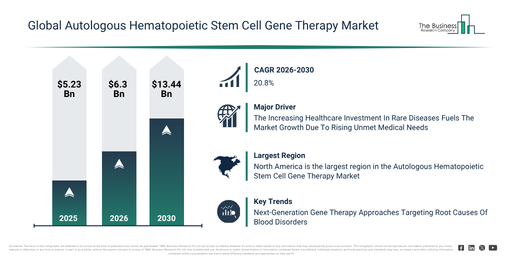
The market size for autologous hematopoietic stem cell gene therapy has experienced significant growth in recent years. It is anticipated to expand from $5.23 billion in 2025 to $6.3 billion in 2026, at a compound annual growth rate (CAGR) of 20.6%. This historical development can be attributed to several factors, including advancements in viral vector technologies, the increasing prevalence of rare genetic disorders, a rise in stem cell transplantation procedures, the growing clinical success of ex vivo therapies, and the expansion of regenerative medicine research.
The autologous hematopoietic stem cell gene therapy market size is projected to experience substantial growth over the coming years. It is anticipated to reach $13.44 billion by 2030, exhibiting a compound annual growth rate (CAGR) of 20.8%. The expansion during the forecast period can be attributed to the increasing commercialization of gene editing therapies, a rise in regulatory approvals for advanced treatments, the growing acceptance of personalized medicine, greater investment in cell and gene therapy infrastructure, and the creation of next-generation non-viral delivery platforms. Major trends foreseen for this period encompass advancements in autologous stem cell engineering platforms, the broadening of ex vivo hematopoietic stem cell modification therapies, the rising use of personalized curative treatments for uncommon genetic conditions, the evolution of next-generation viral and non-viral gene delivery systems, and an expanding clinical pipeline for hematopoietic stem cell-based regenerative therapies.
Download A Free Sample Report For Comprehensive Market Insights:
Autologous Hematopoietic Stem Cell Gene Therapy Market Growth Factors Supporting Long-Term Expansion
The future expansion of the autologous hematopoietic stem cell gene therapy market is anticipated, driven by escalating healthcare funding directed towards rare diseases. Rare diseases are conditions impacting less than 1 in 2,000 individuals, frequently presenting with intricate symptoms and restricted therapeutic choices. Healthcare funding for rare diseases is climbing, stimulated by growing governmental incentives like orphan drug policies, tax credits, and regulatory backing, which motivate pharmaceutical firms to develop therapies for small, neglected patient groups. This investment is speeding up the creation and uptake of autologous hematopoietic stem cell gene therapy through financing cutting-edge research, facilitating clinical studies, and enhancing availability of costly personalized treatments that target the genetic origins of rare blood and immune conditions. An illustration of this trend is seen in April 2024, when Global Genes, a US-based nonprofit, reported that during the first quarter of 2024, companies focused on developing treatments for rare diseases secured $7.1 billion via public equity and debt financings. This represented a substantial 307% surge compared to the $1.8 billion obtained in the corresponding period of 2023. Consequently, expanding healthcare investment in rare diseases is propelling the expansion of the autologous hematopoietic stem cell gene therapy market.
#Autologous Hematopoietic Stem Cell Gene Therapy Market Segment Landscape And Growth Potential
The autologous hematopoietic stem cell gene therapy market covered in this report is segmented –
1) By Therapy Type: Gene Addition Therapy; Gene Editing Therapy; Viral Vector Based Therapy; Non Viral Vector Based Therapy
2) By Disease Area: Rare Blood Disorders; Primary Immunodeficiency; Lysosomal Storage Disorders; Hemoglobinopathies
3) By End User: Hospitals; Specialty Clinics; Research Institutes; Cell And Gene Therapy Centers
Subsegments:
1) By Gene Addition Therapy: Ex Vivo Gene Addition Therapy; Retroviral Gene Addition Therapy; Stable Gene Transfer Therapy; Corrective Gene Replacement Therapy
2) By Gene Editing Therapy: Clustered Regularly Interspaced Short Palindromic Repeats Gene Editing; Zinc Finger Nuclease Gene Editing; Transcription Activator Like Effector Nuclease Gene Editing; Base Editing Therapy
3) By Viral Vector Based Therapy: Lentiviral Vector Therapy; Adenoviral Vector Therapy; Adeno Associated Viral Vector Therapy; Retroviral Vector Therapy
4) By Non Viral Vector Based Therapy: Electroporation Based Gene Delivery; Lipid Nanoparticle Gene Delivery; Plasmid Deoxyribonucleic Acid Delivery; Polymer Based Gene Delivery
Next-Generation Gene Therapy Approaches Targeting Root Causes Of Blood Disorders
Major companies operating in the autologous hematopoietic stem cell gene therapy market are focusing on developing innovative therapies, such as CRISPR/Cas9-based gene-edited treatments to address rare genetic blood disorders and improve long-term disease modification. CRISPR/Cas9-based gene-edited treatments are advanced therapies that use the CRISPR gene-editing system and Cas9 enzyme to precisely modify faulty DNA in a patient’s cells, helping by correcting the genetic cause of disease so the body can produce healthy cells or proteins, potentially reducing symptoms long-term or providing a one-time curative treatment instead of ongoing therapy. For instance, in February 2024, Vertex Pharmaceuticals Inc., a US-based biotechnology company, received conditional marketing authorization from the European Commission for CASGEVY (exagamglogene autotemcel), a CRISPR/Cas9 gene-edited therapy developed in collaboration with CRISPR Therapeutics, for the treatment of patients aged 12 years and older with severe sickle cell disease and transfusion-dependent beta thalassemia. The therapy is designed to edit hematopoietic stem cells outside the body and reinfuse them to enable sustained production of functional hemoglobin, thereby reducing or eliminating vaso-occlusive crises and the need for regular blood transfusions.
Autologous Hematopoietic Stem Cell Gene Therapy Market Competitive Landscape: Who Are The Leading Companies?
Major companies operating in the autologous hematopoietic stem cell gene therapy market are Novartis AG; Vertex Pharmaceuticals Incorporated; CSL Behring LLC; Orchard Therapeutics; Genetix Biotherapeutics; Crispr Therapeutics AG; Rocket Pharmaceuticals; Editas Medicine Inc.; Sangamo Therapeutics Inc.; Beam Therapeutics Inc.; Prime Medicine Inc.
Access The Complete Autologous Hematopoietic Stem Cell Gene Therapy Market Report:
Autologous Hematopoietic Stem Cell Gene Therapy Market Geographic Landscape: Which Region Dominates Industry Growth?
North America was the largest region in the autologous hematopoietic stem cell gene therapy market in 2025. Asia-Pacific is expected to be the fastest-growing region in the forecast period. The regions covered in the autologous hematopoietic stem cell gene therapy market report are Asia-Pacific, South East Asia, Western Europe, Eastern Europe, North America, South America, Middle East, Africa.
Get in touch with us:
The Business Research Company: https://www.thebusinessresearchcompany.com/
Americas: +1 310-496-7795
Asia: +44 7882 955267 & +91 8897263534
Europe: +44 7882 955267
Email us at: marketing@tbrc.info
Follow us on:
LinkedIn: https://in.linkedin.com/company/the-business-research-company
YouTube: https://www.youtube.com/channel/UC24_fI0rV8cR5DxlCpgmyFQ
Global Market Model: https://www.thebusinessresearchcompany.com/global-market-model

Wasay has over a decade of experience in market research, data modelling, and analytics, with prior experience at GlobalData and Decision Tree Consulting Services. At The Business Research Company , he leads research operations across syndicated studies, customized consulting engagements, and the Global Market Model platform. His professional experience includes supporting organizations such as Boston Consulting Group, KPMG, and Ernst & Young. Wasay holds a degree in Electronics and Communications Engineering, postgraduate management qualifications from International Management Institute Belgium and Indian School of Business and Entrepreneurship, and completed the Integrated Program in Business Analytics from Indian Institute of Management Indore.