
Featuring market attractiveness scoring, total addressable market sizing, company benchmarking matrices, interactive Excel dashboards, deeper supply chain intelligence, emerging startup tracking, and granular product-level insights, The Business Research Company’s 2026 market reports are built to deliver research that is both more actionable and more strategically valuable.
Carbon-Smart Employee Benefit Program Market Revenue Outlook: What CAGR Lies Ahead Through 2030?
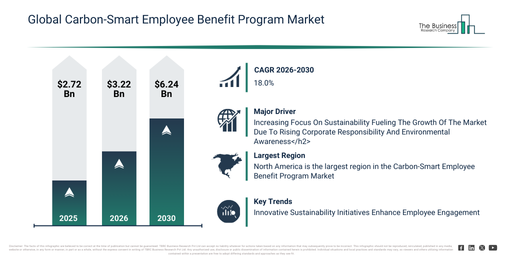
The market for carbon-smart employee benefit programs has seen rapid expansion in recent years. Its size is expected to increase from $2.72 billion in 2025 to $3.22 billion in 2026, reflecting a compound annual growth rate (CAGR) of 18.4%. The historical development of this market can be attributed to several factors, including a rise in corporate sustainability commitments, greater employee awareness of climate impact, the broadening of ESG reporting requirements, an increased adoption of green workplace initiatives, and an enhanced focus by employers on talent retention.
The market size for the carbon-smart employee benefit program is anticipated to experience significant expansion over the coming years. It is projected to reach $6.24 billion in 2030 at a compound annual growth rate (CAGR) of 18.0%. This growth during the forecast period can be attributed to several factors, including the increasing integration of carbon tracking technologies, a rising demand for measurable impact benefits, the expansion of green finance-linked incentives, growing adoption among SMEs, and an increasing alignment with net-zero corporate strategies. Furthermore, key trends expected in the forecast period involve the increasing adoption of ESG-linked employee benefits, a rising demand for carbon offset incentive programs, the growing integration of digital benefit management platforms, the expansion of sustainable commuting benefits, and an enhanced focus on employee engagement in climate action.
Get A Free Sample Report With In-Depth Market Insights:
Carbon-Smart Employee Benefit Program Market Expansion Drivers: What’s Shaping Future Growth?
The carbon-smart employee benefit program market is projected to expand due to a heightened emphasis on sustainability. Sustainability is defined as fulfilling current requirements without jeopardizing future generations’ capacity to meet theirs, achieved by balancing environmental stewardship, social accountability, and economic progress. This elevated focus on sustainability stems from growing corporate accountability for environmental protection, with businesses striving to diminish their carbon footprint and satisfy both regulatory demands and consumer preferences. Carbon-smart employee benefit initiatives contribute to sustainability by encouraging environmentally sound practices among staff, fostering smaller carbon footprints, and aligning with corporate objectives for an eco-friendlier and more sustainable work environment. For example, data from October 2024, provided by the US-based United States Environmental Protection Agency, indicated that greenhouse gas emissions reached 322 million metric tons in 2023, marking a 1.4% rise from 2022. Consequently, the rising need for environmental sustainability is fueling the expansion of the drone-assisted river pollution mapping market. As a result, the heightened attention on sustainability is propelling the growth of the carbon-smart employee benefit program market.
Carbon-Smart Employee Benefit Program Market Segment Outlook: Which Categories Are Growing Fastest?
The carbon-smart employee benefit program market covered in this report is segmented –
1) By Program Type: Carbon Offsetting, Sustainable Commuting Incentives, Green Retirement Plans, Other Program Types
2) By Organization Size: Small And Medium Enterprises, Large Enterprises
3) By Industry Vertical: Information Technology (IT) And Telecommunications, Banking, Financial Services, And Insurance (BFSI), Healthcare, Manufacturing, Retail, Other Industry Verticals
Subsegments:
1) By Carbon Offsetting: Renewable Energy Credits, Reforestation Initiatives, Direct Emissions Reduction Projects, Verified Carbon Standard Programs
2) By Sustainable Commuting Incentives: Public Transit Subsidies, Bicycle Purchase Assistance, Electric Vehicle Charging Access, Carpooling Rewards Programs
3) By Green Retirement Plans: Environmentally Responsible Investment Funds, Fossil Fuel Free Portfolios, Climate Impact Bond Options, Green Pension Schemes
4) By Other Program Types: Sustainable Office Supply Credits, Remote Work Environmental Incentives, Eco Education And Training Programs, Green Volunteer Day Opportunities
Carbon-Smart Employee Benefit Program Market Strategic Trends: What Defines The Next Growth Phase?
Companies operating in the carbon-smart employee benefit program market are concentrating on developing innovative sustainability initiatives, such as integrated carbon management platforms, to enhance corporate ESG performance, boost employee participation, and minimize organizational carbon footprints. Integrated carbon management platforms are defined as digital tools that allow businesses to quantify, decrease, and compensate for their emissions, often by encouraging employees to engage in climate action directly via benefits and incentives. As an illustration, in May 2024, Magnit Inc., a US-based human resources software provider, collaborated with CarbonClick Limited, a New Zealand-based software company, to introduce a carbon offsetting program designed to enable both temporary and permanent employees to assess, reduce, and offset their personal carbon footprints. This inventive sustainability effort embeds carbon management within Magnit’s Vendor Management System (VMS), which allows organizations to automatically compute the emissions from their contingent workforce’s travel and projects. It also features an effortless offsetting capability, enabling companies and their staff to contribute to impactful carbon reduction projects without requiring intricate administrative processes.
Carbon-Smart Employee Benefit Program Market Competitive Overview And Top Companies
Major companies operating in the carbon-smart employee benefit program market are Mapfre Global Risks, Adobe Inc., Lingaro Sp. z o.o., Dr. Bronner’s, TravelPerk, Greenly, NativeEnergy Inc., Mossy Earth Ltd., EcoSoul Partners, CarbonClick Ltd., Carbon Footprint Ltd., Sustaira Ltd., Scope Zero Ltd., BNZ Green Ltd.
View The Full Carbon-Smart Employee Benefit Program Market Report:
Carbon-Smart Employee Benefit Program Market Top Region: Where Does Most Revenue Come From?
North America was the largest region in the carbon-smart employee benefit program market in 2025.Asia-Pacific is expected to be the fastest-growing region in the forecast period. The regions covered in the carbon-smart employee benefit program market report are Asia-Pacific, South East Asia, Western Europe, Eastern Europe, North America, South America, Middle East, Africa.
Reach Out To Our Team:
The Business Research Company: https://www.thebusinessresearchcompany.com/
Americas: +1 310-496-7795
Asia: +44 7882 955267 & +91 8897263534
Europe: +44 7882 955267
Email us at: marketing@tbrc.info
Follow us on:
LinkedIn: https://in.linkedin.com/company/the-business-research-company
YouTube: https://www.youtube.com/channel/UC24_fI0rV8cR5DxlCpgmyFQ
Global Market Model: https://www.thebusinessresearchcompany.com/global-market-model

Wasay has over a decade of experience in market research, data modelling, and analytics, with prior experience at GlobalData and Decision Tree Consulting Services. At The Business Research Company , he leads research operations across syndicated studies, customized consulting engagements, and the Global Market Model platform. His professional experience includes supporting organizations such as Boston Consulting Group, KPMG, and Ernst & Young. Wasay holds a degree in Electronics and Communications Engineering, postgraduate management qualifications from International Management Institute Belgium and Indian School of Business and Entrepreneurship, and completed the Integrated Program in Business Analytics from Indian Institute of Management Indore.