Featuring market attractiveness scoring, total addressable market sizing, company benchmarking matrices, interactive Excel dashboards, deeper supply chain intelligence, emerging startup tracking, and granular product-level insights, The Business Research Company’s 2026 market reports are built to deliver research that is both more actionable and more strategically valuable.
Embodied Carbon Tracking For Infrastructure Market Value Growth And Long-Term Outlook
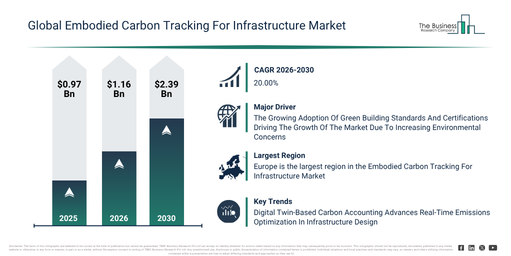
The embodied carbon tracking for infrastructure market size has experienced rapid growth in recent years. It is anticipated to increase from $0.97 billion in 2025 to $1.16 billion in 2026, demonstrating a compound annual growth rate (CAGR) of 19.7%. This historical growth can be attributed to a heightened focus on reducing greenhouse gas emissions in construction activities, the rising adoption of sustainable building certification standards, the global expansion of infrastructure development projects, increasing government regulations regarding environmental impact assessments, and a growing demand for digital construction planning and monitoring solutions.
The embodied carbon tracking for infrastructure market is anticipated to undergo significant growth in the upcoming years. It is forecast to reach $2.39 billion by 2030, exhibiting a compound annual growth rate (CAGR) of 20.0%. This expansion during the projection period can be attributed to several factors, including heightened investment in net-zero infrastructure development initiatives, the increasing use of AI-powered carbon analytics platforms, the wider implementation of IoT-enabled environmental monitoring systems, the spread of cloud-based sustainability reporting solutions, and the growing integration of carbon tracking tools with BIM platforms. Key developments expected throughout this period encompass a greater embrace of life cycle assessment-based carbon tracking systems, an escalating need for real-time carbon monitoring across infrastructure projects, the broader utilization of cloud-based embodied carbon management platforms, an increase in services for verifying and auditing carbon footprints for construction activities, and a heightened inclination towards selecting low-carbon materials and planning sustainable infrastructure.
Get A Free Sample Report With In-Depth Market Insights:
Embodied Carbon Tracking For Infrastructure Market Growth Backed By Core Demand Fundamentals
Increased acceptance of green building standards and certifications is projected to drive expansion within the embodied carbon tracking for infrastructure market moving ahead. These standards and certifications are formal frameworks and assessment systems designed to evaluate and acknowledge structures that are planned, built, and managed to minimize environmental effects, boost energy and resource effectiveness, and improve the well-being and sustainability for occupants. The increasing uptake of green building standards and certifications stems from rising environmental concerns, given their role in lowering carbon emissions, enhancing energy efficiency, preserving natural resources, and fostering sustainable and healthier constructions. Embodied carbon tracking for infrastructure provides a way to precisely measure and decrease emissions throughout a project’s lifecycle, consequently bolstering adherence to green building standards and aiding in obtaining sustainability certifications. As an illustration, in July 2024, the Green Building Council, a US-based nonprofit organization, reported its involvement in over 46,000 residential projects certified by the LEED green building rating system in 2024, which occurred after new LEED residential project registrations saw an almost 5% rise in 2023. Consequently, the increased embrace of green building standards and certifications is fueling the expansion of the embodied carbon tracking for infrastructure market.
Embodied Carbon Tracking For Infrastructure Market Segments: Where Is Growth Concentrated?
The embodied carbon tracking for infrastructure market covered in this report is segmented –
1) By Component: Software, Hardware, Services
2) By Tracking Methodology: Building Information Modeling Integrated Tracking, Life Cycle Assessment Based Tracking, Sensor Based And Internet Of Things Monitoring, Hybrid Manual And Digital Systems
3) By Deployment Mode: On-Premises, Cloud
4) By Application: Buildings, Roads And Highways, Bridges, Railways, Airports, Other Applications
5) By End-User: Construction Companies, Government And Regulatory Bodies, Engineering And Design Firms, Other End-Users
Subsegments:
1) By Software: Carbon Footprint Calculation Software, Life Cycle Assessment Software, Data Visualization Software, Cloud Based Monitoring Software
2) By Hardware: Sensors And Measurement Devices, Data Collection Terminals, Internet Of Things Enabled Monitoring Devices, Servers And Storage Units
3) By Services: Consulting Services, Implementation Services, Training And Support Services, Audit And Verification Services
Embodied Carbon Tracking For Infrastructure Market Growth Trends Reshaping The Competitive Landscape
Major companies operating in the embodied carbon tracking for Infrastructure market are prioritizing the creation of innovative solutions, including digital twin-enabled carbon accounting tools, to integrate real-time carbon measurement into infrastructure design and enhance emissions reduction across the entire project lifecycle. A digital twin-enabled carbon accounting solution is a system that utilizes a real-time digital replica of physical infrastructure to continuously monitor, track, and analyze carbon emissions throughout the design, construction, and operation stages. For instance, in October 2024, Bentley Systems Incorporated, a US-based infrastructure engineering software company, launched advanced carbon analysis capabilities within its iTwin Experience platform, an innovative digital twin-based carbon assessment solution that supports embodied carbon tracking for infrastructure projects. This solution facilitates automated material quantification by consolidating design data from various sources into a unified digital twin, thereby reducing dependence on manual quantity takeoffs and boosting accuracy in carbon calculations. It delivers cradle-to-gate embodied carbon analysis by connecting design elements with established carbon databases such as EC3 and One Click LCA, allowing engineers to evaluate emissions from the extraction of raw materials through manufacturing phases. The platform also features interactive 3D visualizations that depict carbon intensity as heat maps within infrastructure models, enabling users to compare different design alternatives and identify low-carbon materials early in the planning phase.
Embodied Carbon Tracking For Infrastructure Market Competitive Landscape: Which Companies Lead The Industry?
Major companies operating in the embodied carbon tracking for infrastructure market are Skanska AB, AECOM Technology Corporation, Stora Enso Oyj, Autodesk Inc., Stantec Inc., Trimble Inc., Arup Group Limited, Bentley Systems Incorporated, Persefoni AI Inc., Watershed Technology Inc., CarbonCure Technologies Inc., Sweep SAS, One Click LCA Ltd., Locus Technologies Inc., Matrak Industries Pty Ltd., Fandoro Technologies Private Limited, C-Change Labs Inc., Circular Ecology Ltd., Cerclos Pty Ltd., Climatiq GmbH
View The Full Embodied Carbon Tracking For Infrastructure Market Report:
Embodied Carbon Tracking For Infrastructure Market Regional Outlook: Where Is Opportunity Concentrated?
Europe was the largest region in the embodied carbon tracking for infrastructure market in 2025. Asia-Pacific is expected to be the fastest-growing region in the forecast period. The regions covered in the embodied carbon tracking for infrastructure market report are Asia-Pacific, South East Asia, Western Europe, Eastern Europe, North America, South America, Middle East and Africa.
Reach Out To Our Team:
The Business Research Company: https://www.thebusinessresearchcompany.com/
Americas: +1 310-496-7795
Asia: +44 7882 955267 & +91 8897263534
Europe: +44 7882 955267
Email us at: marketing@tbrc.info
Follow us on:
LinkedIn: https://in.linkedin.com/company/the-business-research-company
YouTube: https://www.youtube.com/channel/UC24_fI0rV8cR5DxlCpgmyFQ
Global Market Model: https://www.thebusinessresearchcompany.com/global-market-model

Wasay has over a decade of experience in market research, data modelling, and analytics, with prior experience at GlobalData and Decision Tree Consulting Services. At The Business Research Company , he leads research operations across syndicated studies, customized consulting engagements, and the Global Market Model platform. His professional experience includes supporting organizations such as Boston Consulting Group, KPMG, and Ernst & Young. Wasay holds a degree in Electronics and Communications Engineering, postgraduate management qualifications from International Management Institute Belgium and Indian School of Business and Entrepreneurship, and completed the Integrated Program in Business Analytics from Indian Institute of Management Indore.