
Built to provide research that’s more actionable and strategically valuable, The Business Research Company’s 2026 market reports include market attractiveness analysis, total addressable market sizing, company benchmarking matrices, interactive Excel dashboards, broader supply chain intelligence, emerging startup tracking, and in-depth product insights.
Environmental Impact Assessments Market Size And Revenue Outlook Through 2030
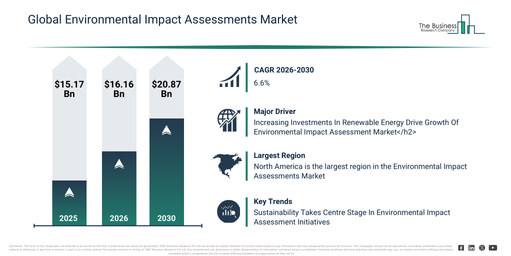
The environmental impact assessments market size has experienced significant growth in recent years. It is anticipated to expand from $15.17 billion in 2025 to $16.16 billion in 2026, at a compound annual growth rate (CAGR) of 6.5%. This historical expansion can be attributed to several factors, including the proliferation of infrastructure and urban development projects, more stringent environmental regulations, an increase in industrial project approvals, rising public environmental awareness, and a greater demand for risk mitigation planning.
The environmental impact assessments market is anticipated to show robust growth in the upcoming years. It is forecast to grow to $20.87 billion in 2030, achieving a compound annual growth rate (CAGR) of 6.6%. The expansion during this period can be attributed to the increasing incorporation of AI-driven assessment models, a heightened focus on climate resilience planning, the development of sustainable infrastructure projects, a rising need for continuous environmental monitoring, and the wider adoption of data-driven decision-making tools. Key trends expected in the forecast period include the increasing use of digital EIA tools, greater integration of GIS and remote sensing data, an escalating demand for real-time environmental monitoring, an expanded scope for climate impact assessments, and an enhanced emphasis on regulatory transparency.
Get A Free Sample Report With In-Depth Market Insights:
Environmental Impact Assessments Market Growth Factors: What’s Supporting Expansion?
Future expansion of the environmental impact assessment market is anticipated, driven by rising investments in renewable energy. Renewable energy sources are defined as those naturally occurring and perpetually renewing. This growth in renewable energy investments can be attributed to heightened global awareness and urgency regarding climate change, the increasing expenditure required for renewable energy technologies, and the proliferation of green bonds and similar financial instruments. Environmental impact assessment is vital for renewable energy projects, as it assesses the potential environmental ramifications of proposed developments. This procedure helps guarantee projects are environmentally sound, socially agreeable, and adhere to regulatory mandates. As an example, the International Energy Agency (IEA), an autonomous intergovernmental organization based in France, stated in its World Energy Investment 2024 report in June 2024 that global energy investment is forecast to exceed $3 trillion in 2024, a new high, with approximately $2 trillion allocated to clean energy technologies. Furthermore, China is expected to be the primary investor in clean energy, projecting $675 billion. Other major contributors include Europe at $370 billion and the United States at $315 billion. Consequently, the rising investments in renewable energy are fueling the expansion of the environmental impact assessment market.
Environmental Impact Assessments Market Segment Performance And Emerging Opportunities
The environmental impact assessments market covered in this report is segmented –
1) By Type: Hydrogeology, Hydrology, Contaminated Land, Geo-Conservation, Geotechnical Engineering
2) By Assessment Method: Screening, Scoping, Environmental Impact Assessments (EIA) Report, Review, Monitoring
3) By Application: Governmental, Industrial, Commercial, Residential, Infrastructure
Subsegments:
1) By Hydrogeology: Groundwater Flow Analysis, Aquifer Testing And Characterization, Contaminant Transport Modeling, Groundwater Resource Management, Water Quality Assessment
2) By Hydrology: Flood Risk Assessment, Stormwater Management Studies, Watershed And River Basin Modeling, Hydrological Impact On Infrastructure, Water Availability And Resource Management
3) By Contaminated Land: Site Contamination Risk Assessment, Soil Remediation And Cleanup Studies, Toxicology And Hazardous Materials Analysis, Landfill And Waste Disposal Impact Studies, Brownfield Site Assessments
4) By Geo-conservation: Geological Site Protection And Management, Biodiversity And Ecosystem Preservation, Assessment Of Natural Heritage Sites, Geological Hazard Mitigation (Landslides, Erosion), Conservation Of Geological Resources
5) By Geotechnical Engineering: Soil And Rock Mechanics Analysis, Ground Stability And Landslide Risk Assessment, Foundation Design And Engineering, Slope Stability Studies, Seismic Hazard And Earthquake Risk Assessment
Environmental Impact Assessments Market Industry Trends: What’s Reshaping Demand?
Leading companies within the environmental impact assessment market are concentrating on developing innovative initiatives, such as a proactive environmental impact strategy, to promptly evaluate and lessen the environmental effects of strategic projects, thereby fostering sustainable development. A proactive environmental impact strategy encompasses the implementation of practices and programs that surpass basic legal compliance, aiming to enhance environmental performance while anticipating and addressing potential environmental challenges before they arise. For instance, in April 2023, the Environment Agency Abu Dhabi (EAD), a principal environmental authority based in the UAE, introduced its Strategic Environmental Assessment (SEA) program. The SEA program involves structured phases like screening, scoping, impact assessment, stakeholder engagement, and continuous monitoring, ensuring environmental considerations are integrated from the very beginning of strategic projects. It promotes sustainable development by guiding mitigation strategies, protecting sensitive habitats, and providing early warnings of cumulative impacts, thereby supporting the UAE’s environmental and Net Zero goals.
Environmental Impact Assessments Market Top Companies Driving Competitive Growth
Major companies operating in the environmental impact assessments market are AECOM Technology Corporation, Bureau Veritas SA, Stantec Inc., GHD Group, Bidwells LLP, BRE Group, BMT Group Ltd., JBA Consulting, OCA Global Corporate Service S.A., Intertek Group PLC, Aspen Environmental Group, KERAMIDA Inc., Millennium EMS Solutions Ltd., Cholamandalam MS Risk Services Ltd., CSA Ocean Sciences Inc., Japan NUS Co. Ltd., EnviroCentre Limited, NGH Environmental Pty Ltd., Enviro-Sciences Inc., WRA Inc.
View The Full Environmental Impact Assessments Market Report:
Environmental Impact Assessments Market Global Footprint: Which Region Leads The Industry?
North America was the largest region in the environmental impact assessments market in 2025. The regions covered in the environmental impact assessments market report are Asia-Pacific, South East Asia, Western Europe, Eastern Europe, North America, South America, Middle East, Africa.
Reach Out To Our Team:
The Business Research Company: https://www.thebusinessresearchcompany.com/
Americas: +1 310-496-7795
Asia: +44 7882 955267 & +91 8897263534
Europe: +44 7882 955267
Email us at: marketing@tbrc.info
Follow us on:
LinkedIn: https://in.linkedin.com/company/the-business-research-company
YouTube: https://www.youtube.com/channel/UC24_fI0rV8cR5DxlCpgmyFQ
Global Market Model: https://www.thebusinessresearchcompany.com/global-market-model

Wasay has over a decade of experience in market research, data modelling, and analytics, with prior experience at GlobalData and Decision Tree Consulting Services. At The Business Research Company , he leads research operations across syndicated studies, customized consulting engagements, and the Global Market Model platform. His professional experience includes supporting organizations such as Boston Consulting Group, KPMG, and Ernst & Young. Wasay holds a degree in Electronics and Communications Engineering, postgraduate management qualifications from International Management Institute Belgium and Indian School of Business and Entrepreneurship, and completed the Integrated Program in Business Analytics from Indian Institute of Management Indore.