
Built to provide research that’s more actionable and strategically valuable, The Business Research Company’s 2026 market reports include market attractiveness analysis, total addressable market sizing, company benchmarking matrices, interactive Excel dashboards, broader supply chain intelligence, emerging startup tracking, and in-depth product insights.
Museums Market Revenue Growth On Track For A 5% CAGR Through 2030
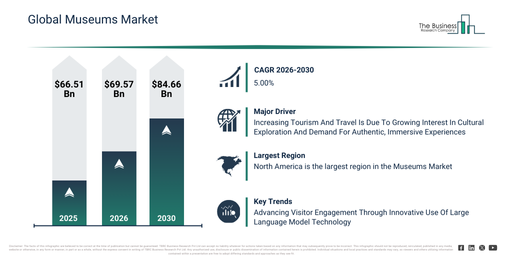
The museums market size has experienced consistent expansion in recent years. It is anticipated to increase from $66.51 billion in 2025 to $69.57 billion in 2026, demonstrating a compound annual growth rate (CAGR) of 4.6%. This historical growth can be linked to several factors, including public funding dedicated to cultural preservation, the enlargement of national and regional museum networks, the rise of educational tourism, a heightened focus on heritage conservation, and the implementation of structured exhibition formats.
The museums market is projected to experience substantial growth over the coming years, reaching $84.66 billion in 2030, driven by a compound annual growth rate (CAGR) of 5.0%. This expansion during the forecast period is primarily due to several factors, including heightened investments in the digital transformation of museums, a growing demand for immersive experiences for visitors, the proliferation of virtual museum platforms, an increased emphasis on sustainable museum practices, and strengthened partnerships with educational institutions. Key developments anticipated in this period encompass a greater embrace of digital and virtual exhibits, the increasing incorporation of interactive visitor experiences, a heightened focus on technologies for collection preservation, the broadening of educational and experiential programs, and improved utilization of data analytics for visitor engagement.
Get A Free Sample Report With In-Depth Market Insights:
Museums Market Expansion Drivers: What’s Shaping Future Growth?
The expansion of the museum market is anticipated to be propelled by the rise in tourism and travel. Tourism and travel refer to individuals briefly departing their regular environments to explore various locations for leisure, business, or educational purposes. This surge in tourism and travel stems from the enhanced affordability of transport, as budget airlines and promotional travel offers allow a greater number of individuals to access diverse destinations at reduced expenses. Increased tourism and travel contribute to the expansion of museums by elevating visitor attendance and income, thereby facilitating investments in improved exhibits and infrastructure. Furthermore, it garners worldwide recognition, fosters varied programming, and promotes development via collaborations and governmental assistance. For example, in May 2025, the United Nations World Tourism Organization, an intergovernmental body situated in Spain, reported that international tourist figures surpassed 300 million during the first three months of 2025, indicating an increase of nearly 14 million compared to the corresponding timeframe in 2024. Consequently, the growing prevalence of tourism and travel is fueling the expansion of the museum market.
Museums Market Segmentation: How Does The Market Break Down By Category?
The museums market covered in this report is segmented –
1) By Museum Type: Art Museums, History Museums, Science Museums, Children’s Museums, Natural History Museums, Specialized Museums, Virtual Museums
2) By Revenue Type: Admission Fees, Donations And Grants, Membership Fees, Merchandising, Other Revenue Type
3) By Governance Type: Public Governance, Private Governance, Corporate Governance, Other Governance Types
Subsegments:
1) By Art Museums: Contemporary Art, Modern Art, Classical Art, Photography, Sculpture
2) By History Museums: Cultural History, Military History, Social History, Archaeological Museums, Local Or Regional History
3) By Science Museums: Technology And Innovation, Natural Sciences, Space And Astronomy, Medical Science, Environmental Science
4) By Children’s Museums: Early Childhood Learning, Science, Technology, Engineering, And Mathematics (STEM) Education, Interactive Play Exhibits, Arts And Crafts, Nature Exploration
5) By Natural History Museums: Paleontology, Botany, Zoology, Geology, Anthropology
6) By Specialized Museums: Maritime Museums, Transportation Museums, Fashion Museums, Sports Museums, Military Museums
7) By Virtual Museums: Virtual Art Galleries, Digital Archives, Interactive Virtual Exhibits, Online Educational Programs, Virtual Reality Experiences
Museums Market Strategic Trends: What Defines The Next Growth Phase?
Leading companies operating within the museum market are prioritizing the development of cutting-edge technologies, such as intelligent assistants powered by large models, to enhance visitor engagement and customize educational journeys. These large-model technology-integrated assistants represent sophisticated intelligent systems that utilize advanced, extensive AI models to perform complex tasks and interact with users across diverse applications. For instance, in November 2024, the China Science and Technology Museum (CSTM), a national science and technology museum based in China, unveiled an AI-driven museum assistant designed to improve visitor interaction and bolster educational initiatives through advanced interactive technologies. These AI assistants distinctively merge general scientific knowledge with sophisticated large-model technology to provide visitors with clear and compelling information. They aid with navigation within the museum and offer insights into exhibits, thereby enriching the overall museum experience. Additionally, they support remote learning by answering science-related questions from younger demographics. As more museums adopt this system, the network of intelligent assistants is poised to continue its expansion and diversification, establishing a broadly connected and adaptable platform.
Museums Market Leading Companies And Competitive Benchmarking
Major companies operating in the museums market are The Metropolitan Museum of Art, The Museum of Modern Art (MoMA), Art Institute of Chicago, National Museum of Korea, British Museum, Victoria and Albert Museum, Museum of Fine Arts Boston, National Gallery London, Solomon R. Guggenheim Museum, Rijksmuseum, Belvedere Museum, Kunsthistorisches Museum Vienna, Uffizi Gallery, Louvre Museum, Musée d’Orsay, National Museum of China, State Hermitage Museum, Tokyo National Museum, Vatican Museums, and Pushkin State Museum of Fine Arts.
View The Full Museums Market Report:
Museums Market Largest Region By Revenue And Market Share
North America was the largest region in the museums market in 2025. Asia-Pacific is expected to be the fastest-growing region in the forecast period. The regions covered in the museums market report are Asia-Pacific, South East Asia, Western Europe, Eastern Europe, North America, South America, Middle East, Africa
Reach Out To Our Team:
The Business Research Company: https://www.thebusinessresearchcompany.com/
Americas: +1 310-496-7795
Asia: +44 7882 955267 & +91 8897263534
Europe: +44 7882 955267
Email us at: marketing@tbrc.info
Follow us on:
LinkedIn: https://in.linkedin.com/company/the-business-research-company
YouTube: https://www.youtube.com/channel/UC24_fI0rV8cR5DxlCpgmyFQ
Global Market Model: https://www.thebusinessresearchcompany.com/global-market-model

Wasay has over a decade of experience in market research, data modelling, and analytics, with prior experience at GlobalData and Decision Tree Consulting Services. At The Business Research Company , he leads research operations across syndicated studies, customized consulting engagements, and the Global Market Model platform. His professional experience includes supporting organizations such as Boston Consulting Group, KPMG, and Ernst & Young. Wasay holds a degree in Electronics and Communications Engineering, postgraduate management qualifications from International Management Institute Belgium and Indian School of Business and Entrepreneurship, and completed the Integrated Program in Business Analytics from Indian Institute of Management Indore.