Backed by market attractiveness analysis, total addressable market sizing, company benchmarking matrices, interactive Excel dashboards, wider supply chain intelligence, emerging startup coverage, and detailed product-level insights, The Business Research Company’s 2026 market reports are designed to offer research that is more actionable and strategically valuable than ever.
Polar Expedition Equipment Market Poised To Hit $2.36 Billion By 2030 With A 7.4% CAGR
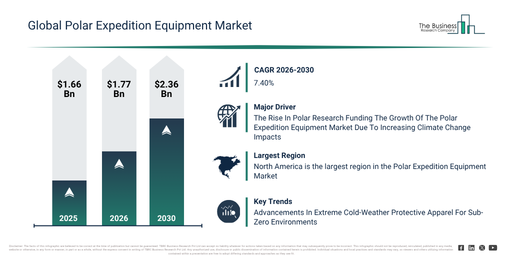
The polar expedition equipment market has seen substantial growth in recent years. Its valuation is set to rise from $1.66 billion in 2025 to $1.77 billion in 2026, exhibiting a compound annual growth rate (CAGR) of 7.2%. This historical expansion can be attributed to several factors, including an increase in polar exploration missions, a rising military presence in arctic regions, a growing demand for scientific climate research expeditions, the limited availability of specialized cold weather equipment, and technological improvements in thermal insulation materials.
The polar expedition equipment market is projected to experience substantial expansion in the coming years. This market is anticipated to reach $2.36 billion by 2030, demonstrating a compound annual growth rate (CAGR) of 7.4%. This projected growth is driven by several factors including the expansion of climate change research, an increase in adventure tourism in extreme environments, heightened geopolitical interest in polar regions, advancements in autonomous robotics support systems for expeditions, and increasing investment in advanced survival technologies. Key trends identified for the forecast period encompass innovations in ultra-insulated multi-layer survival gear, the adoption of lightweight carbon composite expedition equipment, the integration of extreme cold-adaptive wearable systems, the development of advanced polar-grade navigation and tracking systems, and modular emergency shelter designs for quick deployment.
Get A Free Sample Report With In-Depth Market Insights:
Polar Expedition Equipment Market Industry Drivers: What’s Behind The Revenue Growth?
Increased investment in polar research is anticipated to stimulate the expansion of the polar expedition equipment market moving forward. Polar research signifies the growing allocation of financial resources by governments, scientific bodies, and organizations for scientific exploration, environmental monitoring, and climate studies in the Earth’s polar regions. This uptick in funding is primarily propelled by the escalating impacts of climate change, such as accelerated ice melt, sea-level rise, and shifts in Arctic and Antarctic ecosystems, which necessitate enhanced scientific observation and data gathering. Support for polar research facilitates the development, enhancement, and deployment of advanced cold-weather gear, safety apparatus, and logistics technologies crucial for operations in extreme polar environments. A considerable portion of these funds is typically channeled into field operations, encompassing the procurement and upkeep of specialized expedition equipment. For instance, in October 2024, the British Antarctic Survey, a UK-based polar research organization, reported that the UK government awarded $0.0107 billion (£8.4 million) to polar research initiatives spearheaded by the British Antarctic Survey and the Centre for Polar Observation and Modelling to bolster long-term scientific capabilities in polar settings. Consequently, the rising funding for polar research is expected to bolster and contribute to the growth of the polar expedition equipment market.
Polar Expedition Equipment Market Segment Analysis And Revenue Potential
The polar expedition equipment market covered in this report is segmented –
1) By Product Type: Apparel, Footwear, Tents And Shelters, Sleeping Bags, Navigation Equipment, Cooking Equipment, Safety And Survival Equipment, Other Products
2) By Material Type: Synthetic Materials, Natural Materials, Hybrid Materials
3) By Distribution Channel: Online Stores, Specialty Stores, Supermarkets Or Hypermarkets, Other Distribution Channels
4) By Application: Scientific Research, Adventure Tourism, Military, Other Applications
5) By End Users: Individual, Commercial, Government And Defense
Subsegments:
1) By Apparel: Insulated Jackets, Base Layer Tops, Thermal Trousers, Waterproof Outerwear, Gloves And Mittens
2) By Footwear: Insulated Boots, Waterproof Boots, Mountaineering Boots, Snow Gaiters, Thermal Socks, Ice Grip Footwear
3) By Tents And Shelters: Expedition Tents, Four Season Tents, Geodesic Tents, Snow Shelters, Emergency Bivouac Shelters
4) By Sleeping Bags: Down Filled Sleeping Bags, Synthetic Insulated Sleeping Bags, Extreme Cold Sleeping Bags, Mummy Sleeping Bags, Double Sleeping Bags, Sleeping Bag Liners
5) By Navigation Equipment: Magnetic Compasses, Topographic Maps, Global Positioning Devices, Altimeters, Satellite Communication Devices
6) By Cooking Equipment: Portable Stoves, Fuel Canisters, Cooking Utensils, Mess Kits, Water Purification Systems, Heat Resistant Containers
7) By Safety And Survival Equipment: First Aid Kits, Emergency Beacons, Avalanche Safety Kits, Survival Knives, Thermal Blankets
8) By Other Products: Backpacks, Sleds, Climbing Harnesses, Carrying Systems, Storage Containers, Expedition Accessories
#Polar Expedition Equipment Market Growth Trends: What’s Shaping The Future Outlook?
Leading companies within the polar expedition equipment market are prioritizing the creation of novel solutions, such as extreme cold-weather parkas, to improve safety in sub-zero conditions. These heavily insulated outer garments are specifically engineered to deliver maximum thermal protection in exceptionally low-temperature settings, including polar regions. For example, in November 2024, Bosideng International Holdings Limited, an apparel manufacturing firm based in China, unveiled the Polar Workwear Parka, an innovative expedition-grade jacket developed precisely for the Antarctic environment. This parka boasts a segmented and staggered down chamber structure, which both improves heat retention and prevents freezing at seam lines—a common issue in typical insulated jackets. Furthermore, it is tested in extreme conditions reaching -50°C and integrates sophisticated heat and moisture management systems to ensure wearer comfort during prolonged exposure.
Polar Expedition Equipment Market Competitive Landscape: Who Leads The Industry?
Major companies operating in the polar expedition equipment market are Columbia Sportswear Company, Patagonia Inc., Red Wing Shoe Company Inc., VAUDE Sport GmbH And Co. KG, La Sportiva S. p. A., 66°North Ltd., Hestra Handsken AB, Big Agnes Inc., Lukas Meindl GmbH And Co. KG, Mont Adventure Equipment Pty Ltd, Snugpak Ltd., Woolpower AB, NEMO Equipment Inc., Hilleberg AB, Norrøna Sport AS, Goldeck Textil GmbH, Exped AG, Trangia AB, Cascade Designs Inc., Icetrek Polar Equipment Ltd., Zamberlan S. r. l., Crispi Sport S. r. l., AKU Italia S. r. l.
View The Full Polar Expedition Equipment Market Report:
Polar Expedition Equipment Market Geographic Landscape: Which Region Dominates Industry Growth?
North America was the largest region in the polar expedition equipment market in 2025. Asia Pacific is expected to be the fastest-growing region in the forecast period. The regions covered in the polar expedition equipment market report are Asia-Pacific, South East Asia, Western Europe, Eastern Europe, North America, South America, Middle East and Africa.
Reach Out To Our Team:
The Business Research Company: https://www.thebusinessresearchcompany.com/
Americas: +1 310-496-7795
Asia: +44 7882 955267 & +91 8897263534
Europe: +44 7882 955267
Email us at: marketing@tbrc.info
Follow us on:
LinkedIn: https://in.linkedin.com/company/the-business-research-company
YouTube: https://www.youtube.com/channel/UC24_fI0rV8cR5DxlCpgmyFQ
Global Market Model: https://www.thebusinessresearchcompany.com/global-market-model

Wasay has over a decade of experience in market research, data modelling, and analytics, with prior experience at GlobalData and Decision Tree Consulting Services. At The Business Research Company , he leads research operations across syndicated studies, customized consulting engagements, and the Global Market Model platform. His professional experience includes supporting organizations such as Boston Consulting Group, KPMG, and Ernst & Young. Wasay holds a degree in Electronics and Communications Engineering, postgraduate management qualifications from International Management Institute Belgium and Indian School of Business and Entrepreneurship, and completed the Integrated Program in Business Analytics from Indian Institute of Management Indore.