
Built to provide research that’s more actionable and strategically valuable, The Business Research Company’s 2026 market reports include market attractiveness analysis, total addressable market sizing, company benchmarking matrices, interactive Excel dashboards, broader supply chain intelligence, emerging startup tracking, and in-depth product insights.
Clothing Retail Market Value Analysis: What Growth Lies Ahead Over The Forecast Period?
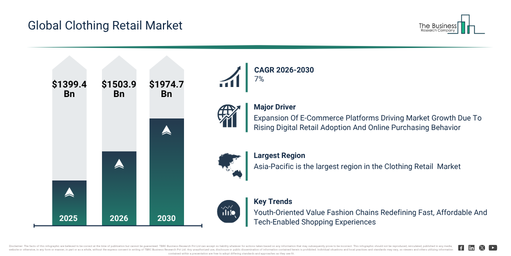
The clothing retail market has experienced robust expansion in recent years. This market is projected to expand from $1399.41 billion in 2025 to $1503.96 billion by 2026, demonstrating a compound annual growth rate (CAGR) of 7.5%. Historically, this growth can be ascribed to factors such as the proliferation of physical retail outlets, the expansion of the worldwide apparel manufacturing sector, increased consumer desire for branded apparel, rising urbanization alongside higher disposable incomes, and the establishment of structured fashion retail networks.
The clothing retail market is projected to experience substantial expansion over the upcoming years, with its size set to reach $1974.78 billion by 2030, exhibiting a compound annual growth rate (CAGR) of 7.0%. This anticipated growth is largely due to factors such as the proliferation of e-commerce fashion platforms, the growing impact of digital marketing and social media fashion trends, a heightened demand for sustainable apparel, the expansion of AI-powered personalized shopping experiences, and the development of omnichannel retail infrastructure. Key trends anticipated during this period involve the increasing adoption of omnichannel retail models, which seamlessly merge physical stores with online platforms to enhance customer experience. Also prominent are the growing utilization of personalized recommendation systems, informed by consumer purchasing habits and style preferences; an escalating demand for fast fashion and trend-responsive apparel collections, heavily influenced by social media; the expansion of sustainable and ethical clothing retail approaches, emphasizing eco-friendly sourcing and circular fashion; and the greater integration of smart inventory management systems to optimize stock availability and minimize overstocking in retail establishments.
Get A Free Sample Report With In-Depth Market Insights:
Clothing Retail Market Demand Drivers Opening New Revenue Streams
The ongoing expansion of e-commerce platforms is projected to drive growth within the clothing retail market. E-commerce platforms, defined as digital marketplaces, enable the buying and selling of products and services over the internet through websites or mobile applications. Their rise is attributed to increasing internet penetration, which makes online shopping services more accessible and convenient for a wider population. This growth is transforming the clothing retail industry by allowing brands to reach a broader customer base, offer seamless shopping experiences, and achieve higher sales via personalized digital marketing and convenient doorstep delivery. For instance, in February 2025, according to the Census Bureau, a US-based government agency, total e-commerce sales in the fourth quarter of 2024 increased by 9.4% compared to the fourth quarter of 2023, while total retail sales increased by 3.8% during the same period, highlighting continued expansion in online retail activity. Thus, the broadening reach of e-commerce platforms is a significant driver for the growth of the clothing retail market.
Clothing Retail Market Segmentation And Category Overview
The clothing retail market covered in this report is segmented –
1) By Product Type: Casual Wear, Formal Wear, Sportswear And Activewear, Ethnic Wear, Innerwear And Loungewear, Luxury Apparel
2) By Price Range: Economy, Mid-Range, Premium
3) By Distribution Channel: Online Stores, Supermarkets Or Hypermarkets, Specialty Stores, Other Distribution Channels
4) By End User: Women, Men, Children, Unisex
Subsegments:
1) By Casual Wear: T Shirts, Polo Shirts, Casual Shirts, Jeans, Casual Trousers
2) By Formal Wear: Formal Shirts, Formal Trousers, Business Suits, Blazers, Formal Skirts
3) By Sportswear And Activewear: Active T Shirts, Track Pants, Compression Wear, Sports Jackets, Yoga Wear
4) By Ethnic Wear: Traditional Dresses, Ethnic Suits, Tunics, Ethnic Skirts, Traditional Shirts
5) By Innerwear And Loungewear: Undergarments, Sleepwear, Lounge Pants, Robes, Thermal Wear
6) By Luxury Apparel: Designer Dresses, Premium Suits, Luxury Outerwear, Couture Apparel, Premium Knitwear
Clothing Retail Market Trends Powering Strategic Industry Growth
Global clothing retail enterprises are prioritizing the development of inventive approaches, like youth-oriented value fashion retail chains, to attract Gen Z consumers with reasonably priced, trend-responsive clothing, swift fashion refresh cycles, and technologically supported in-store shopping environments. Youth-focused value fashion retail chains are retail models that offer affordable, trend-driven apparel tailored for young consumers, frequently combining rapidly changing styles with budget-friendly prices and a robust digital or experiential shopping atmosphere. As an illustration, in August 2023, Reliance Retail, an India-based diverse retail company, launched Yousta, an innovative youth-focused value fashion retail chain. Yousta is conceived as a fast-moving, trend-driven apparel format aimed at Gen Z and young consumers, featuring highly accessible pricing where the majority of products are under ?999 and many are below ?499, ensuring widespread market availability. It introduces weekly “Starring Now” capsule drops that regularly update outfit selections, guaranteeing constant alignment with current fashion trends and reducing inventory build-up compared to traditional seasonal retail cycles. Additionally, the stores incorporate technology-enabled experiences such as QR-based product details access, self-checkout terminals, free Wi-Fi, and charging points, creating a smooth integration of physical and digital shopping. This blend of affordability, rapid fashion rotation, and digital integration enables the format to effectively contend in India’s fast-growing value fashion segment and improve conversion rates among digitally native customers.
Clothing Retail Market Competitive Analysis Of Leading Industry Participants
Major companies operating in the clothing retail market report are Abercrombie & Fitch Co., Amazon.com Inc., American Eagle Outfitters Inc., Aritzia Inc., ASOS plc, Associated British Foods plc, Boohoo Group plc, Fast Retailing Co. Ltd., Gap Inc., Hennes & Mauritz AB, Inditex S.A., JD Sports Fashion plc, Lululemon Athletica Inc., Macy’s Inc., Marks and Spencer Group plc, Next plc, Nike Inc., Punto Fa S.L., PVH Corp., Ross Stores Inc., Target Brands Inc., The Buckle Inc., The TJX Companies Inc., Urban Outfitters Inc., Walmart Inc., Zalando SE
View The Full Clothing Retail Market Report:
Clothing Retail Market Geographic Landscape: Which Region Leads Industry Growth?
Asia-Pacific was the largest region in the clothing retail market in 2025. Asia-Pacific is expected to be the fastest-growing region in the forecast period. The regions covered in the clothing retail market report are Asia-Pacific, South East Asia, Western Europe, Eastern Europe, North America, South America, Middle East, Africa.
Reach Out To Our Team:
The Business Research Company: https://www.thebusinessresearchcompany.com/
Americas: +1 310-496-7795
Asia: +44 7882 955267 & +91 8897263534
Europe: +44 7882 955267
Email us at: marketing@tbrc.info
Follow us on:
LinkedIn: https://in.linkedin.com/company/the-business-research-company
YouTube: https://www.youtube.com/channel/UC24_fI0rV8cR5DxlCpgmyFQ
Global Market Model: https://www.thebusinessresearchcompany.com/global-market-model

Wasay has over a decade of experience in market research, data modelling, and analytics, with prior experience at GlobalData and Decision Tree Consulting Services. At The Business Research Company , he leads research operations across syndicated studies, customized consulting engagements, and the Global Market Model platform. His professional experience includes supporting organizations such as Boston Consulting Group, KPMG, and Ernst & Young. Wasay holds a degree in Electronics and Communications Engineering, postgraduate management qualifications from International Management Institute Belgium and Indian School of Business and Entrepreneurship, and completed the Integrated Program in Business Analytics from Indian Institute of Management Indore.