
Built to provide research that’s more actionable and strategically valuable, The Business Research Company’s 2026 market reports include market attractiveness analysis, total addressable market sizing, company benchmarking matrices, interactive Excel dashboards, broader supply chain intelligence, emerging startup tracking, and in-depth product insights.
Footwear Stores Market Size, Value And Growth Trajectory Through 2030
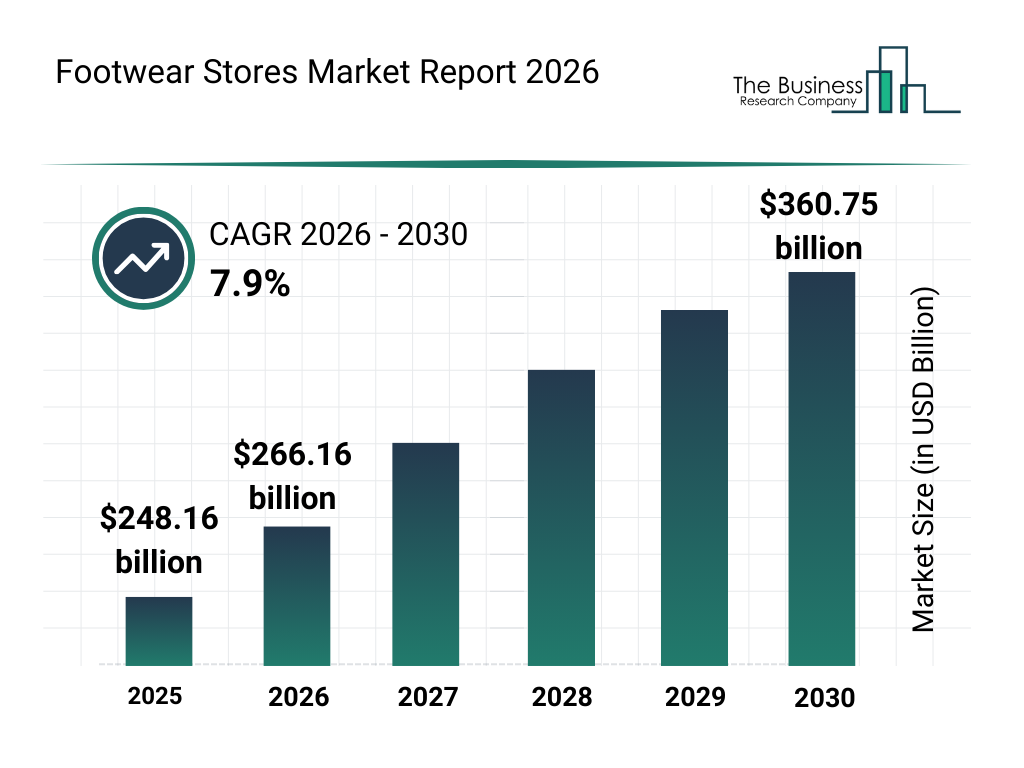
The footwear stores market has seen robust expansion in recent years. This market is expected to increase from $248.16 billion in 2025 to $266.16 billion in 2026, with a compound annual growth rate (CAGR) of 7.3%. The historical drivers of this growth include the rising demand for fashion footwear, the broadening of offline retail networks, an increase in disposable income, heightened brand awareness, and the widespread popularity of sports footwear.
The footwear stores market is projected to experience substantial expansion over the coming years. This market is anticipated to reach a valuation of $360.75 billion by 2030, demonstrating a compound annual growth rate (CAGR) of 7.9%. This anticipated growth during the forecast period is attributable to several factors, including the expansion of online footwear retail, the increasing adoption of environmentally friendly materials, the incorporation of AI and IoT technologies within stores, market expansion into developing regions, and the growing popularity of athleisure trends. Key trends foreseen for this period encompass AI-driven personalized shopping experiences, the development of sustainable and environmentally conscious footwear, the implementation of intelligent inventory management systems, the rise of connected retail environments, and the widespread integration of digital payment and e-commerce solutions.
Get A Free Sample Report With In-Depth Market Insights:
Footwear Stores Market Growth Momentum: What Factors Are Shaping Demand?
The expansion of the footwear store market is anticipated to be fueled by a rise in expenditures on luxury branded goods. Luxury items encompass products or services recognized as premium within society, including high-end apparel like Haute couture, accessories such as jewelry and sophisticated watches, designer footwear, luggage, among others. Consumers tend to acquire more luxury products from reputable online and physical establishments due to their perceived prestige and comfort. As an illustration, data from July 2024, provided by Bank of America, a financial institution located in the US, indicates an upward trajectory in luxury goods spending outside of the US. Specifically, June 2024 exceeded figures from both June 2023, which itself demonstrated a surge to 16% from 8% in June 2022, and the entire summer of 2022. Consequently, an increase in expenditures on branded luxury items will serve as a primary driver for the footwear store market.
Footwear Stores Market Segment Outlook: Which Categories Are Growing Fastest?
The footwear stores market covered in this report is segmented –
1) By Type: Athletic, Non-Athletic
2) By Material: Leather, Non-Leather (Rubber)
3) By Store Type: Offline Retail Stores, Online Retail Stores
4) By End User: Men, Women, Children
Subsegments:
1) By Athletic: Running Shoes, Training Shoes, Sports-Specific Footwear
2) By Non-Athletic: Casual Footwear, Formal Footwear, Boots
Footwear Stores Market Trends Redefining Industry Growth
Major companies operating in the footwear stores market are concentrating on innovating advanced tools, such as augmented reality (AR) virtual try-on solutions, to enhance product visualization, improve customer shopping experiences, and increase consumer confidence in online purchases. This AR virtual try-on refers to a technology that overlays digital 3D footwear models onto a user’s real-world environment in real-time, facilitating virtual “try-on” experiences that simulate in-store browsing. For instance, in October 2023, Timberland, a U.S.-based outdoor footwear and apparel retailer, launched Vyking-powered virtual try-on technology across its EMEA e-commerce platforms, introducing over 250 footwear products with immersive AR/3D try-on capabilities. This AR solution allows customers to visualize how shoes would look on their feet through augmented displays and mirrors, bridging online and physical shopping experiences while supporting increased engagement and conversion for Timberland and its retail partners.
Footwear Stores Market Top Companies Driving Competitive Growth
Major companies operating in the footwear stores market are Adidas AG, Nike Inc., PUMA SE, Under Armour Inc., Skechers U.S.A Inc, Geox S.p.A, VF Corporation, Crocs Inc., ECCO Sko A/S, Wolverine Worldwide Inc., FILA Holdings Inc., ASICS Corporation, Bata Corporation, Timberland, Reebok International Limited, New Balance Athletics Inc., Clarks, Foot Locker Inc., DSW Inc., Caleres Inc., Deckers Brands, Famous Footwear, The Aldo Group Inc., Steve Madden Ltd., Camper, Aerosoles, Saucony, Converse Inc., Salvatore Ferragamo S.p.A., Jimmy Choo Ltd., ALDO Group
View The Full Footwear Stores Market Report:
Footwear Stores Market Global Footprint: Which Region Leads The Industry?
Asia-Pacific was the largest region in the footwear stores market in 2025. The regions covered in the footwear stores market report are Asia-Pacific, South East Asia, Western Europe, Eastern Europe, North America, South America, Middle East and Africa.
Reach Out To Our Team:
The Business Research Company: https://www.thebusinessresearchcompany.com/
Americas: +1 310-496-7795
Asia: +44 7882 955267 & +91 8897263534
Europe: +44 7882 955267
Email us at: marketing@tbrc.info
Follow us on:
LinkedIn: https://in.linkedin.com/company/the-business-research-company
YouTube: https://www.youtube.com/channel/UC24_fI0rV8cR5DxlCpgmyFQ
Global Market Model: https://www.thebusinessresearchcompany.com/global-market-model

Wasay has over a decade of experience in market research, data modelling, and analytics, with prior experience at GlobalData and Decision Tree Consulting Services. At The Business Research Company , he leads research operations across syndicated studies, customized consulting engagements, and the Global Market Model platform. His professional experience includes supporting organizations such as Boston Consulting Group, KPMG, and Ernst & Young. Wasay holds a degree in Electronics and Communications Engineering, postgraduate management qualifications from International Management Institute Belgium and Indian School of Business and Entrepreneurship, and completed the Integrated Program in Business Analytics from Indian Institute of Management Indore.