
Enhanced with market attractiveness analysis, total addressable market evaluation, company benchmarking matrices, interactive Excel dashboards, expanded supply chain intelligence, emerging startup coverage, and detailed product insights, The Business Research Company’s 2026 market reports deliver more actionable and strategically valuable research.
Intelligent Virtual Store Design Solution Market Forecast: What Market Value Is Expected By 2030?
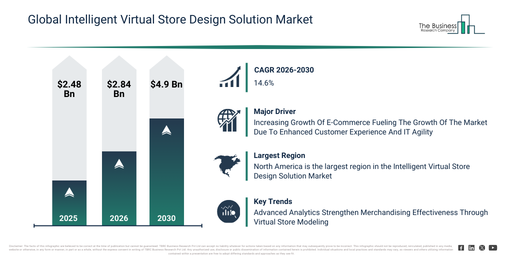
The intelligent virtual store design solution market size has experienced rapid expansion in recent years. It is projected to grow from $2.48 billion in 2025 to $2.84 billion in 2026, at a compound annual growth rate (CAGR) of 14.4%. The growth observed in the historic period can be attributed to the adoption of digital design tools by retail chains, increasing demand for immersive shopping experiences, early integration of VR/AR in store planning, the influence of e-commerce on physical store design, and the rising use of analytics for merchandising decisions.
The market for intelligent virtual store design solutions is projected to experience rapid growth in the coming years, anticipated to reach $4.9 billion by 2030 at a compound annual growth rate (CAGR) of 14.6%. This expansion during the forecast period is attributed to several factors, including the wider adoption of AI-driven store simulation tools, the increasing use of cloud-based design platforms, the integration of IoT sensors for real-time store analytics, continued growth in cross-channel retail optimization, and a rising demand for personalized and interactive shopping environments. Significant trends expected in this period encompass virtual store layout optimization, enhanced 3D modeling and rendering efficiency, the development of interactive retail experience designs, expanded cross-platform deployment capabilities, and sophisticated data-driven store performance analysis.
Download A Free Sample Report For Comprehensive Market Insights:
Intelligent Virtual Store Design Solution Market Growth Momentum: Which Factors Are Influencing Demand?
The expanding prevalence of e-commerce is anticipated to fuel the expansion of the intelligent virtual store design solution market in the foreseeable future. E-commerce involves the transaction of products and services via digital channels, allowing companies to access consumers globally with enhanced ease and capacity. This swift increase in e-commerce is primarily driven by greater internet access, higher smartphone adoption, evolving consumer buying habits, and a need for smooth, tailored online retail experiences. Intelligent virtual store design solutions aid e-commerce by empowering retailers to construct engaging, data-informed, and visually appealing virtual stores, thereby boosting customer interaction, streamlining navigation, and simulating physical store experiences digitally. As an illustration, the U.S. Census Bureau, a government agency based in the US, reported in December 2025 that seasonally adjusted U.S. retail e-commerce sales amounted to $310.3 billion in Q3 2025. This figure marked a 5.1% increase year-on-year compared to Q3 2024, constituting 16.4% of all retail sales. Consequently, the expanding e-commerce sector in the United States is propelling the growth of the intelligent virtual store design solution market.
Intelligent Virtual Store Design Solution Market Segment Breakdown: Which Categories Generate The Most Revenue?
The intelligent virtual store design solution market covered in this report is segmented –
1) By Component: Software, Hardware, Services
2) By Deployment: Cloud-based, On-premise, Hybrid
3) By Technology: Artificial Intelligence And Machine Learning, Virtual Reality, Augmented Reality, Three-Dimensional Modeling, Data Analytics
4) By Application: Consumer Packaged Goods, Retail, Consumer Electronics, Restaurant, Other Applications
5) By End User: Consumer Packaged Goods Manufacturers, Grocery Or Hypermarkets, Convenience Or Department Or Discount Stores, Specialty Retail, Electronics And Telecom Retail, Quick Service Restaurants, Other Commercial Stores
Subsegments:
1) By Software: Standalone Design Platforms, Integrated Suite Solutions, Artificial Intelligence And Machine Learning Engines, Three-Dimensional Modeling And Rendering Software, Analytics And Visualization Dashboards
2) By Hardware: Virtual Reality Headsets And Equipment, Augmented Reality Devices And Smart Glasses, Interactive Displays And Kiosks, Internet Of Things Sensors And Beacons, High-Performance Computing Workstations
3) By Services: Strategy And Consulting Services, Custom Design And Development, System Integration And Implementation, Support And Maintenance, Managed And Training Services
Intelligent Virtual Store Design Solution Market Trends Reshaping Industry Growth
Major companies operating in the intelligent virtual store design solution are increasingly concentrating on advancing intelligent, artificial intelligence (AI)-driven capabilities to enhance store layout planning, optimize merchandising effectiveness, and elevate shopper engagement through data-backed decision-making. These AI-powered functionalities allow retailers to digitally simulate virtual store environments and meticulously analyze shopper behavior, thereby enabling the testing and refinement of layout and assortment choices prior to their physical deployment. For instance, in November 2023, InContext Solutions, a US-based retail analytics and insights provider, introduced artificial intelligence-powered shopper insight capabilities within its virtual retail environment. Aimed at assisting retailers and brands in elevating merchandising performance and operational efficiency, this solution employs predictive analytics and machine learning to assess planogram efficacy, simulate shopper interactions within 3D store settings, and pinpoint optimal product placements, ultimately guiding organizations toward more informed decisions regarding layout and merchandising.
Intelligent Virtual Store Design Solution Market Key Players And Strategic Industry Positioning
Major companies operating in the intelligent virtual store design solution market are Microsoft Corporation, IBM Corporation, Cisco Systems Inc., Oracle Corporation, SAP SE, Adobe Systems Incorporated, Atos SE, Dassault Systèmes, Zebra Technologies, PTC Inc., Unity Technologies, Magic Leap Inc., GlamAR, Vention, Tulfa, Emperia, InContext Solutions, ServReality, Arimars Technologies, and Monkhub Innovations.
Access The Complete Intelligent Virtual Store Design Solution Market Report:
Intelligent Virtual Store Design Solution Market Geographic Landscape: Which Region Dominates Industry Growth?
North America was the largest region in the intelligent virtual store design solution market in 2025. Asia-Pacific is expected to be the fastest-growing region in the forecast period. The regions covered in the intelligent virtual store design solution market report are Asia-Pacific, South East Asia, Western Europe, Eastern Europe, North America, South America, Middle East, Africa.
Get in touch with us:
The Business Research Company: https://www.thebusinessresearchcompany.com/
Americas: +1 310-496-7795
Asia: +44 7882 955267 & +91 8897263534
Europe: +44 7882 955267
Email us at: marketing@tbrc.info
Follow us on:
LinkedIn: https://in.linkedin.com/company/the-business-research-company
YouTube: https://www.youtube.com/channel/UC24_fI0rV8cR5DxlCpgmyFQ
Global Market Model: https://www.thebusinessresearchcompany.com/global-market-model

Wasay has over a decade of experience in market research, data modelling, and analytics, with prior experience at GlobalData and Decision Tree Consulting Services. At The Business Research Company , he leads research operations across syndicated studies, customized consulting engagements, and the Global Market Model platform. His professional experience includes supporting organizations such as Boston Consulting Group, KPMG, and Ernst & Young. Wasay holds a degree in Electronics and Communications Engineering, postgraduate management qualifications from International Management Institute Belgium and Indian School of Business and Entrepreneurship, and completed the Integrated Program in Business Analytics from Indian Institute of Management Indore.