
Delivering more actionable and strategically valuable research, The Business Research Company’s 2026 market reports feature market attractiveness analysis, total addressable market evaluation, company benchmarking matrices, interactive Excel dashboards, expanded supply chain intelligence, emerging startup coverage, and detailed product insights.
Product Take-Back Program Market Size Forecast: How Large Could The Market Become By 2030?
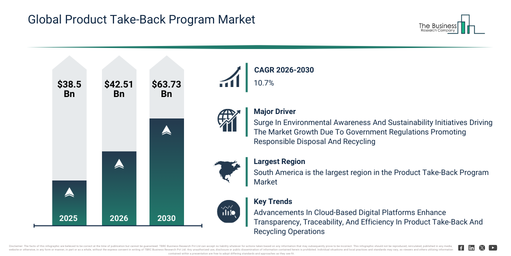
The market size for product take-back programs has experienced rapid growth in recent years. It is anticipated to expand from $38.5 billion in 2025 to $42.51 billion in 2026, representing a compound annual growth rate (CAGR) of 10.4%. This historical growth can be attributed to increasing concerns regarding electronic and industrial waste generation, the implementation of environmental protection regulations, a rise in corporate responsibility toward sustainability, stricter landfill restrictions and higher disposal costs, and the expansion of recycling and waste management services.
The product take-back program market is anticipated to experience substantial expansion in the coming years, with its size projected to reach $63.73 billion by 2030, demonstrating a compound annual growth rate (CAGR) of 10.7%. This growth during the forecast period can be attributed to several factors, including the increasing implementation of circular economy practices by businesses, heightened consumer awareness regarding environmentally responsible disposal methods, significant progress in material recovery and recycling technologies, an expanding demand for products that have been refurbished or remanufactured, and the reinforcement of global regulatory requirements concerning product take-back initiatives. Key trends anticipated within this period involve the broadening of reverse logistics and collection networks, a greater embrace of refurbishment and remanufacturing services, the emergence of more incentive-based and loyalty-driven return schemes, an intensified emphasis on regulatory adherence and reporting, and the incorporation of repair and recycling considerations into broader product lifecycle planning.
Download A Free Sample Report For Comprehensive Market Insights:
#Product Take-Back Program Market Demand Drivers Creating New Revenue Opportunities
The burgeoning environmental consciousness and various sustainability endeavors are projected to stimulate the expansion of the product take-back program market. These initiatives encompass actions and programs aimed at informing people and organizations about environmental issues, while also advocating for practices that conserve resources, lessen pollution, and sustain long-term ecological balance. The escalation in environmental awareness and sustainability efforts is largely propelled by government regulations and policies, which obligate businesses and individuals to adopt eco-friendly methods and diminish their environmental footprint. This heightened environmental awareness and commitment to sustainability encourage the implementation of organized return and recycling systems. Such systems promote responsible disposal and the circular economy for products, thereby facilitating efficient resource recovery and reducing waste. As an illustration, in November 2024, the Ember-Energy Organization, a UK-based think tank, reported expectations for solar installations to achieve 593 GW in 2024, reflecting a 29% year-on-year rise following substantial 87% growth in 2023. Thus, the Increasing Environmental Awareness And Sustainability Initiatives is demonstrably fueling the growth of the product take-back program market.
Product Take-Back Program Market Segment Analysis Highlighting Growth Areas
The product take-back program market covered in this report is segmented –
1) By Program Type: Retailer Take Back, Manufacturer Take Back, Third Party Take Back
2) By Product Category: Electronics, Appliances, Packaging, Textiles, Automotive, Other Product Categories
3) By Collection Channel: In Store, Online, Drop Off Centers, Mail Back
4) By Organization Size: Small And Medium Enterprises, Large Enterprises
5) By End User: Residential, Commercial, Industrial
Subsegments:
1) By Retailer Take Back: In Store Collection, Online Collection, Drop Off Collection, Incentive Based Collection, Loyalty Program Collection
2) By Manufacturer Take Back: Direct Return Programs, Mail Back Programs, Product Exchange Programs, Warranty Return Programs, Take Back For Recycling
3) By Third Party Take Back: Recycling Service Providers, Reverse Logistics Providers, Waste Management Contractors, Collection Hub Services, Remanufacturing Service Providers
Product Take-Back Program Market Trends Driving Strategic Industry Expansion
Major companies operating in the product take-back program market are concentrating on developing digital take-back management and tracking systems to boost the transparency, efficiency, and scalability of product return and recycling operations. These digital take-back management and tracking systems function as software platforms, empowering companies to oversee, administer, and optimize the collection, return, and recycling of end-of-life products through continuous tracking, detailed reporting, and analytical insights. For instance, in March 2025, Gesellschaft für Rückführung industrieller und gewerblicher Kunststoffverpackungen, a Germany-based take-back systems provider, introduced its upgraded cloud-enabled agricultural take-back systems as part of the VerenA, ERDE, PAMIRA, and PRE initiatives. This launch incorporates digitally optimized collection networks and data-driven monitoring to facilitate the extensive take-back of agricultural packaging, plastics, and chemical containers. The platform enhances the traceability of returned materials, extends the nationwide collection infrastructure, and supports elevated recycling rates, simultaneously aiding agricultural stakeholders in reducing their environmental impact and complying with circular economy regulations.
Product Take-Back Program Market Leading Companies: Who Holds Significant Market Presence?
Major companies operating in the product take-back program market are Amazon.com Inc., Apple Inc., Samsung Electronics, Dell Technologies, Sony Corporation, Siemens AG, LG Electronics, Lenovo Group, IBM Corporation, Panasonic Corporation, Cisco Systems, Best Buy Co. Inc., Canon Inc., Hewlett Packard Enterprise (HPE), Toshiba Corporation, Vestas Wind Systems AS, Philips Electronics, Ricoh Company Ltd., Staples Inc., Xerox Corporation.
Access The Complete Product Take-Back Program Market Report:
Product Take-Back Program Market Geographic Landscape: Which Region Dominates Industry Growth?
South America was the largest region in the product take-back program market in 2025. Asia-Pacific is expected to be the fastest-growing region in the forecast period. The regions covered in the product take-back program market report are Asia-Pacific, South East Asia, Western Europe, Eastern Europe, North America, South America, Middle East, Africa.
Get in touch with us:
The Business Research Company: https://www.thebusinessresearchcompany.com/
Americas: +1 310-496-7795
Asia: +44 7882 955267 & +91 8897263534
Europe: +44 7882 955267
Email us at: marketing@tbrc.info
Follow us on:
LinkedIn: https://in.linkedin.com/company/the-business-research-company
YouTube: https://www.youtube.com/channel/UC24_fI0rV8cR5DxlCpgmyFQ
Global Market Model: https://www.thebusinessresearchcompany.com/global-market-model

Wasay has over a decade of experience in market research, data modelling, and analytics, with prior experience at GlobalData and Decision Tree Consulting Services. At The Business Research Company , he leads research operations across syndicated studies, customized consulting engagements, and the Global Market Model platform. His professional experience includes supporting organizations such as Boston Consulting Group, KPMG, and Ernst & Young. Wasay holds a degree in Electronics and Communications Engineering, postgraduate management qualifications from International Management Institute Belgium and Indian School of Business and Entrepreneurship, and completed the Integrated Program in Business Analytics from Indian Institute of Management Indore.