
Featuring market attractiveness scoring, total addressable market sizing, company benchmarking matrices, interactive Excel dashboards, deeper supply chain intelligence, emerging startup tracking, and granular product-level insights, The Business Research Company’s 2026 market reports are built to deliver research that is both more actionable and more strategically valuable.
Synbiotic Moisturizer Market Size Forecast: How Big Could The Market Get By 2030?
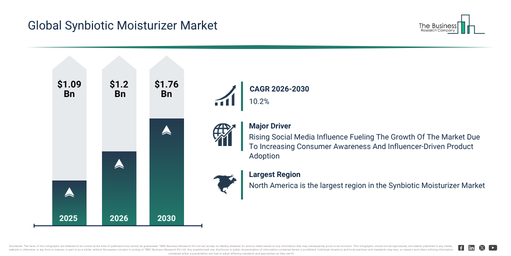
The synbiotic moisturizer market has shown significant expansion in recent years. It is anticipated to increase from $1.09 billion in 2025 to $1.2 billion in 2026, achieving a compound annual growth rate (CAGR) of 10.0%. The historical growth in this market can be linked to an escalating awareness of skin microbiome health, the increasing incorporation of moisturizers into daily skincare routines, a heightened demand for natural and functional ingredients, the growth of online skincare retail platforms, and a rising consumer preference for personalized skincare solutions.
The synbiotic moisturizer market is expected to demonstrate significant expansion in the upcoming years. It is forecast to grow to $1.76 billion by 2030 at a compound annual growth rate (CAGR) of 10.2%. This growth over the projection period is linked to the increased integration of synbiotic formulations within creams and serums, a rising consumer demand for products aimed at sensitive and dry skin, the widening availability through e-commerce and specialty retail channels, broader application of hydrating and barrier-support technologies, and a heightened emphasis on sustainable and eco-friendly packaging. Notable trends during this timeframe encompass the increasing adoption of microbiome-friendly skincare items, a growing need for hydrating and barrier repair formulations, enhanced incorporation of probiotics and prebiotics into creams and lotions, an expansion of online and specialized retail outlets, and a greater focus on gender-neutral and sensitive skin solutions.
Get A Free Sample Report With In-Depth Market Insights:
Synbiotic Moisturizer Market Industry Drivers: What’s Behind The Revenue Growth?
The increasing impact of social media is anticipated to boost the synbiotic moisturizer market’s expansion in the future. Social media refers to digital platforms where individuals can generate, disseminate, engage with content, and interact with others instantly online. Its growing influence stems from extensive smartphone and internet availability, allowing constant connectivity and the consumption of tailored, live content that influences perspectives and choices. This rising influence stimulates demand for synbiotic moisturizers by enhancing awareness via influencer campaigns and educational material, fostering consumer comprehension and confidence in microbiome-focused skincare items. For example, data from We Are Social, a UK-based digital marketing agency, showed that in February 2024, the United Kingdom comprised approximately 56.2 million social media users, each spending an average of 1 hour and 49 minutes daily across roughly 6.4 platforms. Platforms like Facebook, Instagram, TikTok, LinkedIn, and Snapchat saw year-over-year increases in advertising reach, with Pinterest notably expanding its potential advertising audience by 5.9 million users, a 77.9% rise from the prior year. Consequently, the expanding reach of social media is a key driver for the synbiotic moisturizer market’s growth. The increasing reach of e-commerce platforms is projected to drive the future growth of the synbiotic moisturizer market. E-commerce involves the online exchange of products or services via digital platforms facilitating internet-based transactions. These channels are expanding because consumers increasingly favor convenience, enabling them to explore, compare, and buy products remotely at any time, eliminating the need for physical store visits. The growth of e-commerce bolsters synbiotic moisturizers by enhancing their availability, allowing consumers to effortlessly find, compare, and acquire microbiome-centric skincare items from diverse brands irrespective of their geographical position. For instance, as per the Census Bureau, a US-based government agency, U.S. retail e-commerce sales were estimated at $316.1 billion in the fourth quarter of 2025 on a seasonally adjusted basis, excluding price adjustments, representing a 1.7% increase (±0.5%) when compared to the third quarter of 2025. Thus, the proliferation of e-commerce channels is fueling the expansion of the synbiotic moisturizer market.
Synbiotic Moisturizer Market Segment Trends And Revenue Contributors
The synbiotic moisturizer market covered in this report is segmented –
1) By Product Type: Creams, Lotions, Serums, Gels, Other Product Types
2) By Skin Type: Dry, Oily, Combination, Sensitive, Normal
3) By Distribution Channel: Online Stores, Supermarkets or Hypermarkets, Specialty Stores, Pharmacies, Other Distribution Channels
4) By Application: Face Care, Body Care, Other Applications
5) By End-User: Men, Women, Unisex
Subsegments:
1) By Creams: Anti Aging Creams, Hydrating Creams, Brightening Creams, Barrier Repair Creams, Nourishing Creams
2) By Lotions: Lightweight Moisturizing Lotions, Daily Hydration Lotions, Balancing Skin Microbiome Lotions, Soothing Body Lotions, Protective Moisturizing Lotions
3) By Serums: Hydrating Facial Serums, Skin Barrier Repair Serums, Microbiome Balancing Serums, Anti Aging Treatment Serums, Brightening And Revitalizing Serums
4) By Gels: Hydrating Gel Moisturizers, Cooling Skin Gels, Oil Control Moisturizing Gels, Soothing And Calming Gels, Lightweight Barrier Support Gels
5) By Other Product Types: Moisturizing Face Mists, Skin Nourishing Balms, Overnight Hydration Masks, Moisturizing Ampoules, Skin Repair Sleeping Packs
Synbiotic Moisturizer Market Competitive Analysis Of Leading Industry Participants
Major companies operating in the synbiotic moisturizer market are Dermalogica Inc., Dr. Dennis Gross Skincare LLC, Eminence Organic Skin Care Ltd., Lano-Luxe Pty Ltd., Dermaviduals, Esse Skincare (Pty) Ltd., Beauty Pie Ltd., Ellis Brooklyn Beauty Inc., Glowbiotics Skincare LLC, Seoulista Beauty Limited, Epara Skincare Limited, FarmHouse Fresh Skincare LLC, Juno & Co. LLC, Oskia Skincare Limited, Codex Beauty Labs, Gallinée, LaFlore Probiotic Skincare Inc., Aurelia Probiotic Skincare, Laboratoire Synbionyme, The Nue Co.
View The Full Synbiotic Moisturizer Market Report:
Synbiotic Moisturizer Market Geographic Spread And Regional Opportunities
North America was the largest region in the synbiotic moisturizer market in 2025. Asia-Pacific is expected to be the fastest-growing region in the forecast period. The regions covered in the synbiotic moisturizer market report are Asia-Pacific, South East Asia, Western Europe, Eastern Europe, North America, South America, Middle East, Africa.
Reach Out To Our Team:
The Business Research Company: https://www.thebusinessresearchcompany.com/
Americas: +1 310-496-7795
Asia: +44 7882 955267 & +91 8897263534
Europe: +44 7882 955267
Email us at: marketing@tbrc.info
Follow us on:
LinkedIn: https://in.linkedin.com/company/the-business-research-company
YouTube: https://www.youtube.com/channel/UC24_fI0rV8cR5DxlCpgmyFQ
Global Market Model: https://www.thebusinessresearchcompany.com/global-market-model

Wasay has over a decade of experience in market research, data modelling, and analytics, with prior experience at GlobalData and Decision Tree Consulting Services. At The Business Research Company , he leads research operations across syndicated studies, customized consulting engagements, and the Global Market Model platform. His professional experience includes supporting organizations such as Boston Consulting Group, KPMG, and Ernst & Young. Wasay holds a degree in Electronics and Communications Engineering, postgraduate management qualifications from International Management Institute Belgium and Indian School of Business and Entrepreneurship, and completed the Integrated Program in Business Analytics from Indian Institute of Management Indore.